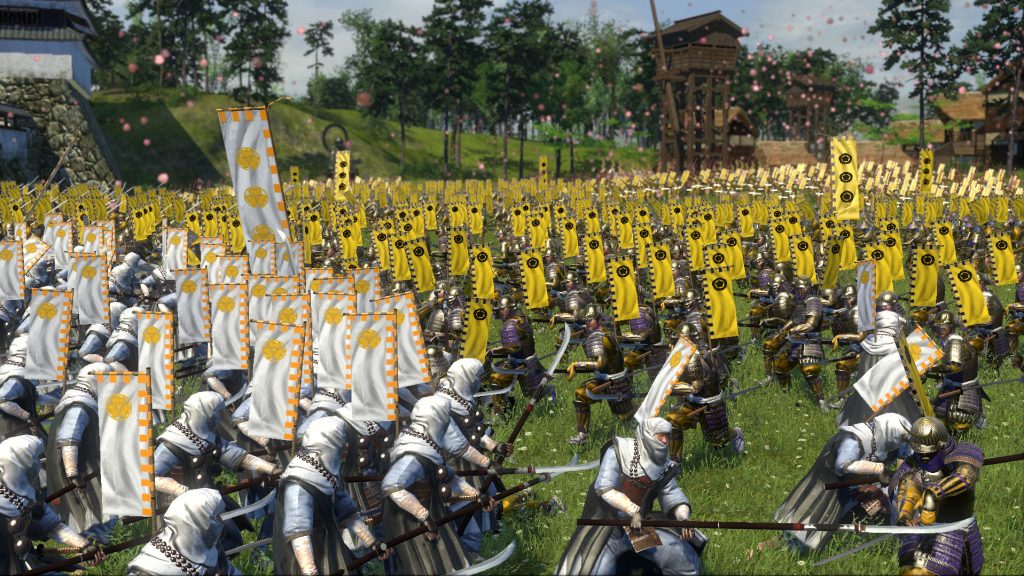
TL;DR: Total War Shogun 2 Realm Divide preparation means making the clan capable of fighting after diplomatic support deteriorates. Watch fame and the Kyoto objective, consolidate useful fronts, repair and replenish armies, and fund their upkeep with a strong domestic economy. Keep food available for planned development and treat threatened trade as uncertain income. Prepare before the next expansion pushes you into the crisis; a comfortable treasury today does not guarantee that trade and alliances will survive.

This guide covers the base Sengoku campaign. The Realm Divide reference separates its rules from Rise and Fall of the Samurai, where Kyoto and faction affiliations work differently. It identifies territory, vassal holdings and certain major battles as sources of fame. Do not use an expansion’s political alignment to predict who will support a base-game clan.
On this page
Total War Shogun 2 Realm Divide preparation: the sequence
- Review fame and the implications of your next conquest or Kyoto operation.
- Finish repairs and food improvements in the territory you already hold.
- Position armies to defend plausible approaches and support one another.
- Compare recurring costs with income you can retain after trade disruption.
- Protect relevant ports and shorten naval commitments where necessary.
- Enter the next expansion with a funded first response to several enemies.
The purpose of a pause is to complete those preparations. If another quiet turn adds little to the army, economy or frontier, waiting indefinitely is less useful than choosing a controlled next objective. Preparation should give the campaign a workable next phase.
1. Read fame before committing to another objective
Realm Divide follows the clan’s rising prominence. Province acquisition is a major source of fame, and vassals and their holdings count too. Certain significant battles also contribute. Creating a vassal is therefore not a universal method for expanding without approaching the event.
Use the fame display and your current victory objectives to judge the next move. A fixed province count copied from another campaign can ignore battle contributions and different campaign conditions. Plan around your own position rather than assuming that one more conquest is always safe.
The base game’s Kyoto route also matters. Capturing and holding Kyoto can bring the crisis into the campaign, so it should be part of the same military and financial plan. The official manual describes becoming shogun through Kyoto while retaining power and sufficient territory.
Check what taking Kyoto would require afterward: a force able to hold the objective, a route for reinforcement, and defenses elsewhere. A successful assault followed by exposed borders and an empty treasury leaves the important work unfinished.
2. Consolidate the frontier before adding another one
Mark the likely land approaches into the realm. Which army can meet a force at each entrance? Which province can provide reinforcement? Two armies separated by several hostile or poorly defended provinces may not support each other when the crisis arrives.
Prefer positions that make the next threat manageable. A short frontier, defended crossing or useful castle can reduce how many directions the same army must cover. Geography is valuable when the supporting force can actually reach the threatened area.
Do not scatter every available unit across every settlement. Decide which castles need a meaningful garrison and where a mobile army provides the better response. A large collection of isolated detachments can have high upkeep while lacking enough strength to stop a concentrated attacker.
Use a reserve for a defined purpose: reinforce a likely land front, recover from casualties, or respond to a coastal threat. If the same reserve must cover opposite ends of the map, reconsider either its position or the number of commitments.
3. Make the existing armies ready to fight again
Preparation starts with the units already paid for. Restore the spear line, ranged support or cavalry role damaged in the last campaign. Counting unit cards alone can hide an army whose essential formation is too weak to handle the next fight.
Recruit for the opponent and battlefield jobs you expect. An additional expensive unit has value when it solves a problem; it has less value when the army already performs that job and still lacks protection on another approach.
Keep the commander useful and safe. The manual describes general influence and rallying as morale support and explains the harm caused by a general’s death. A steady army is a stronger foundation for several consecutive fights than a costly force whose leadership was lost unnecessarily.
Plan replacement access as well as the first engagement. Identify the province that can recruit the required role and the route to the front. A remote specialist recruitment center does not instantly replace a unit lost near Kyoto.

4. Test recurring costs against domestic income
Compare army and fleet upkeep with money generated by holdings you expect to retain. Trade can support expansion, but the Realm Divide reference describes broad hostility and deteriorating relationships. Agreements that look valuable before the event can become unreliable afterward.
Use a simple stress test. Suppose a hypothetical clan receives 6,000 per turn, including 2,000 from vulnerable trade, and spends 3,500 on recurring costs. Losing that trade leaves a much smaller margin. A further 1,000 of upkeep could then make the preparation unsustainable. These numbers illustrate the calculation, not actual game income.
Improve productive holdings before purchasing another permanent expense. The Metsuke reference describes overseeing a town as a way to improve tax income. Assign an economic agent where that benefit helps the budget, while considering protection and the opportunity cost of other duties.
Retain cash for repairs, replacements and a response to lost income. A treasury reserve buys time; a positive domestic balance helps the clan keep fighting after the reserve is spent. Judge both together instead of treating a large bank balance as sufficient preparation.
5. Keep development compatible with food and order
The food reference identifies farms as food producers in base Shogun 2 and castle development as a consumer. Surplus also supports town wealth growth across the faction. Buying several castle upgrades together can consume the margin that the campaign relies on.
Review planned consumption before confirming the construction queue. Give useful farm production time to support development, and postpone a castle level that adds little to the next military task. An upgrade is easier to justify when the required food and treasury are both available.
Repair recent acquisitions and check local order before moving their defenders away. A province that remains unstable can demand the same army you intended to place on the border. Resolve that conflict while the realm has fewer simultaneous enemies.
Use the pause to make a functioning interior, rather than simply filling every available building slot. Choose projects that support income, production, recruitment or a concrete defensive need. Several unfinished luxuries do not provide an immediate response when a frontier is attacked.
6. Protect trade routes you intend to keep
The trade-node reference explains that trade ships produce goods from nodes and that a usable, unblocked trade port matters. A node fleet can remain on the map while its commercial support is interrupted elsewhere.
Examine the whole commitment: trading vessels, their route, the port and the fleet that can respond to attack. Retaining every distant node may require more ships than the land campaign can afford. Prioritize the routes with a defensible connection and a meaningful benefit.
Keep an overseas army’s reinforcement needs separate from the desire for maximum trade. If the only available escort is protecting a remote commercial position, it cannot simultaneously provide dependable support for a distant landing. Decide which mission matters first.
Prepare a reduced-income plan even for protected trade. Naval defense can address a blockade or rival fleet, but it does not preserve every diplomatic agreement. The army budget should remain understandable when one part of that network stops contributing.
7. Use diplomacy without building the whole defense on it
Existing relationships can help complete the preparation period, but they should not replace a military response. The base event applies pressure broadly, and positive relationships can deteriorate. Treat every likely neighboring front as a planning question.
Do not assume a vassal is outside the fame system or that a signed agreement permanently removes its direction from consideration. Keep enough visibility and response capacity to revise the plan if the relationship changes.
The reference notes an exception for factions that appear after Realm Divide. That is a specific circumstance, not a guarantee for every existing ally. Check the actual faction and available diplomacy instead of interpreting the exception as a universal protection.
8. Set priorities when Realm Divide begins
Recheck income, relationships and threatened approaches immediately. Defend the location whose loss would damage recruitment, food or access to the central army. A remote low-value province can be a lower priority than keeping a core reinforcement route open.
Choose one offensive objective that improves the position while leaving the other fronts supported. Replacing every broken agreement with a separate invasion can stretch the clan further. Preserve the army’s ability to recover between victories and reconsider the budget after each significant change.
Frequently asked questions
Is there one safe province count before Realm Divide?
No universal count covers every position. Territory, vassals and battle-derived fame matter; read the current campaign display.
Should I stop expanding permanently?
No. Pause to complete useful preparations, then pursue a supported objective.
Will all existing allies remain dependable?
Do not budget on that assumption. Base-game relationships can deteriorate during the event.
Does this guide cover Fall of the Samurai?
No. Its affiliation and independence choices require a separate plan.
Sources and further reading
Keep exploring
Total War Shogun 2 Naval Bombardment: check the campaign first
The queried coastal bombardment and land-battle naval support belong to Fall of the Samurai, rather than base SHOGUN 2 naval combat.
Total War Attila vs Total War Shogun 2: survive or reunite?
ATTILA offers late-antique survival and destructive warfare; SHOGUN 2 centers a clan campaign on reunifying Japan.
Total War Rome 2 vs Total War Shogun 2: empire or clan?
ROME II suits classical empire building; SHOGUN 2 suits a focused Japanese clan campaign with growing generals and agents.