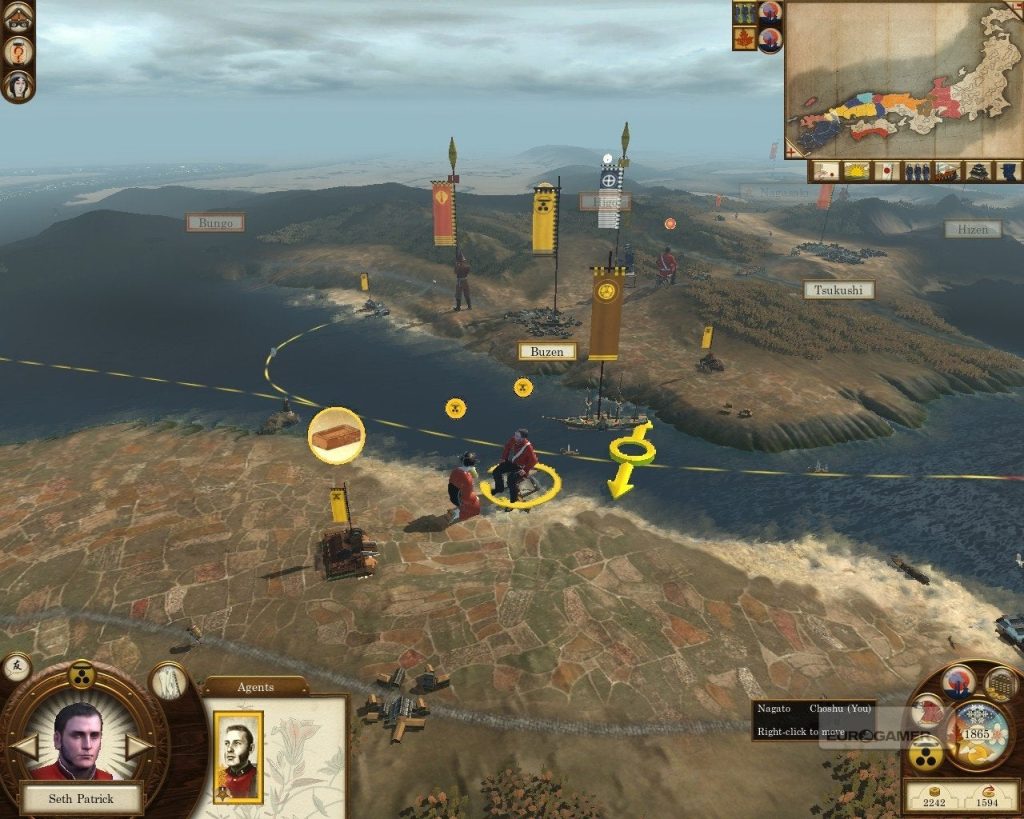
TL;DR: The Total War Shogun 2 Fall of the Samurai campaign needs a nineteenth-century plan built around modernization, public happiness, rifle infantry, rail access and coastal naval support. Choose the clan and political affiliation first, modernize toward a useful funded capability and keep the population stable as development advances. Support gun lines against melee and cavalry, connect recruitment to the front, and prepare for the affiliation or independence choice at Realm Divide. Do not copy a base Sengoku food-and-bow opening unchanged.

The dedicated Fall of the Samurai reference describes the 1864 campaign and its later standalone Saga release. Its units, agents and politics differ from the sixteenth-century base game. This guide uses campaign-specific sources and conditional choices rather than a fixed first-turn script for every clan.
On this page
Total War Shogun 2 Fall of the Samurai campaign: the opening priorities
- Choose a clan whose starting front and affiliation fit your campaign plan.
- Compare current income, development and local happiness.
- Modernize toward a capability you can recruit or build afterward.
- Give the existing army a workable firing and protection plan.
- Develop transport or naval support for a defined route.
- Reassess diplomacy, army access and the budget before political escalation.
The campaign is a transition between traditional and modern systems. The useful question is what the next development enables and whether the clan can sustain it, rather than how quickly every province can be industrialized.
1. Start with the clan’s front and political side
Clans support the Imperial or Shogunate cause in the dedicated game source. Geography still determines the neighbors and approaches the army must handle. Choose a route that can be defended and supplied from the holdings you actually control.
Compare the current opponents rather than attacking every nearby clan immediately. A useful first objective improves the frontier or economic base without creating several unsupported directions. Retain enough capacity to hold what the army wins.
Keep political alignment visible in the diplomacy plan. It matters especially as Realm Divide approaches, but it does not make the opening’s military position irrelevant. An attractive relationship across the map cannot replace the force needed to retain the home province.
2. Modernize toward a specific useful capability
The Modernisation reference ties development to research and modern buildings. Higher clan development opens further technology tiers, while insufficient modernization prevents access to the next tier.
It also describes a tradeoff: lower development favors traditional-unit conditions and happiness, while higher development supports research and technologies but reduces happiness across the realm. A new facility can therefore contribute to local production and a broader political burden.
Choose the next capability before purchasing several modern projects. A useful rifle recruiting chain, transport route or production improvement provides a reason to develop. Building unrelated upgrades together can raise the population’s burden before the new benefits are ready.
Keep a funded response for that transition. Compare order support, construction and army upkeep before advancing the development plan. A technically available unit or building is less useful when the clan cannot retain the provinces financing it.
A development tier opens further research access rather than completing every technology within it. Identify the intended research and the production step that follows. Reserve money for that step so the modernization effort results in a usable capability instead of an unlocked aspiration that the treasury cannot support.

3. Build a protected firing army
The Line Infantry reference describes Cadet School access for most factions and better firing performance than Levy Infantry. It also warns that rifle troops need support against close combat and cavalry.
Give the gun line a useful facing and room to engage the approach. Keep a melee or mounted response that can intercept the threat before it reaches exposed infantry. More rifle units do not solve a formation that leaves their side unprotected.
The source distinguishes Fall line infantry from older games’ square-formation expectations. Prepare the line to face the mounted approach rather than assuming a familiar anti-cavalry button is available. Use the actual unit’s abilities and support.
Choose upgrades for a role. The reference identifies later stronger rifle formations, but greater expense still competes with replacement troops and another front. A sustainable army with protected firing positions can be more practical than buying elite units while its support remains weak.
4. Fund replacement and delivery
Inspect the recruiting center and the route to the army before planning a long campaign. A new formation helps when it can join the force where the fight occurs. A distant production facility is not immediate replacement access.
Retain money for losses and damage after the first victory. The next enemy can challenge a different part of the formation, and a recently captured holding may require support before it funds further recruitment. Reassess the budget after the acquisition.
Modernization and military purchases should support one another. If a new development unlocks a useful troop but all available money is committed to construction, the army cannot exploit it. Stage the projects so the capability and its funding arrive together.
5. Use rail access where it actually exists
The Rail Network source describes rail travel for armies and agents, with Telegraph Offices upgraded to Railway Stations in eligible provinces. Not every province can build rail facilities.
A Telegraph Office alone is not a working troop-transport station. Build the useful connection for a recruiting center, reinforcement route or likely front. Do not buy a disconnected transport aspiration without considering the stations the army can actually reach.
The reference describes usable own or allied routes and unavailable hostile or neutral routes. A railway drawn on the map is not automatically an accessible shortcut. Connect diplomatic access, stations and the intended destination before counting rail travel in the army plan.
Travel still uses movement points, and damaged or sabotaged rails can interrupt the route. Keep a marching or naval alternative for an important reinforcement when possible. The transport network is valuable support rather than a guarantee that every replacement arrives instantly.

6. Give coastal naval support a defined task
The game reference describes navies attacking ports and bombarding adjacent campaign targets within range. Naval support can connect the sea and land campaign, but the fleet must be in the appropriate position.
Decide whether the fleet’s immediate job is protection, bombardment or support for a coastal operation. A ship group guarding a distant route is not simultaneously present to support the army’s next land fight. Position the fleet for the task that matters first.
The same source warns about coastal attrition inside an enemy port’s radius. Approach hostile coasts deliberately and compare the benefit of staying with the exposure. A fleet can need recovery or relocation after completing its useful support.
Keep bombardment separate from a guarantee of victory. The army still requires a protected formation and a way to hold the objective. Plan the support’s location and the following land action together rather than counting on offshore guns to replace the infantry.
7. Use the campaign’s own agents
Fall of the Samurai introduces Foreign Veterans, Ishin Shishi and Shinsengumi in the dedicated source, alongside a changed geisha role. These are not the base campaign’s ninja, metsuke and Buddhist monk trees.
The source explicitly distinguishes Fall geisha from base assassins. Do not assume a character with the same name can perform the old action. Select the agent available in the campaign and the task its own abilities support.
Agent support belongs inside the military and political plan. Choose the useful current task and place the character where it applies, while retaining money for the operation and a response if the action is unsuccessful.
8. Prepare the affiliation or independence decision
The Realm Divide reference separates Fall’s political rules from base Shogun 2. In Fall, fame drives the event, and holding Kyoto does not use the base game’s trigger route.
The reference describes support within the chosen Imperial or Shogunate side after escalation, with the option to declare independence. Independence creates a different political position and can remove affiliation-linked units and agents.
Before choosing it, compare the army roster and the relationships the clan relies on. Ordinary Line Infantry are not affiliation units in their dedicated source, while faction-linked formations can have different consequences. Count the actual affected assets rather than assuming the whole army remains unchanged.
Fund a replacement and defense plan if pursuing independence. More opponents and lost specialist assets can change several fronts at once. A political choice should fit the supported realm, rather than be selected solely for its narrative appeal.
9. Adjust the pace to the position
A quiet home region with funded modernization
Develop toward the useful technology, support happiness and retain enough money to recruit the enabled role. Connect the production base to the front before starting several additional projects.
An active frontier with strained income
Restore the existing army’s firing and protection roles, retain local stability and postpone a modern project that currently adds little to defense. Revisit development when the acquisition or victory improves the budget.
These are conditional priorities rather than measured campaign scripts. The useful pace is modernization the clan can convert into a funded capability while retaining the holdings and army that make it possible.
Frequently asked questions
Does this campaign use the base Sengoku opening unchanged?
No. Development, rifle warfare, agents, rails and political escalation differ.
Can every province build railroads?
No. The rail reference identifies eligible provinces and the necessary station development.
Does independence preserve every affiliated asset?
No. Check affected units, agents and relationships before choosing it.
Sources and further reading
Keep exploring
Total War Shogun 2 Naval Bombardment: check the campaign first
The queried coastal bombardment and land-battle naval support belong to Fall of the Samurai, rather than base SHOGUN 2 naval combat.

Total War Attila vs Total War Shogun 2: survive or reunite?
ATTILA offers late-antique survival and destructive warfare; SHOGUN 2 centers a clan campaign on reunifying Japan.
Total War Rome 2 vs Total War Shogun 2: empire or clan?
ROME II suits classical empire building; SHOGUN 2 suits a focused Japanese clan campaign with growing generals and agents.