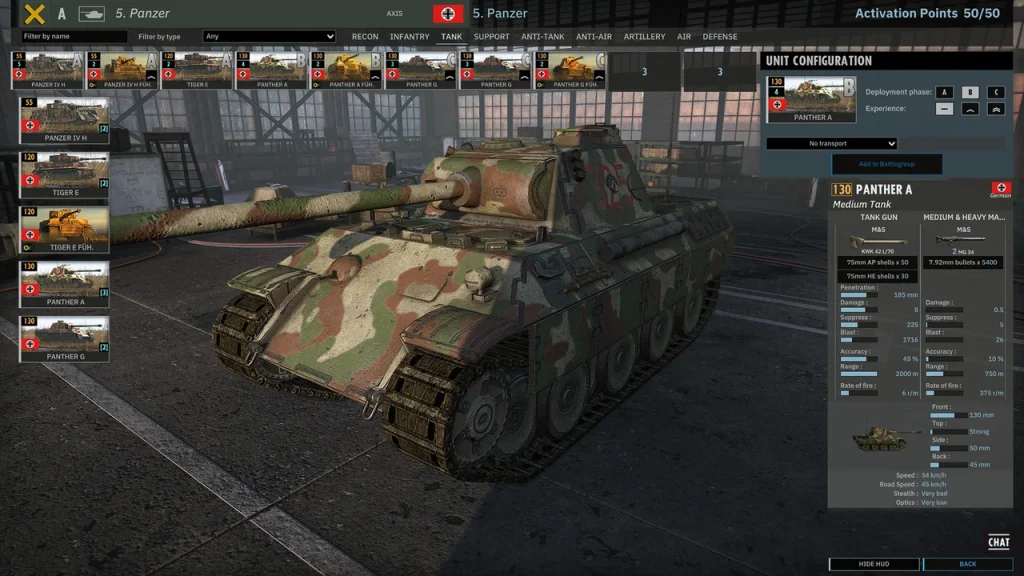
TL;DR: Plan Steel Division 2 deployment phases around an opening force that can hold useful ground, a specific reinforcement job in B, and enough suitable units for C. Check each card’s phase, quantity and veterancy separately from tactical income. An unlocked card still needs points and a usable arrival route before it can help.
The phase schedule should explain what your force can do at each stage of a skirmish. Put indispensable opening roles in A, use B to strengthen the position you intend to contest, and reserve a meaningful late force without making the early army helpless. A large C inventory cannot protect a position before those cards become available.

This guide follows Eugen’s official deck-builder explanation and distinguishes it from Army General’s battle eligibility system. The linked development articles describe the design at their publication dates. Use the installed deck builder and match settings for current card quantities, income values and phase timing; the examples below are planning exercises rather than tested builds.
On this page
Plan Steel Division 2 deployment phases from the opening job
Start with the ground your A force must occupy and defend. Choose a practical holding position, an observation point and a supported firing lane before deciding how many late cards look attractive.
For a hypothetical road beside a village, the opening job could be infantry holding covered ground while an anti-tank weapon watches the open approach. Recon checks the road and nearby terrain. The plan needs all three functions early enough to work together; placing the only suitable anti-tank card in C leaves a clear problem if armor appears sooner.
Choose available units within your parent division rather than assuming every roster provides the same tools. Eugen’s deck-builder diary explains that the division determines the roster and category slots. A phase plan must fit those options, including the actual transport choices and card restrictions shown for that division.
Write the opening as a short sequence: reach the holding ground, establish observation, then place support where it can engage the relevant approach. That sequence exposes a deck gap more clearly than a list of favorite units. If the transport route is contested, the gun arrives late, or the infantry cannot hold until support deploys, the opening needs a different purchase or route.
Give yourself a response to a plausible opening threat. This does not mean buying every category immediately. It means knowing what you would purchase if the opponent attacks the road with armor or pressures the covered position with infantry. The response must be available in A and affordable within the actual match economy.
Schedule a specific reinforcement job in B
Use B to solve a problem your opening can identify. Reinforcing a threatened lane, adding a weapon for a newly observed target and building a supported attack are clearer jobs than simply buying a larger army.
In the village example, suppose the A force holds but cannot cross an exposed field. A B card might supply the supporting weapon needed to contest the far edge, while additional infantry protects its approach. Decide where those units will stage and who already observes their target. Buying the weapon alone does not create a complete crossing plan.
Check how long the A force can remain useful while that reinforcement travels. A phase transition changes availability; it does not instantly put a new unit beside your depleted infantry. If the entire opening depends on immediate rescue, you have built a fragile schedule even when the B card itself is a good choice.
Separate replacement from expansion. Infantry that replaces a lost holding unit preserves the current position. Infantry assigned to a new attack creates another job. Counting the same card quantity for both jobs can leave you expecting units that the deck no longer contains.
Read the card quantities after choosing phase and veterancy. The official deck explanation describes these as linked deck choices: changing a card’s phase or experience can change the available count. Its pre-release T-34 example illustrates the tradeoff, but its numerical table is not a current universal availability chart.
If you choose greater experience for a scarce support card, identify what happens after a loss. A stronger individual unit can still leave a phase without a replacement. The useful decision depends on the role, current card options and the amount of repetition that role needs.
Keep a useful C force instead of a collection of leftovers
Your C cards should have jobs that remain relevant late in the match. They can support a sustained contest, replace losses or add a capability that earlier phases deliberately limited.
Look at the force you expect to survive. A late armor card may need infantry and observation that your earlier cards have already exhausted. A large infantry pool may need anti-armor cover to move through the area now contested. Plan those supporting relationships rather than treating each late card as an independent solution.
Consider a different hypothetical position: your opening holds a wooded edge, but the opponent controls the road beyond it. A useful C plan might maintain infantry in the covered position and reinforce the road threat with suitable weapons. It does not require replacing every surviving A unit simply because the phase label changed.
Avoid postponing every scarce capability. If your only observer, anti-armor response or air-defense option is a later card, ask how the opening handles the corresponding threat. Some divisions deliberately accept weaknesses, but the phase schedule should make that choice visible before the match.
Also avoid assigning large quantities that you cannot reasonably use. Availability is a ceiling on what the card can provide, not an instruction to purchase it all. A balanced late force can be more practical than one category with extensive reserves and no supporting units.

Separate phase unlock, purchase and arrival
A reinforcement passes through several checks before it changes the battle. Its card must be available, an individual unit must remain, you must have sufficient tactical points, and the unit must reach a position where it can do its job.
Use those checks when a purchase seems unavailable. A phase lock, an exhausted card and insufficient points require different responses. Moving the card to an earlier phase in the next deck revision cannot solve a points shortage in the current match. Selecting a higher-income curve cannot restore units already exhausted from a card.
Inspect the reinforcement route before committing the purchase. A road can be quick while still crossing a watched approach. A protected staging point gives you a place to assemble support before advancing toward the actual fight.
Check the arrival order as well. Sending the anti-tank weapon, infantry and recon separately can leave the first arrival exposed. Choose the sequence around what is already present. If observation is missing, do not assume the newly purchased weapon can identify every threat by itself.
Watch the transition indicator in your current match rather than relying on remembered timings from a different setup. Purchase planning works best when you prepare the job before the unlock and then confirm that the battlefield still needs it. A lost approach can make the original arrival route unsuitable.
Match the income curve to the schedule
Choose an economy that funds the phase where your plan needs pressure, while still supporting the phases it must survive. Income and card availability are related planning decisions but remain separate mechanics.
The 2019 deck-builder diary describes Juggernaut as late-focused and Maverick as having stronger B income. Those descriptions explain the intended profiles. They do not establish current numerical income for every selectable economy, and later patches have changed economy options and balance.
Inspect the current curve against your intended purchases. An early purchase plan that spends heavily needs an income schedule that can sustain its follow-up. A late-oriented schedule still needs a viable opening force and a way to hold ground while waiting for its stronger purchasing period.
Do not assume a Conquest flag pays for its own attack. Eugen’s Conquest explanation distinguishes objective control from income: flags affect the victory contest rather than increasing the tactical economy. Capturing an exposed flag does not automatically fund the reinforcement needed to defend it.
Before changing economy after a loss, identify the actual shortage. Were you waiting for points with useful units available, or waiting for a later card despite having points? The first problem concerns purchasing power; the second concerns the phase assignment. Changing both at once makes the next result harder to interpret.
Recognize the separate Army General phase system
Army General uses A, B and C in battle preparation too, but campaign battalion eligibility is not the same decision as assigning a skirmish unit card to a phase.
Eugen’s Army General combat diary explains that distance, location and action-point conditions affect which battalions can join and when. The battle planner shows that participation for the selected fight. Moving a battalion on the strategic map can change the support available against a particular enemy.
Read the current battle preview before initiating combat. A battalion you hoped would support the opening may only become eligible later, or may not be eligible for that selected engagement. Plan the initial force around what the preview actually allows.
The original diary contains preview-era battlegroup slots and action-point examples. Do not use those old numbers as a guarantee for every current campaign. The practical distinction is stable enough to guide your check: strategic positioning and campaign conditions determine participation, while the skirmish deck builder determines the phase availability of selected cards.
Fix one phase gap after a match
Review the first moment when your intended force could not perform its job. Name the missing capability, the phase and the reason it was absent.
If armor broke the village approach before B, check whether an A anti-armor response existed and whether you bought and positioned it. If the response was present but had no view, changing its phase will not fix the observation gap. If it was locked until C, moving a suitable option earlier could address the schedule.
If B reinforcements arrived piecemeal and were lost, revise the staging and order sequence before adding more cards. If C lacked holding infantry because earlier quantities were exhausted, compare availability and veterancy choices for that role.
Use the Steel Division 2 hub to review the related deck and recon mechanics. For the next match, write one sentence per phase describing what you will hold, reinforce or contest, then check that the current cards and income can support those sentences.
FAQ
Does a new phase automatically deploy my later cards?
No. Phase availability is one requirement for purchasing a unit. You still need remaining card quantity, tactical points and a useful arrival route.
Should the strongest units always go in C?
Assign units by the job and its timing. A late card with attractive availability cannot solve an opening threat, while an early scarce unit may leave too few replacements for a sustained role.
Do I need to replace A units when B begins?
Plan around the surviving force and its current usefulness. The phase transition is an opportunity to add or replace capabilities, not a reason to discard a functioning position.
Are Army General phases controlled through the same deck choices?
No. Inspect campaign participation in the battle planner. Battalion positioning and campaign conditions determine eligibility; a custom skirmish deck uses card phase assignments.
Sources and further reading
- https://steamstore-a.akamaihd.net/news/externalpost/steam_community_announcements/3702426087238377874
- https://steamstore-a.akamaihd.net/news/externalpost/steam_community_announcements/2417771014048533539
- https://steamstore-a.akamaihd.net/news/externalpost/steam_community_announcements/2425653583382603208
- https://steamstore-a.akamaihd.net/news/externalpost/steam_community_announcements/4074045878072394391
Keep exploring
Steel Division 2 anti tank positioning: match the lane, target and ammunition
Choose an observed lane that matches the gun’s actual ammunition range, set its engagement behavior, and reassess after the target or observation changes.
Steel Division 2 artillery correction: connect the observer area to the target
Identify the radio-equipped observer and eligible artillery, place the intended target inside the correction area, then check the shot and move the observer when the task changes.
Gates of Hell Ostfront vs Steel Division 2: Conquest or Army General?
Pick Ostfront for researching and developing a Conquest army with switchable unit control; pick Steel Division 2 for battalion-map planning and battlegroup decks.