TL;DR: Steel Division 2 veterancy choices should match a unit’s job and the number of replacements that job needs. Inspect the current card’s quantity after choosing phase and experience. Use higher veterancy where individual performance matters enough to justify the available count, and consider leader support separately.
Do not raise experience across the entire deck without checking what disappears from its reserves. A force can have more experienced individual units while lacking enough infantry to maintain several positions. The useful choice depends on the role, frontage and actual availability shown by the card.

This guide uses Eugen’s deck-builder and commander explanations. Their pre-release examples describe the intended tradeoffs rather than current balance tables. Use the installed card and command indicators for exact quantities and bonuses; none of the suggested scenarios is presented as a tested competitive build.
On this page
Read Steel Division 2 veterancy choices on the actual card
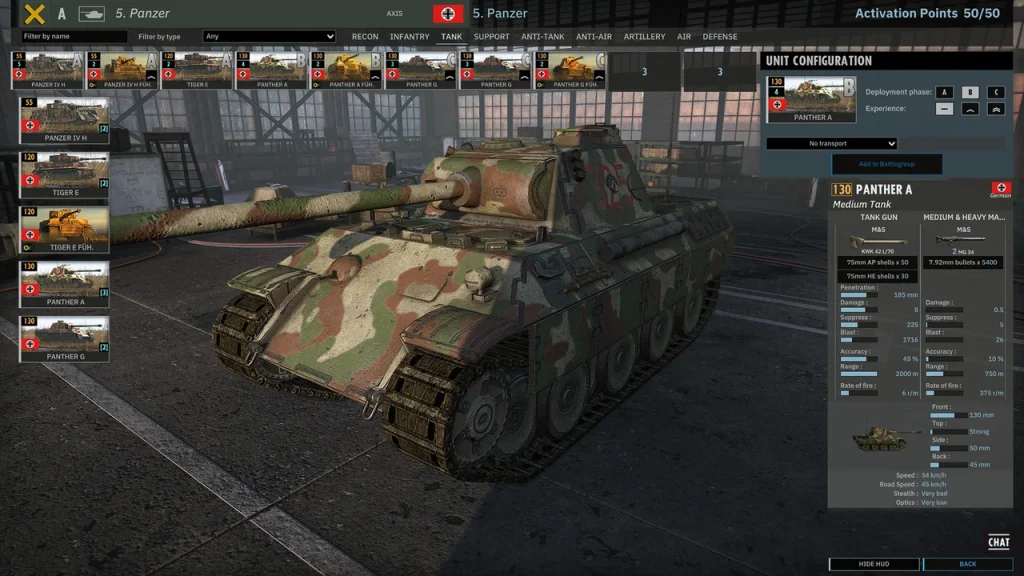
Select the phase, choose an available experience level and compare the resulting quantity. The deck-builder interface is the reference for that particular card, not a rule that every unit follows the same reduction.
Eugen’s deck-builder diary explains that both phase and veterancy affect card quantities. It illustrates the relationship with a T-34 example. That historical numerical example is useful for understanding the design, but should not be copied as a current availability chart.
Inspect restrictions as well. The same explanation notes that some specific units can have a higher default experience or other limits. Do not assume every roster offers every veterancy setting in every phase.
Compare alternatives while keeping the job constant. If you are choosing infantry to hold two covered approaches, ask how each setting changes the units available for those positions and their replacements. Comparing one setting for a holding task against another for a different attack makes the tradeoff harder to assess.
Check tactical cost separately rather than assuming an old development example describes every current price relationship. Experience selection, available quantity and purchase cost all belong in the decision, but you should read the actual values the current card presents.
Choose quality for a specific job
Consider higher veterancy when a small number of units must perform a demanding, clearly supported role. Identify what improved individual performance is supposed to accomplish before accepting fewer available units.
For a hypothetical narrow approach, one well-supported unit may be responsible for a critical position while infantry and observation protect its surroundings. A higher experience choice can be worth comparing there because the task concentrates on a small part of the force.
The support matters. If the unit has no useful view, an unsuitable destination or no protected approach, selecting more experience does not automatically fix those conditions. Diagnose the arrangement before assigning the failure to the card’s veterancy.
Do not read experience as a guarantee of winning a named matchup. Current equipment, terrain, orders and the opponent’s position still affect the encounter. This guide gives no universal claim that an experienced unit defeats a particular enemy every time.
Also ask what happens after the unit is lost or displaced. If the job remains essential throughout the match, a card with very limited replacements can become a problem even when the initial unit performs well. The quality decision needs a reserve plan.

Keep quantity for frontage and repeated tasks
Use lower available experience settings when the role needs more units than the higher setting can supply. Maintaining several positions and replacing losses are practical reasons to value quantity.
Suppose your infantry must hold a village edge and a separate woodland approach. Both positions need coverage, and neither disappears when you start another action. A small high-experience pool can force you to leave one job vacant or borrow the same unit for conflicting tasks.
Read the deck phase by phase. More units in C do not replace opening units before those later cards become available. If the A card is your only holding infantry, inspect how much frontage it can cover and whether the B schedule supplies meaningful continuity.
Avoid counting the same reserve twice. A replacement for the village defender is not also an extra unit for a new advance unless the card contains enough quantity for both. Write the jobs separately before deciding the card has sufficient depth.
Quantity alone is not a complete answer either. A larger pool without observation or useful support can repeat the same failure. Choose the availability that lets you sustain a functioning arrangement, rather than treating spare units as a substitute for positioning.
Plan leader support as a separate system
Card veterancy is a deck choice; leader and commander support is a battlefield arrangement. Inspect both before assuming the force has the experience level you planned around.
Eugen’s commander diary describes local leader auras and a chain linking leaders with commanders. It also explains that losing a key unit can break the link and remove the additional benefit.
Use the current indicators to confirm coverage and connections. The source contains development-era radii and bonus values, so this guide does not present those numbers as universal current settings. A leader placed somewhere nearby is not enough evidence that every intended unit receives the desired support.
Keep leaders protected and relevant to the supported force. Moving the combat group beyond the local coverage can change the arrangement without changing the card’s original veterancy. Recheck after a reposition rather than assuming the opening connection remains intact.
Avoid bunching every unit at the leader’s position merely to preserve coverage. The observation, holding and support tasks still need useful terrain and views. Choose the command placement around those jobs and inspect whether the current aura actually reaches them.
Do not replace a planned card choice with imagined permanent leader coverage. If a unit frequently works away from the command arrangement, its independent role deserves consideration when you set the deck’s available experience.
Review the first specific failure before changing experience
Identify whether the problem was individual performance, missing units or lost support. Each points toward a different deck or positioning change.
If the force ran out of holding infantry while useful positions remained, inspect quantity and phase distribution. Raising the experience of that same small pool could make the reserve problem worse.
If a supported specialist repeatedly struggled at its assigned job, compare current equipment and engagement conditions before deciding greater experience is the solution. A mismatched role does not become well matched merely through a higher setting.
If the command link broke during movement, revise leader placement and continuity. Changing every card’s veterancy after that event would address a different problem from the one you observed.
Make one targeted revision and keep the rest of the plan understandable. Use the Steel Division 2 hub for deployment and team-role guides, then compare the next result against the specific gap you meant to fix.
FAQ
Should every unit use the highest available veterancy?
No. Compare the role’s individual demands with the card quantity, frontage and replacements it needs. Higher experience can reduce useful availability.
Does changing phase affect the veterancy decision?
Yes. Inspect the resulting card quantity after both settings. A later availability advantage cannot supply an opening job before the card unlocks.
Can leaders replace all deck veterancy choices?
Leader support is a separate battlefield arrangement with coverage and connection requirements. Consider units that operate outside it and what happens when the link is lost.
Why did a high-experience force still lack enough units?
Inspect the available count and the number of simultaneous jobs. A stronger individual unit does not fill two separated holding positions at once.
Sources and further reading
- https://steamstore-a.akamaihd.net/news/externalpost/steam_community_announcements/3702426087238377874
- https://steamstore-a.akamaihd.net/news/externalpost/steam_community_announcements/2530366080595791757
- https://steamstore-a.akamaihd.net/news/externalpost/steam_community_announcements/4074045878072394391
Keep exploring
Steel Division 2 artillery correction: connect the observer area to the target
Identify the radio-equipped observer and eligible artillery, place the intended target inside the correction area, then check the shot and move the observer when the task changes.
Steel Division 2 anti tank positioning: match the lane, target and ammunition
Choose an observed lane that matches the gun’s actual ammunition range, set its engagement behavior, and reassess after the target or observation changes.
Gates of Hell Ostfront vs Steel Division 2: Conquest or Army General?
Pick Ostfront for researching and developing a Conquest army with switchable unit control; pick Steel Division 2 for battalion-map planning and battlegroup decks.