TL;DR: This Steel Division 2 review recommends shortlisting the game if you want a 1944 Eastern Front setting, turn-based strategic campaigns and division-based real-time battles. Its official campaign description explicitly offers tactical play or autoresolve, giving a campaign-first buyer a useful choice. Check the particular campaign, division pack and online mode you want before choosing an edition.
Quick verdict: The combination of strategic campaigns and tactical formats is the clearest attraction. The advertised roster size alone is a weaker buying reason than a campaign or division you actually want to explore.

Checked November 8, 2026. This is an editorial evaluation of Steel Division 2’s official Steam description and verified DLC descriptions. It is not a hands-on test. The assessment assigns no current price, numerical review rating, online population or performance benchmark.
On this page
Steel Division 2 review: identify the experience you want
Someone choosing a historical strategy game may want several different things: a continuing strategic campaign, occasional stand-alone battles, roster preparation or an online format shared with friends. Steel Division 2 advertises more than one of these. Choosing the first activity makes its large catalog easier to assess.
| Your priority | Documented attraction | Next buying check |
|---|---|---|
| Eastern Front campaign | 1944 setting and Dynamic Strategic Campaigns | Find the specific campaign and required content |
| Strategic play with fewer tactical sessions | Campaign autoresolve explicitly described | Confirm the intended campaign’s current rules |
| WW2 roster preparation | Division-based deck system | Identify the formation and ownership requirement |
| Play with friends | Co-op and large online formats advertised | Verify the exact mode and compatible versions |
| More content for an existing library | Different campaign, battlegroup and cosmetic products | Choose the missing experience rather than every pack |
1. Choose the Eastern Front setting for a concrete reason
The base description sets Steel Division 2 on the Eastern Front in 1944 and centers it on Operation Bagration. That provides a clear shortlist reason for a player interested in the named WW2 period and region. It also distinguishes the game from a Cold War roster-focused RTS or a medieval dynasty game.
The setting is more specific than a general war-game label. If you want an Eastern Front campaign and its represented divisions, the product addresses that interest directly. If you principally want a nineteenth-century campaign with a persistent army, a different title may serve the intended sessions more closely.
The publisher makes strong claims about historical detail. This review uses the named period, represented units and campaign setting as advertised features. It does not independently validate the historical accuracy of every formation or turn the software into a model of real-world outcomes.
Separate the base setting from later additions. A roster pack can introduce divisions associated with another historical context without adding a complete strategic campaign in that context. The campaign list, division list and historical-battle list answer different questions about what you would receive.
For an existing owner, a specific historical addition can be a stronger reason to return than a broad claim that the game has more content now. Name the campaign or formation that interests you, then inspect the actual product supplying it.

2. Understand the campaign and battle-resolution choice
Steel Division 2 explicitly describes turn-based Dynamic Strategic Campaigns alongside real-time tactical battles. The strategic format is therefore part of the core purchase proposition, rather than something to infer from a promotional battlefield image. Expansion descriptions also use the Army General campaign label.
The official base description says campaign battles can be fought in real time or resolved automatically for a strategic experience. That is a meaningful distinction for someone who wants a continuing campaign without entering every tactical engagement.
Autoresolve availability is a feature statement, not a guarantee of identical outcomes or a claim that the campaign is easier. The useful question is whether that stated option matches the sessions you want. Inspect current rules for the specific campaign if resolution behavior is the deciding requirement.
Conversely, a buyer mainly interested in real-time battles has a separate attraction to assess. A campaign can supply context, while tactical play and roster preparation are distinct parts of the package. You do not have to assume that every advertised mode will become a regular activity.
A continuing strategic campaign also asks for a different kind of commitment from reopening one isolated battle. This review does not estimate campaign length in hours. It recommends choosing around the format you would realistically return to, then checking the content that delivers it.
3. Decide whether division and deck preparation interests you
The official tactical description places division selection and deck preparation at the center of the roster framework. This is a documented part of the software experience. It is relevant if inspecting a formation and constructing a game roster sounds like an enjoyable part of your time.
The base feature list advertises more than six hundred units across eighteen divisions and twenty-five maps. These are figures from the core description. They are not a new audit of every unit, division or map available through all later DLC and updates.
A catalog total also does not mean a single division can use every item. A buyer interested in one formation should inspect its stated content and access requirements. The game’s larger catalog describes overall variety rather than unrestricted access inside every prepared roster.
This makes a specific roster interest more useful than a simple numerical comparison with another RTS. You might be attracted to a particular WW2 division, while another player prefers national catalogs in a Cold War game. Different preparation frameworks can appeal without one winning a universal depth contest.
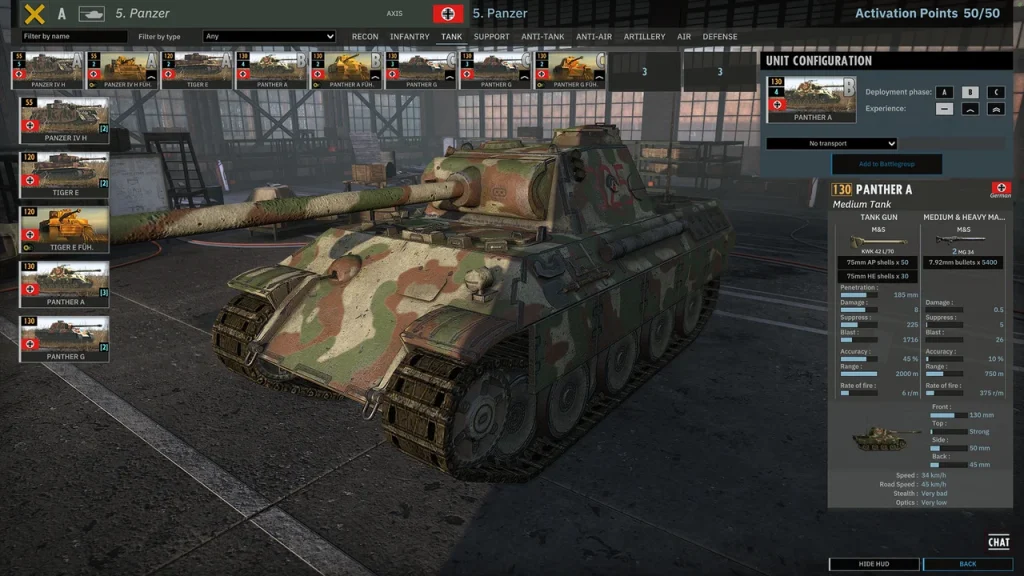
The official screenshots include a selected vehicle model with unit cards and configuration information. That image supports the existence of a roster interface. It does not establish that this reviewer tested every option, measured its usability or identified a current competitive meta.
4. Match solo sessions and group plans to the exact mode
The base description advertises offline and online formats, cooperative play and large 10v10 battles. Those make Steel Division 2 relevant to more than a solo campaign buyer. They are invitations to inspect the particular mode, rather than proof that every campaign and expansion supports every group arrangement.
A group interested in one Army General campaign should confirm that exact campaign’s current cooperative conditions and required content. A group interested in online battles should agree on the intended format and versions. These are different plans even when the same friends own the game.
For a solo buyer, the strategic campaign and tactical options provide documented activities to investigate. For someone wanting occasional historical content, inspect the listed historical battles in the relevant product. A feature called a new battlegroup does not by itself promise another authored battle or campaign.
Maximum online format does not measure the present community. This review does not promise available opponents, short queues or a healthy lobby at your preferred time. Obtain current mode-specific evidence if online availability determines the purchase.
A specific shared activity is the strongest group buying reason. Confirm the game, platform, build, mode and any required DLC before assembling a purchase list. Similar games from the same developer do not automatically share players or content ownership.

5. Distinguish campaign additions from battlegroup packs
The verified Battle of Dukla Pass listing describes a new Army General campaign and six divisions. This is a concrete candidate for someone wanting another strategic campaign with its named historical setting.
The verified Nemesis: Hell’s Highway listing instead describes two new battlegroups, including the British 43rd Wessex formation and Kampfgruppe Walther. That is a roster-oriented purchase to assess, with stated use in Skirmish or online multiplayer.
Death on the Vistula describes an Army General campaign, four divisions, historical battles and other content. Its listing names a History Pass and particular editions in which it is included. Check the actual current offer and your library before purchasing another copy.
These examples make three different shopping questions visible. Do you want another campaign? Do you want more formations for existing tactical formats? Do you want named historical battles? A pack can contain several, but the generic word expansion does not establish which.
For example, a campaign-first owner can investigate Dukla Pass before collecting every battlegroup pack. A player satisfied with the existing campaign but curious about Hell’s Highway’s formations has a different next purchase. The correct content list follows the intended activity.

6. Check returning rosters, cosmetic extras and edition contents
The verified Tribute to D-Day Pack describes six returning divisions from Steel Division: Normandy 44, usable in Steel Division 2 solo, cooperative and online multiplayer. It is a specific roster addition within Steel Division 2.
A reference to another game’s divisions does not prove that owning that other game grants this pack. Treat it as its own listed product and inspect the current entitlement. Likewise, returning divisions do not establish a new Normandy strategic campaign unless the actual content description supplies that promise.
The Commander Deluxe Pack lists six cosmetic Aces, five camos and digital extras such as an artbook and battle log. This can appeal to a collector interested in presentation and development material. It is a different purchase from another Army General campaign.
The distinction is practical for a buyer comparing editions. A product with Deluxe in its name may supply a stated set of items. The name alone does not establish every campaign, every roster addition or future content. Compare the included products individually with the experience you want.
No current prices or discount calculations are used here. Before checkout, compare the live offer with your owned content and the requirements of your chosen mode. That produces an actual buying decision without an invented monetary value score.
7. Confirm the platform, creator content and personal fit
The Steam metadata checked for Steel Division 2 lists Windows support and Workshop. These identify a platform and creator-content channel. They do not establish compatibility with every handheld, laptop, custom project or operating-system arrangement a buyer might want.
If one modification is the reason to buy, inspect its present version, required content and installation instructions. Workshop availability describes a channel. It cannot guarantee that a particular project works with the latest game build, selected DLC or a friend’s installation.
Use the current complete system requirements for the machine you intend to use. Promotional screenshots cannot measure text readability, control comfort or frame rate on that machine. A relevant current device report is more useful than assuming the release date settles performance.
For personal fit, consider which interface you would enjoy revisiting: campaign decisions, division configuration or tactical play. This review does not assign a universal difficulty score or promise a learning time. A clear preferred activity is a more grounded starting point.
The supplied pictures are copyrighted official promotional screenshots. They are not this author’s gameplay captures, and they do not verify current balance or stability. Their purpose is to show the kinds of scene and interface represented in the product.
Verdict: a specific campaign and roster combination
Shortlist Steel Division 2 for its Eastern Front campaign framework. The 1944 setting, turn-based strategic format, division decks and explicit campaign autoresolve option supply concrete reasons for a campaign-focused buyer to investigate it.
Choose extra content around the next activity. Dukla Pass, Hell’s Highway, Tribute to D-Day and Commander Deluxe illustrate different campaign, roster and collector interests. Start with the one that fills an actual gap in your plans.
Verify group and device requirements when they decide the purchase. Advertised co-op, 10v10 and Workshop features are useful starting points, while exact current compatibility remains a mode or project question.
The strongest Steel Division 2 review conclusion is therefore a fit judgment: it addresses a buyer who wants this period and combination of campaign and tactical formats. It need not win an unsupported realism, popularity or performance contest to be relevant.
Continue with the Steel Division 2 hub, the Steel Division 2 vs WARNO comparison or the Steel Division 2 vs Red Dragon comparison.
Sources and further reading
Keep exploring
Steel Division 2 artillery correction: connect the observer area to the target
Identify the radio-equipped observer and eligible artillery, place the intended target inside the correction area, then check the shot and move the observer when the task changes.
Steel Division 2 anti tank positioning: match the lane, target and ammunition
Choose an observed lane that matches the gun’s actual ammunition range, set its engagement behavior, and reassess after the target or observation changes.
Gates of Hell Ostfront vs Steel Division 2: Conquest or Army General?
Pick Ostfront for researching and developing a Conquest army with switchable unit control; pick Steel Division 2 for battalion-map planning and battlegroup decks.