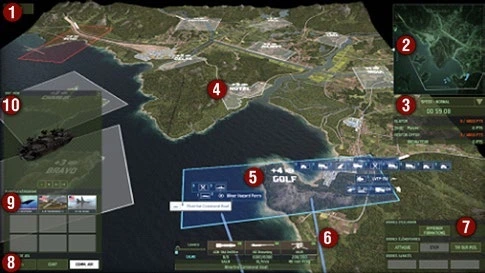
Wargame Red Dragon SEAD aircraft are a specialized answer to radar air defense, rather than a replacement for every bomber or fighter. Choose a plane whose actual anti-radar weapon can address the threat, give it a specific in-game mission, and reassess the route when the enemy changes its defense. Keep a different answer available for non-radar weapons and enemy fighters.
The useful decision is whether a SEAD sortie makes another action worthwhile. Spending on a specialist that cannot address the current target can leave your ground force short of support. A successful attack on one weapon also does not establish that the whole airspace is safe.

On this page
Match the aircraft to a specific defense
Identify the target through the game’s available information and inspect the selected aircraft’s weapons. The official manual separates SEAD, air superiority, close air support and ground-attack roles. Treat those distinctions as different jobs when spending points. A fighter protecting your aircraft does not substitute for a weapon suitable against the radar target.
Do not buy solely from a familiar aircraft name. The South African air-force developer preview gives a useful example: its Cheetah D was described with BARB anti-radiation bombs, using HE damage and a very short-range SEAD representation. The developer explicitly said the preview was work in progress. The example establishes why payload and damage type matter; its archived values are not a current universal damage calculation.
Why an inactive radar weapon changes the SEAD task
The community-authored Wargame guide documents the missing distinction: a unit’s active radar-related weapon makes it eligible for a SEAD aircraft’s anti-radar attack, while disabling that radar weapon removes this eligibility. This is a weapon-state rule, not proof that the unit disappears from all reconnaissance or is protected against every other attack. The guide was last updated in 2015; its unit rankings and numerical claims are not used here.
For your mission, this means an enemy can deny the intended anti-radar target by switching off the relevant weapon, while also giving up that weapon’s fire. If the SEAD plane no longer has an eligible target, reassess whether the sortie still serves the objective. Other enemy weapons can remain active, and reactivating the radar weapon restores the associated targeting exposure. Do not send an ordinary follow-up aircraft on the assumption that one inactive radar weapon proves the entire defense is gone.

Decide what happens after the sortie
| Current problem | Useful decision | Remaining risk |
|---|---|---|
| A known radar defense blocks an intended air-support task. | Consider a suitable SEAD mission, with the supported action clearly identified. | Other air defenses and fighters can remain. |
| Your available weapon cannot address the identified defense. | Use another suitable game unit or choose a different objective. | Delaying the aircraft does not remove the defense. |
| You lose reliable information about the target. | Reassess before committing another expensive aircraft. | The opponent can change position or weapon state. |
| The ground force has no useful follow-up. | Keep the reinforcement points until the mission serves an objective. | The enemy defense remains available for later action. |
Coordinate the purpose of a sortie with your teammate when playing a team game. A short message identifying the game objective and the support you intend to provide is more useful than assuming another player will automatically exploit it. Avoid purchasing two specialists for the same job while a neighboring lane lacks reconnaissance or ordinary defense.
A conditional mission example
Suppose your ground units need help against a position, a radar-tagged air-defense weapon has been identified, and your deck offers a suitable SEAD aircraft. These are scenario assumptions, not a recorded match. Check whether the intended supporting aircraft has a useful target and whether enemy fighters or other defenses would still make that follow-up a poor trade.
If the specialist engages but the defense survives, assess what changed before sending the next plane. Damage to one unit is not proof of a cleared route. If your ground attack has stalled for an unrelated reason, such as lost reconnaissance or empty ammunition, fix that problem rather than continuing an air mission that no longer serves it.
Keep the aircraft’s mission cycle in mind. The manual says planes return to base between missions. A purchased plane is not continuously available at the front, and a repeat call should have a fresh purpose. Reserve enough points to handle an unexpected ground threat instead of tying your entire response to the aircraft returning.
Practice the decision without relying on a unit ranking
Use a small skirmish to learn the selected aircraft’s eligible targets and mission controls. Compare what its payload does with the job of an ordinary bomber and a fighter. Record the conditions you actually observe, such as target eligibility and the aircraft’s return state, rather than turning one engagement into a guaranteed matchup rule.
The official manual supports the role and mission distinctions. The South African aircraft preview illustrates a specific payload design and explicitly retains its development caveat. Start with a mission that helps an objective, and stop spending when the assumptions behind that mission disappear.
Sources and further reading
Keep exploring
wargame red dragon radar anti air management: coverage and weapon-state decisions
A source-backed guide to managing specific radar-related weapons within a complete Wargame Red Dragon air defense.
wargame red dragon korean war campaign: keep a usable campaign roster
A practical wargame red dragon korean war campaign guide using the official manual, with explicit assumptions and the limits of archived game information.
wargame red dragon artillery smoke: screen one useful movement
A practical wargame red dragon artillery smoke guide using the official manual, with explicit assumptions and the limits of archived game information.