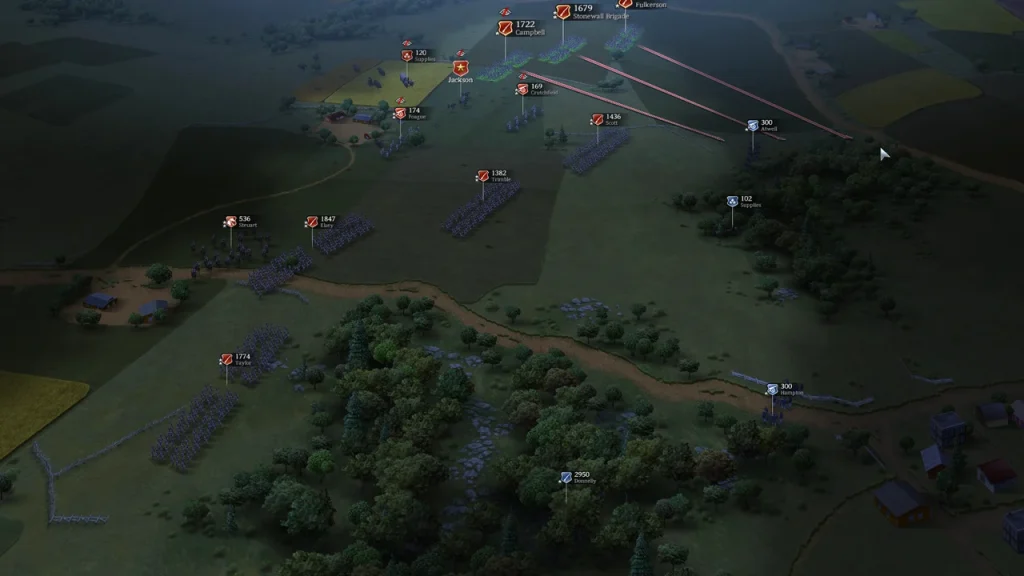
TL;DR: A sound Ultimate General Civil War Union campaign opening uses the Union’s larger resource pool to build an army that can keep improving. Complete the first mission while preserving useful formations, then restore officers and equipment in camp. Compare rookie and veteran replacements before applying them, and spend for the next battle’s actual deployment rather than the largest army you can buy.
The Union offers more resources, but the official game guide describes its recruits as less experienced than their Confederate counterparts. Your opening task is to turn that numerical and economic room into usable strength. Keep enough trained soldiers alive to develop the army instead of repeatedly replacing the same losses.

The plan below follows the official v1.25 campaign and camp systems. Use your current mission, difficulty and recruitment previews for exact forces and costs. A mod or a different scenario can change the opening; the decisions still begin with the army and objective actually on your screen.
On this page
Ultimate General Civil War Union campaign opening: spend for usable strength
Union resources give you options, but they still serve several competing needs. Gold buys equipment and officers and pays for veteran replacements. Recruits fill existing brigades or create additional formations. A pile of recruits cannot repair a missing weapon stock or an unsuitable command arrangement.
Decide what the army must do next before deciding how much to enlarge it. A force that can hold the required ground, support another brigade and maintain ammunition is a more useful opening investment than extra soldiers with no suitable equipment or deployment slot.
Preserve a core of improving units through the early missions. The official game overview connects surviving troops with experience and campaign losses with reinforcement pressure. That continuity is the reason to evaluate an early victory by the army it leaves you, as well as the result itself.
Choose a career start that supports your opening plan
Inspect all three background selections and the final allocation before beginning. The guide lists West Point graduation, Mexican-American War service and Further Career as the decisions shaping your initial career points.
For a learning start concerned with developing Union recruits, Strategist, Training and Politics are a coherent set to inspect. The documented choices provide organization and training support, with political and economic support from the final choice. Check the resulting totals before you commit; this is a purpose for the selections, not a claim that one combination wins every campaign.
A player who wants early information about enemy forces can instead compare the Tactician route and its reconnaissance contribution. Another player worried about ammunition and casualties can inspect the Artillery service choice. Read each selection for the skills it grants, rather than treating its historical label as a promise of starting units.
Choose a difficulty deliberately and keep the Advisor available if you are still learning. The manual recommends Colonel for becoming familiar with the controls. Use the final screen to review the setup, then begin with a goal you can manage.
Solve the first objective before chasing extra casualties
Read Objective Conditions as soon as the opening mission begins. Identify what must be captured or held, then check the mission timer and the route your available units can use.
When an opening presents Capture Philippi, look at the town objective and its approaches together. The official Union screenshot shows that objective above a force beside a road, ridges and woodland. Use it as an example of the information to inspect, while taking the actual mission screen as the authority for your starting force and requirements.
Allocate the main infantry to the task that changes the objective’s status. Use available skirmishers to investigate the approach and protect against an unexpected enemy on the side. The first formation should not spend the mission pursuing a small unit away from the required ground.
Watch phase changes and messages. The guide explains that mission events can override a timer and that reinforcement messages can move the camera to their location. Reassess where the army is needed when the situation changes.
Before finishing, check the victory conditions and the surviving army. A useful extra action secures a requirement or improves a manageable position. Fighting longer solely because an enemy remains visible can add losses without improving the next camp visit.
Use scouting to decide where the Union line advances
Scout the ground that the main brigade will have to cross. The manual describes skirmishers as useful for visibility and concealment, while hills and woodland can change what both armies see.
Keep the scout’s job limited: identify a threat, delay it if useful, and leave before a close engagement becomes unfavorable. Skirmishers are vulnerable in melee. Their ability to reveal a position does not make them a replacement for the infantry that must contest it.
Choose a receiving position with usable cover and inspect the approach into it. A good defensive location does not protect the entire route leading there. Give the brigade a short, understandable movement task and check its condition when it arrives.
Use the information to decide whether to commit the next formation, turn the line or wait for support. This is especially useful for an army whose young units need time to become reliable. Avoid exposing the whole opening force to a threat you could have identified with a smaller unit.
Protect the young army during the first fight
Watch morale and condition as separate limits. A tired unit can arrive poorly prepared for its job, while a unit with falling morale can become difficult to control. Inspect the card before deciding that another charge or movement order will solve the problem.
Use available cover and preserve support between formations. When a brigade is under concentrated pressure, a controlled Fall Back toward supporting troops can retain a force you will need later. The manual distinguishes that command from exposing its rear with an ordinary movement order.
Keep the corps general in a position to support the line without becoming the exposed forward unit. Officers contribute to command and efficiency, and losses among brigade or division officers can weaken otherwise useful troops. Check officer status after the fight.
Protect artillery and ammunition when those units are present. A wagon needs nearby units within its supply radius and friendly protection from attackers. A battery also needs visibility on a useful target. Letting either unit sit alone beyond the infantry creates another repair problem for camp.

Treat the first camp visit as an audit
The official guide places camp after the first campaign victory. Open the Army panel and inspect each surviving brigade before hiring or enlarging anything. Record which unit is short of soldiers, missing an officer, poorly equipped or likely to have a useful job in the next deployment.
Restore missing brigade and division commanders first where their absence causes a command penalty. Check the Reserve in Barracks for officers you already own before hiring from the Academy. Officer rank must suit the appointment, and larger units need adequate command to retain efficiency.
Look at brigade skills and the officer’s progression. A unit that survived with useful experience deserves a deliberate replacement choice. The number of stars is based on several skills; it is not a complete description of the force by itself.
Check the Armory for existing weapon stock and the corps supply allocation. Keep those constraints beside your recruitment plan. You can have room to recruit more men while still lacking the weapons or officers that make another formation usable.
Compare rookies and veterans before applying replacements
Select a brigade and move the replacement slider to the size you are considering. Inspect the skill and cost preview in Rookie mode, then compare Veteran mode before Apply.
The guide says rookies lower unit skills through the addition of untrained soldiers. Veterans preserve skills at a gold cost that increases with the unit’s average quality. The Union’s access to more recruits therefore does not remove the choice between preserving quality and conserving money.
For an illustrative decision, consider a surviving line brigade that needs additional soldiers. If its next job is to hold a less pressured sector with support, the rookie preview may be acceptable. If it is the experienced formation you depend on for a difficult objective, preserving more of its quality can justify veteran spending.
Evaluate the entire army after that choice. Veteran replacements for one brigade can consume money needed to give another brigade a usable officer or weapon. Prioritize the formations carrying the next battle’s important tasks.
Read the equipment part of the cost as well. The manual says replacements use armory stock first and can require purchases from the shop when stock is short. A rookie choice can still produce a bill for weapons. Check the final preview rather than treating the recruitment label as the total cost.
Match equipment purchases to the next deployment
Inspect the weapons you already own, the shop supply and the brigades you expect to deploy. Give priority to equipment that changes the performance of a formation with an actual job.
A reliable line unit and a newly created specialist place different demands on the budget. Buying a specialist also needs the appropriate officer and enough troops to form it. Consider that complete package before spending on a weapon whose main attraction is its name.
The manual describes different roles for artillery guns and cavalry equipment. Use those roles to decide what the current force lacks. Add a unit to solve a specific problem, such as supporting the line or scouting, while retaining the infantry and supply required for the objective.
Check Army Organization against the upcoming deployment. More capacity can provide room to grow, but the battle’s corps and brigade slots remain a separate restriction. You do not need to buy every available formation before seeing where it can participate.
Choose side battles as investments in the grand battle
Open each available battle’s reward window. The guide describes campaign stages with a grand battle and optional smaller missions, whose rewards can improve the army and reputation.
Compare the potential gold and recruits with the force and repairs the mission is likely to require. Consider the outcome risk as well. A defeat or draw can carry a reputation cost, and reputation affects both campaign survival and troop morale.
A mission that leaves an experienced brigade badly depleted can be less useful than its victory reward initially suggests. Review the post-battle replacement and equipment bill before expanding again. Growth becomes easier when rewards and surviving quality accumulate together.
Government support is another choice with a cost. The manual describes resource requests spending reputation. Read the offer and the current reputation before using that support to cover a budget gap. Keep it attached to a specific need.
Review intelligence without assuming every estimate is visible
Use the battle briefing and the Intelligence Service to understand the coming opposition. Reconnaissance determines how much battle information is revealed. A missing detail should not be interpreted as an empty enemy slot.
The guide separates estimates of enemy army size, training and armory quality. Read them as different concerns. More soldiers, more experienced troops and better equipment each change how you prepare.
Compare those reports with the terrain and deployment opportunities. If you expect strong opponents, preserve a usable reserve and avoid planning an opening that depends on every brigade succeeding immediately. Information can change which task receives your best formation.
Leave camp with a written deployment plan
Before Start, assign the permitted corps and check the brigade limits in each slot. Identify the force available initially and the reinforcements the scenario supplies later. Your plan must work with the soldiers present at the relevant time.
Write one sentence for the first task: which brigade approaches or holds the objective, who scouts its route, and where support waits. Add the condition that makes you revise the plan, such as a newly revealed threat or a reinforcement message.
Use the Ultimate General: Civil War guides hub when the next problem needs a focused explanation. For this opening, finish by checking officers, replacement previews, equipment stock, supply and deployment together. Spend the Union advantage on an army you can continue to develop.
FAQ
Does the Union resource advantage mean all replacements should be rookies?
No. Compare the dilution of brigade skills with the cost of preserving them. Use the next job and the whole army’s budget to make the choice.
Can I enter camp before the first campaign mission?
The official guide says camp becomes available after the first campaign victory. Use the opening force and inspect camp when it opens.
Why can recruiting rookies still cost gold?
Weapons may need to be purchased if armory stock is insufficient. Read the full equipment and replacement preview before applying the change.
Should I follow one fixed Union opening build?
Match the career selections and purchases to your difficulty, current force and mission. A build needs a clear purpose before it becomes useful advice.
Sources and further reading
Keep exploring

Hearts of Iron 4 vs Ultimate General Civil War: nation or army command?
Pick HOI4 for national industrial and political war planning; pick Ultimate General: Civil War for tactical formation command and an army that carries battle consequences forward.
Gates of Hell Ostfront vs Ultimate General Civil War: which army campaign?
Choose Ostfront for a researched WWII force and direct control; choose Ultimate General: Civil War for brigade command and a campaign shaped by surviving soldiers and officers.
Games like Ultimate General Civil War: 3 clear choices
Criterion-based alternative selection for UGCW players: same-franchise focused battlefield, same-war national strategy, or different-period gunpowder regional campaign; explicit scope and evidence limits.