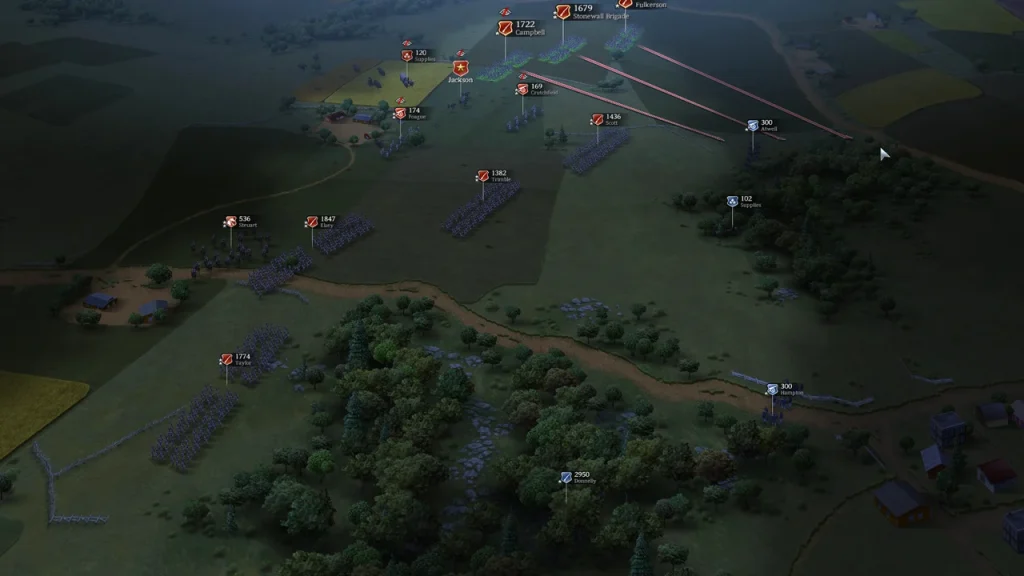
An Ultimate General Civil War Confederate campaign opening works best when you preserve useful brigades and buy only the strength needed for the next mission. The official manual describes the Confederate side as having better recruits but fewer weapons, gold and available men. That makes careless replacements and unnecessary losses expensive. Read the opening mission conditions, win the required ground with supported units, then repair command and equipment before expanding the army.
Seven opening checks: choose a career purpose; read the mission conditions; preserve supported positions; repair command gaps; compare replacement previews; audit weapon stock; and fund the next deployment. This guide follows the official UGCW manual and the developer’s Civil War game overview. It gives a decision process, not a scripted first-battle route or a claim about current numerical balance.

On this page
Ultimate General Civil War Confederate campaign opening: protect what is hard to replace
The Confederate advantage is the quality of the army you can put to work. It does not make each brigade safe to spend in a costly attack. A formation that wins a position but loses many trained men can leave you with an awkward choice: pay for veterans, dilute its skills with rookies, or enter the next battle below your intended strength.
Give your starting units different jobs. One holds a useful position, another supports its exposed side, and a mobile element watches the approach you cannot see. Keep artillery and supply behind troops that can protect them. Before committing another formation, ask what it will accomplish: hold the objective, threaten a flank, reveal a route or cover a withdrawal. Extra participation alone is not a reason to expose it.
Set a career purpose before choosing the opening force
The career background offers different combinations of skills. In the manual, a West Point Strategist starts with Organization and Training, while a Logistician starts with Organization and Logistics. Later background choices can support those categories or add others. Choose with a practical bottleneck in mind, such as formation capacity, ammunition or the cost of maintaining experienced troops.
A capacity-focused opening still needs enough recruits and weapons to fill that capacity. A replacement-focused opening still needs officers and a usable force. Avoid selecting bonuses simply because all their descriptions sound valuable. Write one sentence explaining your intended army, then choose a background that helps it operate. For a first campaign, the manual recommends Colonel difficulty; choose the challenge level deliberately rather than using an advanced build to compensate for unfamiliar controls.
Career investment continues after battles. The manual says changes apply on the next campaign turn, so do not budget an immediate purchase around a discount you have just selected. Check what the camp actually charges before committing.
Read the first mission as a requirement to satisfy
Open Objective Conditions and identify the victory and draw requirements. Determine which locations matter, whether holding or capturing them is required, and what the current phase asks your force to do. The visible enemy line is information about the problem; it is not automatically the objective itself.
Build the opening around the conditions shown in your campaign. This guide does not assume a particular first-mission roster, entrance route or timer. If the requirement is to take a position, look for the route that lets supporting units contribute. If you must hold ground, avoid pulling the entire line away to pursue a retreating enemy. Pause when the phase or available forces change and read the requirements again.
The manual explains that events can affect phase timing and that a Finish option may appear. Treat the clock as one part of the mission state. Do not assume every displayed timer gives an unlimited extension or that a position is secure merely because an enemy unit has withdrawn.
Use position and support to preserve the starting units
Hover over terrain and inspect its effects before moving into contact. Woods, elevated ground and crossings can change the usefulness of a route. Cover helps, but the manual explicitly does not treat it as complete protection. A brigade in cover can still suffer when it stays under sustained fire or becomes exposed from another direction.
Move a supporting formation far enough to help without stacking your whole force into one crowded approach. Watch the direction the brigade faces after it arrives. A move order can achieve the right location while leaving the unit poorly oriented for the next exchange. Use the named frontline and rotation controls when the line needs adjustment.
Check morale and condition when the attack slows. A tired unit repeatedly ordered forward may be losing the capacity to carry out the plan. A safer option can be to halt, let another formation cover it, and change the angle of attack. The useful question is whether the current position lets the army work together, not whether every unit is advancing.
Reserve charges for a defined opening
Charges spend condition and expose troops to fire during the approach. Give a charge a specific purpose before issuing it: clear a vulnerable unit from required ground, exploit a gap already opened by supporting fire, or respond to a threat that cannot be stopped in time by shooting. A healthy enemy line with support behind it is a different problem from an isolated formation.
Inspect the target’s support, the approach and your own unit’s condition. Plan where the charging brigade will finish and which friendly unit will protect it there. If success would leave it alone beyond your line, the order may create a second problem immediately after solving the first.
Learn Fall Back as well. The manual describes it as a withdrawal that preserves a facing toward the threat, while an ordinary move away can expose the rear. Use named controls because manual hotkey references are inconsistent. A controlled retreat can preserve the experienced core that the Confederate resource budget needs.

Audit camp before expanding the army
Camp becomes available after the first campaign victory. Inspect Army, Armory, Barracks and Career before creating new formations. Start with the officers and brigades that already exist. Look for command gaps, wounded officers, reduced strength, depleted equipment stock and units whose skills were already weakened by previous replacements.
Record four numbers from the live camp: available recruits, available gold, weapons in stock for the intended equipment, and the replacement cost of each priority brigade. Then inspect the next mission’s deployment. This ties spending to usable troops rather than to a roster that merely looks complete.
Repair in order of consequence. A brigade without suitable command or equipment may need attention before a healthy unit receives extra men. A reserve that can cover the next mission’s threatened flank may matter more than enlarging your strongest brigade. Revisit the budget after each applied change instead of assuming every preview can be funded together.
Build the replacement budget around the experienced core
The replacement interface offers Rookie and Veteran choices. According to the manual, rookies dilute a brigade’s skills; veterans maintain those skills at a gold cost that grows with the quality being preserved. Compare both previews at the same proposed strength so that you can see the actual tradeoff.
Choose which units need their existing quality for the next task. A brigade assigned to the most demanding defensive position may deserve a different replacement budget from one intended as a supporting reserve. That is a planning judgment, not a rule that all Confederate brigades must receive veterans. Recruits and weapons are required either way, so the cheaper gold preview does not remove the other constraints.
Apply replacements selectively, then inspect the resulting skills and remaining resources. If the desired repair would exhaust the budget, reduce the target strength or reconsider the assignment. A partly repaired army with clear jobs can be more usable than one expensive formation surrounded by unresolved shortages.
Treat captured weapons as inventory with a cost
Weapons recovered through campaign results can help a resource-limited army, but read the actual reward and Armory stock. Do not plan a new brigade around equipment you hope the next battle will produce. Even weapons already in storage need recruits, an officer and available organization to become a fighting formation.
When replacing men, the camp uses the equipment available for the brigade’s selected weapon and purchases more when stock is insufficient and the shop can supply it. If neither source has enough, adding men with that weapon is constrained. Consider the actual alternatives in camp rather than assuming the money alone solves the shortage.
Before switching equipment, compare the role and the live Equip preview. A weapon that suits close fighting might belong in a different brigade from one intended to support a firing line. Keep an inventory note showing what is available now, what must be bought and what the change leaves for other units.
Add formations only when organization and equipment support them
New brigades require the organizational capacity, appropriate officers, recruits and equipment described in the manual. Check all four before pressing ahead with expansion. Increasing a capacity limit does not automatically fund or command the formations that fit inside it.
Compare two concrete options: enlarge an existing brigade or create another unit with a separate assignment. The new unit adds flexibility, but it consumes a formation slot and may need an officer purchase. Enlarging the existing unit concentrates resources and changes the size its commander must handle. Inspect efficiency and command rather than choosing solely by the number of men.
Also check where the formation will be deployed. A new reserve has value when the mission can bring it onto the field at a useful time. If it cannot fit the next deployment, make sure its longer-term purpose justifies spending resources that the active force still needs.
Evaluate side battles by the army they leave
Campaign stages can offer optional side missions before a grand battle. Read the mission reward, commitment and deployment limits. Then estimate the repairs that a costly result would require. The displayed reward is only one part of the decision; the condition of the army afterward matters to the upcoming grand battle.
Ask whether the side mission can be fought with a supported force you are willing to expose. If it requires sending the same damaged core into another demanding fight, repairing first may be necessary. If you cannot afford the repair and the mission is optional, evaluate proceeding to the grand battle with the resources you already have.
A victory screen does not settle this assessment. Review casualties, recovered troops, rewards and equipment in camp. Keep the lessons specific: which unit could not perform its role, which approach was expensive and which shortage should be resolved before repeating the same commitment.
Prepare for the grand battle with a deployable reserve
Read the grand battle briefing for the corps and brigade slots you can use, along with the starting and reinforcement arrangements. The official later-stage deployment screenshot illustrates that these limits exist; it does not establish your opening deployment. Build the plan from the current screen.
Assign the troops that hold ground, the support that keeps them useful and a reserve that can respond to an exposed side or exhausted formation. Check that the selected units have officers and equipment, and that your supply allocation supports the battle you expect to fight. Avoid leaving a key role dependent on a unit that arrives later than your plan assumes.
For related controls and specialist topics, use the Ultimate General Civil War guide hub. Leave camp with a short deployment note: required objective, starting force, reserve job and the shortage you must manage. That makes the next battle easier to evaluate when its opening situation appears.
FAQ
Should the Confederate opening use veterans for every replacement?
No universal rule follows from the manual. Veterans preserve skills but cost gold; rookies dilute skills. Compare the previews and prioritize the units whose next assignments depend most on maintaining quality.
Does the Confederate side start with more resources?
The manual describes better recruits alongside fewer weapons, gold and available recruits. Use the actual campaign resource display to budget the army; this guide does not promise a fixed starting amount.
Is every optional side battle worth taking?
Evaluate its rewards, likely commitment and the army needed afterward. An optional battle can provide useful resources, but losses and repair costs can reduce its value before the grand battle.
Sources and further reading
Keep exploring

Hearts of Iron 4 vs Ultimate General Civil War: nation or army command?
Pick HOI4 for national industrial and political war planning; pick Ultimate General: Civil War for tactical formation command and an army that carries battle consequences forward.
Gates of Hell Ostfront vs Ultimate General Civil War: which army campaign?
Choose Ostfront for a researched WWII force and direct control; choose Ultimate General: Civil War for brigade command and a campaign shaped by surviving soldiers and officers.
Games like Ultimate General Civil War: 3 clear choices
Criterion-based alternative selection for UGCW players: same-franchise focused battlefield, same-war national strategy, or different-period gunpowder regional campaign; explicit scope and evidence limits.