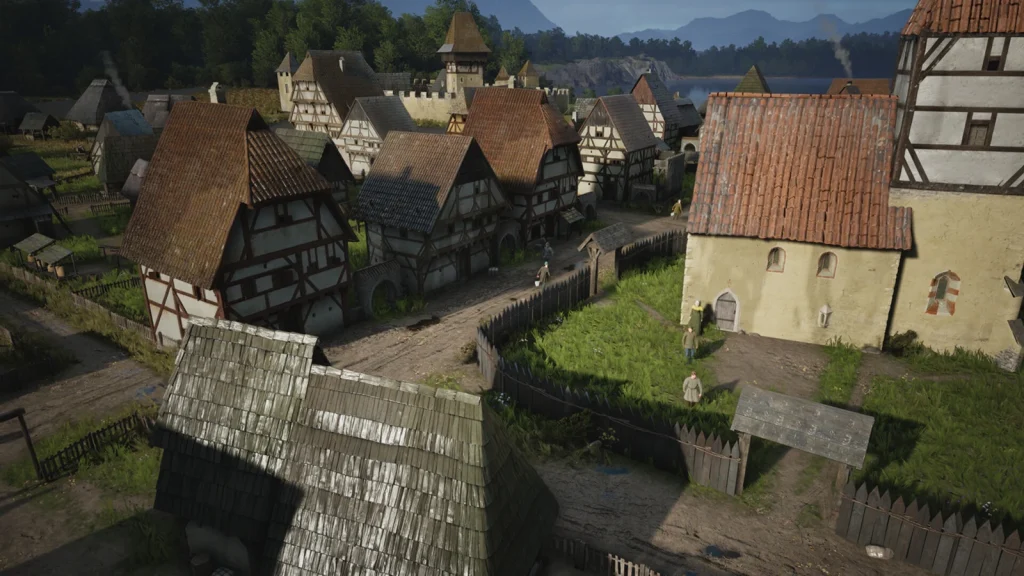
Manor Lords burgage plot upgrades need both the selected plot’s current requirements and the resources to complete construction. Start by opening that plot and reading its Residential Requirements. Then trace any missing service or category through the village; the regional stock total alone does not tell you whether the home is supplied.
Two current rules change older advice. In the March 2026 release, a new level 3 was inserted and the previous level 3 became level 4. The same update made settlement progression count resident families at certain levels. A three-level launch checklist can therefore identify the wrong target.

On this page
Manor Lords Burgage Plot Upgrades: Read the missing requirement as a supply problem
| The selected plot shows | First useful check | Next action |
|---|---|---|
| Missing food variety | Required category and actual market supply | Add a missing category or repair its distribution |
| Missing fuel | Fuel in the supplying Storehouse and its stalls | Restore collection or staffing before adding more homes |
| Missing service | The named service and its current supply state | Finish the relevant building and its operating requirements |
| Upgrade can start but stalls | Construction inputs, ox guidance and builder requirement | Complete transport and required labor |
| Upgraded buildings do not advance settlement | Resident families and completed level | Supply living space and allow the relevant families to move in |
Use the actual plot as the test case. Select a home that is failing, note one missing item, and inspect the supplying chain. Changing several industries at once makes it harder to learn which correction solved the problem.
The December 2025 core rework introduced food categories: foraged goods, meats, fishes, vegetables, grains and animal produce. The upgrade asks for category variety rather than simply a long list of named foods. Pork and small game are both meats; their combined presence does not automatically replace an absent vegetable or fish category.
That rework also changed actual household consumption by burgage level. A higher-level home creates recurring demand, so satisfying a requirement just long enough to click Upgrade is an incomplete plan. Keep the supply chain working after the construction finishes.

Case: food in storage, but the plot still cannot upgrade
Suppose your target home lacks a food category even though the resource bar shows food. First identify which food the bar is counting. If your entire reserve belongs to categories the plot already receives, the town is short of variety rather than quantity.
If the missing category exists at a producer, inspect its collection into the correct Granary. The December core-system notes state that storage workers supply their stalls from their own storage building. A full producer with an empty supplying Granary is a collection problem; a full Granary with an empty stall is a different link in the chain.
Then inspect marketplace filters. The October 2026 update explicitly discusses foods that a marketplace does not allow, using oats as an example. Producing a category that the supplying market excludes will not make a good upgrade plan. Allow the intended goods and confirm actual distribution.
After correcting one link, let the simulation update and recheck the same home’s requirement. If it still fails, inspect the stall’s stock and whether that stock is sufficient for the homes it serves. Do not assume that relocating the entire residential district is the first repair.
For a practical food addition, choose a chain the region can support. A garden needs a suitable backyard, a paid planting operation and household work. Fish needs a real fishing node and sustainable collection. Grain-based production needs a crop calendar and processing. Pick the missing category whose full route you can finish.
Case: the upgrade is paid for, but construction is not finishing
Check whether the project is waiting for materials, eligible labor or advanced construction. A paid order establishes a commitment; it does not show that the village has transported every input to the building.
Timber requires an ox and guide. The March release restricts construction ox guidance to unassigned or Logging Camp workers. If you assigned the whole workforce to production, create the appropriate availability and watch whether the delivery begins.
The August main update added Advanced Structures that require professional builders at a Construction Yard. Use the project’s actual requirement to decide whether that building and workforce are necessary. Extra unassigned families can help with basic tasks but do not replace the professional requirement.
When several upgrades compete for scarce inputs, pause the optional ones and finish the plot that serves your immediate milestone or artisan plan. That is easier to recover than committing the same timber and construction time to an entire street.
Inspect completion rather than appearance. The October release states that families count as higher-level only after the burgage upgrade process fully completes. A home showing a changed construction scene is not proof that its residents already count toward the next settlement level.
Choose which homes deserve the next upgrade
Upgrade for a specific purpose: the next family-level milestone, a workshop unlock or a household you can sustainably supply. Higher levels are not an automatic instruction to upgrade every home simultaneously.
Cobbler and Baker extensions require level 3 under the March update. The August update adds a Cheesemonger at level 3. If one of those is your goal, identify a suitable plot and prepare the workshop’s inputs as well as the residential upgrade.
Artisan setup has another separate step. August replaced Production Focus with Active Recipes and made new artisans start without any active recipe. Once the workshop is complete, choose the intended recipe and inspect input reserves, output storage and maintenance. An upgraded home with an idle artisan can be correctly built but incompletely configured.
Expansion and tier upgrades are different choices. The March release says the Expansion upgrade adds one living space regardless of level. If migration is constrained by housing, that can solve a different problem from raising the existing residents’ level. Check which result the settlement needs before spending.
Use the Manor Lords guides hub when the missing requirement points to market distribution, food categories or construction. Fix the actual blocker, complete one upgrade, then inspect the village’s recurring supply before starting the next group.
Sources and further reading
- https://steamstore-a.akamaihd.net/news/externalpost/steam_community_announcements/1819386365095372
- https://steamstore-a.akamaihd.net/news/externalpost/steam_community_announcements/1827626365750540
- https://steamstore-a.akamaihd.net/news/externalpost/steam_community_announcements/1842212951300554
- https://steamstore-a.akamaihd.net/news/externalpost/steam_community_announcements/1847920302241640
Keep exploring

Manor Lords vs Crusader Kings 3: build a town or guide a dynasty?
Pick Manor Lords for a medieval settlement and its household economy; pick Crusader Kings III for rulers, relationships and a realm passed between generations.
Northgard vs Manor Lords: clan objectives or settlement planning?
Choose Northgard for clan-specific strategy and explicit victory routes; choose Manor Lords for the placement, households and production of a medieval settlement.

Manor Lords Retinue Management: Roster, Armor and Treasury
Manor Lords retinue management: budget recruitment and armor, assign a clear battlefield role, and protect the settlement economy behind it.