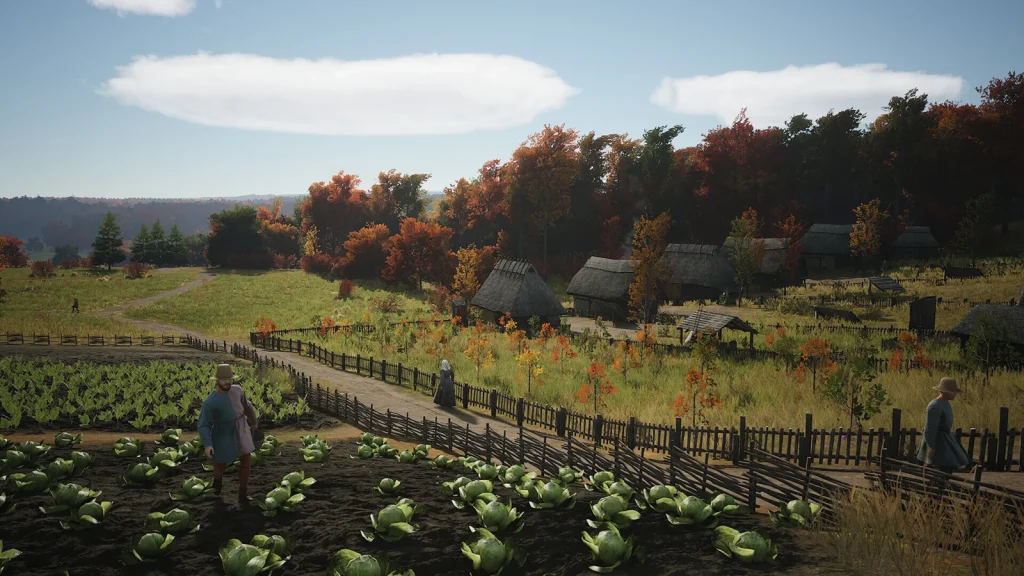
Manor Lords food variety is now about food categories, not merely how many named products you own. To satisfy a burgage requirement, supply the categories shown on that home’s panel through a working marketplace. A second meat product can increase reserves while leaving the missing category unresolved.
The December 2025 released core rework replaced the older food system with categories and revised burgage requirements. Start here if a launch guide tells you that any two different foods are enough.

On this page
Manor Lords Food Variety: Six categories, many products
| Documented category | Examples from the rework | Planning consequence |
|---|---|---|
| Foraged goods | Berries, mushrooms | Two foraged products still belong to the same category |
| Meats | Small game, pork, chicken, mutton and other named meats | Adding another animal product called meat does not create a new category |
| Fishes | Carp, eel | Inspect the actual local fishing node |
| Vegetables | Cabbages, carrots, beetroots | Garden choice changes the product, not the category |
| Grains | Check the current food tooltip and processing chain | A crop in a field is not yet food in a stall |
| Animal produce | Milk is explicitly introduced in this category | A dairy source solves a different need from meat |
Do not turn that table into a requirement that every first home needs all six categories. The selected plot’s level and current Residential Requirements determine what you need. Higher-level demand is the reason to develop variety deliberately rather than rush every chain on the opening day.
Honey is another reason to read the current tooltip. The December rework removed its consumption as food; the August 2026 release added mead made from honey at the Brewery. An apiary stockpile is therefore not evidence that you have supplied an additional food category.

Find the shortest complete route to a missing category
Begin with the region’s actual resources. A settlement with a usable fishing node has a different early choice from one with small game. A seasonal foraging source is useful, but its production window makes stored reserve important.
For a missing vegetable category, consider a suitable burgage garden. Its area affects planting cost under the December system, and residents must work it. Avoid paying for an enormous garden before checking whether the household has enough time to maintain the promised production.
For milk, inspect the animal source, its seasonal output and the complete support chain. The August 2026 main update added cows with milk production and winter feed requirements for pasture animals. Cows are not a free permanent supply simply because they fit in a pasture.
For grain supply, plan the crop and processing before counting it in the food reserve. The same August update introduced oats that can be consumed directly after threshing. The October release makes oats a spring crop, so a new field started outside its sowing window does not give an immediate emergency food source.
Imports can bridge a category you cannot produce, but they need a sustainable regional-wealth budget and a functioning Trading Post. Treat an import as a recurring purchase. A brief shipment that unlocks an upgrade can leave a larger household demand behind after the money runs out.
A stocked region can still have an unsupplied home
Use one failing plot to trace the whole route: producer or import, collection into storage, supplying stall, marketplace allowance, then the home’s requirement. Check each link separately.
Suppose your town holds small game, pork and carrots, while the chosen plot lacks vegetables. The carrots solve the category problem only if they reach usable market supply. If they remain in a garden’s output store, staff collection. If the supplying Granary is empty, repair that link before adding another vegetable plot.
Under the December rework, storage workers supply stalls from their own Granary or Storehouse. Goods sitting in a different building are not interchangeable with stock in the supplying worker’s building. Inspect the particular storage and stall involved.
Marketplace filters can also break the route. The October 2026 default-branch notes explicitly discuss excluding oats from marketplaces and how family food consumption follows requested market types. Allow the intended product, then recheck actual supply rather than simply counting regional oats.
Finally, compare stall supply with total demand. A tiny stock of a new category is vulnerable when many homes rely on it. Fixing one home’s requirement once is useful evidence, but check whether the category remains available through the next consumption cycle.
Protect variety through the season
Review both quantity and continuity before upgrading several homes. A town can have plenty of total food and a fragile category that disappears first. Keep a reserve of that vulnerable category, limit its competing uses, or add a second sustainable source within the same category.
That is when two products from one category can help. They do not add category count, but they can protect the category’s availability when one producer is seasonal or constrained. The value is reliability, not a higher variety score.
Processing introduces competing demand. Oats can become winter animal feed; apples can become cider; honey can become mead. Set input reserves and production limits so a new industry does not consume the stock your food or livestock plan depends on.
Use Records to compare production, consumption and losses where the current UI exposes them. If a food vanishes quickly, inspect spoilage and distribution as well as the number of workers. More production is an expensive repair when the true problem is an undelivered or poorly preserved stock.
For the next upgrade, identify its one weakest category and finish that chain before adding more homes. The Manor Lords guides hub covers the separate garden, livestock, market and crop decisions when you need to repair a specific link.
Sources and further reading
Keep exploring

Manor Lords vs Crusader Kings 3: build a town or guide a dynasty?
Pick Manor Lords for a medieval settlement and its household economy; pick Crusader Kings III for rulers, relationships and a realm passed between generations.
Northgard vs Manor Lords: clan objectives or settlement planning?
Choose Northgard for clan-specific strategy and explicit victory routes; choose Manor Lords for the placement, households and production of a medieval settlement.

Manor Lords Retinue Management: Roster, Armor and Treasury
Manor Lords retinue management: budget recruitment and armor, assign a clear battlefield role, and protect the settlement economy behind it.