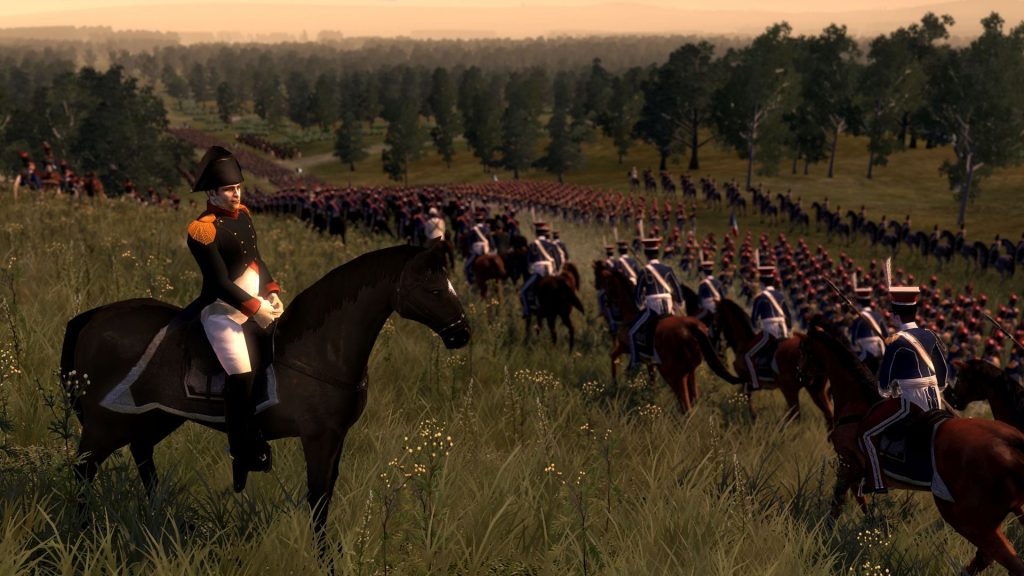
The best Napoleonic strategy games split into two clear jobs: Total War: NAPOLEON lets you command the troops fighting the battle, while Wars of Napoleon emphasizes the organization, supply and political setting of the campaign. Start with the first for direct battlefield control and the second when marching a supported army to the right place is the attraction.
This is a focused two-game shortlist. It covers the Napoleonic period itself, rather than adding medieval games or later gunpowder wars to lengthen the list. Both offer military campaigns, but their interfaces and command scales make them suitable for different evenings of play.

On this page
The battlefield choice: Total War NAPOLEON
Total War: NAPOLEON – Definitive Edition covers campaigns from Napoleon’s early career through Waterloo. Its campaign map and real-time battles are the draw if you want the political and territorial situation to lead into encounters that you direct personally.
The visible army roster includes infantry, cavalry and artillery, and the official description details specialist units with distinct battlefield purposes. For example, the Coalition Battle Pack description identifies light cavalry as useful against skirmishers and distant artillery. That is the kind of troop interaction to look for when deciding whether the battles appeal.
You are choosing a campaign-and-battle loop. The campaign gives the army an objective and places it among other forces; the battle gives you the formations and immediate orders. A player who enjoys both scales has a clearer reason to choose this than someone who only wants to study an operational map.
Definitive Edition’s official description includes the Peninsular Campaign, Coalition Battle Pack, Heroes of the Napoleonic Wars and Imperial Eagle Pack. Verify the edition label at checkout, but this package is an obvious starting point when you want its included campaigns and units without assembling that older content piecemeal.
Why the Peninsular Campaign matters
The Peninsular Campaign offers France, Britain and Spain on an independent Iberian map. The official overview describes their different positions: France faces resistance and political alignment, Britain can support liberation, and Spain has access to guerrillas. It is a concrete alternative to treating every campaign as another march toward a European capital.
The published features include guerrilla units, political agents and harassment actions. That makes it relevant if regional resistance and occupation interest you as much as large army clashes. Choose this included campaign for that context, not solely because its map is smaller.
The compromise: you need to enjoy commanding battles as well as moving forces on the campaign map. This older game also deserves a compatibility and interface check on your own PC. The supplied screenshots establish the presentation, not a promise of flawless performance on every modern configuration.

The campaign staff choice: Wars of Napoleon
Wars of Napoleon is the alternative for detailed campaign organization. Its official features include creating armies and corps, appointing generals, arranging mutual support and maintaining a supply network. This is a better fit when your interesting decision is how a force reaches the next engagement.
Depots, foraging and supplies make movement a commitment. The military description also includes forced marches, redoubts, emergency troops and naval operations. These systems create a command problem around resources and location instead of asking you to manually turn a cavalry formation during a 3D battle.
Leadership is another concrete distinction. You can promote generals and organize divisions, but the description warns about the political support of officers bypassed for younger commanders. Choosing an army hierarchy is therefore linked to the political setting rather than being a cosmetic list of historical portraits.
The advertised grand campaign covers 1805–1815, with shorter Austerlitz, Jena and Waterloo scenarios. A short scenario is worth inspecting before choosing a decade-long campaign. It reveals whether you enjoy the army and supply interface without requiring you to understand every national obligation at once.
Coalitions are part of the work
The listed major powers are France, Great Britain, Prussia, Russia, Austria, Spain and the Ottoman Empire. Diplomacy includes coalitions, passage rights and defensive treaties. Allied forces and expeditionary operations make the campaign more than a contest between two isolated national armies.
Money, guns and horses are resources the description specifically asks you to manage. Political options also include satellite nations and the Continental Blockade. This is the choice for a player who wants those relationships and material constraints to sit alongside the military map.
The compromise: detailed organization adds learning work. Do not choose it expecting Total War’s direct battlefield presentation. Read the tutorials and inspect a full turn of play, including reports and army management, before deciding that a large map is the right form of complexity for you.
Compare the work you will actually perform
| Question | Total War NAPOLEON | Wars of Napoleon |
|---|---|---|
| What attracts the player? | Direct battles linked to territorial campaigns | Campaign organization, supply and diplomacy |
| What should you preview? | A complete battle and a campaign turn | An army hierarchy, supply check and turn reports |
| Which narrower content helps? | The included Peninsular Campaign | Austerlitz, Jena or Waterloo scenarios |
If you want a cavalry charge to succeed because of an order you gave during the fight, choose Total War NAPOLEON. If you want an offensive to succeed because corps, depots and allies were arranged beforehand, choose Wars of Napoleon. Neither description justifies a universal historical-realism winner; the useful distinction is the part of command each puts in your hands.
The official links above establish the advertised campaigns and systems. This article does not claim a tested AI ranking, present multiplayer population or a hands-on performance result. Check requirements and current purchase availability. The American Civil War strategy selection is the next stop if you want later nineteenth-century warfare.
Sources and further reading
Keep exploring

Hearts of Iron 4 occupation laws: control resistance without draining reserves
Match occupation policy to resistance, compliance and a garrison you can actually supply; use stronger control only when the situation justifies its cost.
wargame red dragon radar anti air management: coverage and weapon-state decisions
A source-backed guide to managing specific radar-related weapons within a complete Wargame Red Dragon air defense.
wargame red dragon sead aircraft: choose a mission that helps
A concise source-backed guide to choosing and reassessing a useful SEAD mission in Wargame Red Dragon.