The best American Civil War strategy games depend on the command job you want. Ultimate General: Civil War is the clearest choice for directing brigades and preserving an army across battles. Grand Tactician: The Civil War connects battlefield command to national mobilization and supply. Civil War II suits players who prefer simultaneous orders on an operational map.
All three focus on the American Civil War itself. The useful comparison is what happens between engagements: replacing veterans, supplying armies across a nation, or planning movements that resolve together. Their official descriptions establish those systems; they do not establish a universal winner for historical accuracy or AI quality.

On this page
Ultimate General: Civil War for the brigade commander
Ultimate General: Civil War builds its campaign around real-time battles and persistent army management. The advertised campaign includes more than 50 engagements, with major battles such as Shiloh, Antietam and Gettysburg alongside smaller encounters. Historical battles can also be played separately.
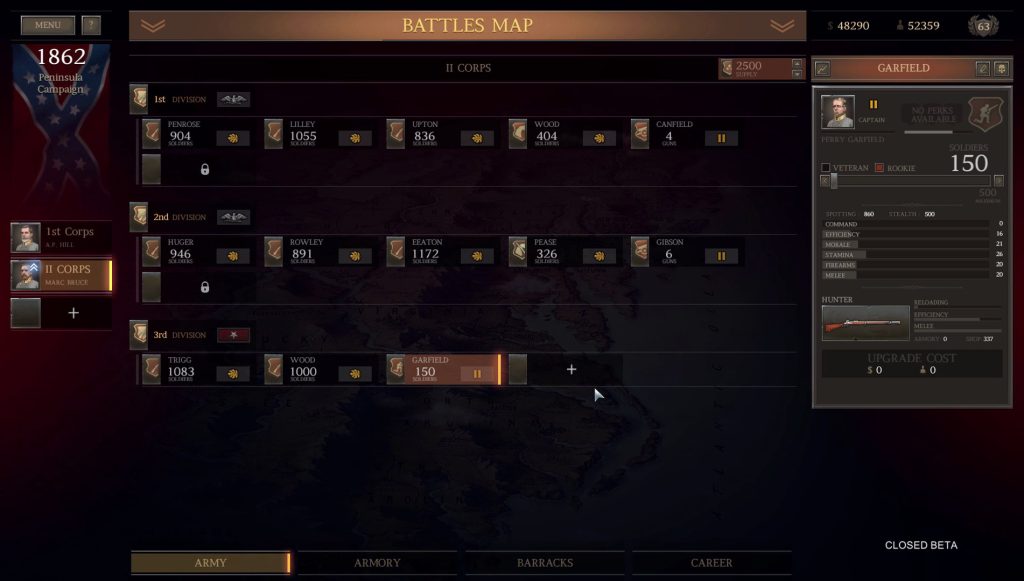
The lasting army is the reason to choose it. You arrange corps, divisions and brigades, keep experienced troops alive, equip them with available weapons and work within the reinforcements you receive. A victory that destroys several valuable formations can make the next battle much harder. You are choosing an army to carry forward, rather than rebuilding an unrelated force for every map.
Its command system allows individual unit orders or broader goals assigned through commanders. The official description includes drawing a defensive line and directing a flanking maneuver with an arrow. This gives you a way to work at a wider level when the battle grows, while still handling a threatened formation yourself.
Terrain and provisions belong to that decision. Hills improve observation, forests can conceal movement, and rivers or bridges shape defensive positions. Skirmishers can scout ahead and cavalry can dismount or raid supplies. Preview an ordinary engagement with those interactions, not only a dramatic charge, because protecting artillery and provisions is part of the command work.
Where it stops: the campaign’s army-management layer is not the same as running the national economy, elections and railroad system. Choose it for a sequence of tactical encounters with persistent consequences. If those wider national decisions are your main interest, look at the next game.

Grand Tactician for the national war effort
Grand Tactician: The Civil War (1861–1865) combines a real-time strategic campaign with tactical battles. Its official features describe mustering and supporting armies, managing supply flows, expanding railroads, conducting blockades and watching the morale of citizens and troops.
This is the pick when you want the battle to emerge from a larger mobilization problem. An army needs more than a talented commander and a favorable hill: it needs to reach the front with support. Railroads can move and supply forces, while naval operations and blockade runners connect the war to trade and access overseas.
Political and public pressure also matter. The description presents an extended war in which enthusiasm turns to fatigue, money runs short and drafting can create unrest. Alternative outcomes include European intervention and the 1864 election. These are reasons to consider it if you want the national situation to complicate military planning.
On the battlefield, the advertised tools include engineers building pontoons and trenches, multi-day engagements, reserves and changing reinforcement arrivals. The game lists five campaign starts and twenty standalone historical battles. A standalone battle lets you inspect its troop interface, but a campaign turn is equally necessary to understand the purchase.
The cost of that scope: you are taking on both army control and national administration. More systems create more information to interpret. Watch someone trace an army’s supply route and explain a campaign decision before buying solely on the sight of a large battle.

Civil War II for simultaneous operational planning
Civil War II uses the AGE engine’s WEGO system. You issue orders in advance, then both sides act together. The official description gives each turn a two-week span, resolved in fourteen daily phases, with battles occurring during that sequence.
The attraction is anticipating where the opponent will be when your orders execute. Forces that seem close together when you plan can arrive at different times. Organizing an offensive therefore requires attention to movement, leaders and logistics, rather than simply concentrating counters near a target before pressing attack.
Its regional map covers more than 3,000 regions and includes navigable rivers, supply, weather, attrition and fog of war. You organize brigades, divisions, corps and armies, appoint commanders and make military production and political choices. Regional Decision Cards and historical events add another layer to the campaign.
This is a useful alternative when you want to study the plan without issuing rapid battlefield commands. The game includes two tutorials and smaller scenarios such as Shiloh and the New Mexico campaign, as well as full-war starts. Use the tutorials to inspect how orders, timing and reports fit together before committing to the grand campaign.
The tradeoff: tactical resolution is not a brigade battle that you command in the same way as Ultimate General. Its strongest fit is the player who enjoys interpreting operational results and revising the next set of orders. Do not choose it expecting a continuous 3D battlefield to be the center of the experience.
Pick the decision you want to make repeatedly
| Your recurring question | Start here |
|---|---|
| How do I position brigades and retain veterans for the next battle? | Ultimate General: Civil War |
| How do I mobilize, supply and sustain a national war effort? | Grand Tactician: The Civil War |
| How do I synchronize armies when enemy orders resolve alongside mine? | Civil War II |
For a first purchase, preview one ordinary session in the game you selected: a full brigade encounter, a national campaign turn, or a WEGO order-and-report cycle. Check the current system requirements and edition separately. No measured performance result, present multiplayer population or personal playthrough is claimed here.
If you want an earlier nineteenth-century setting with a similar battlefield-versus-campaign choice, the Napoleonic strategy selection offers that comparison. Stay with this shortlist when the American Civil War’s forces, geography and operational problems are the reason you are looking.
Sources and further reading
Keep exploring

Hearts of Iron 4 occupation laws: control resistance without draining reserves
Match occupation policy to resistance, compliance and a garrison you can actually supply; use stronger control only when the situation justifies its cost.

wargame red dragon radar anti air management: coverage and weapon-state decisions
A source-backed guide to managing specific radar-related weapons within a complete Wargame Red Dragon air defense.
wargame red dragon sead aircraft: choose a mission that helps
A concise source-backed guide to choosing and reassessing a useful SEAD mission in Wargame Red Dragon.