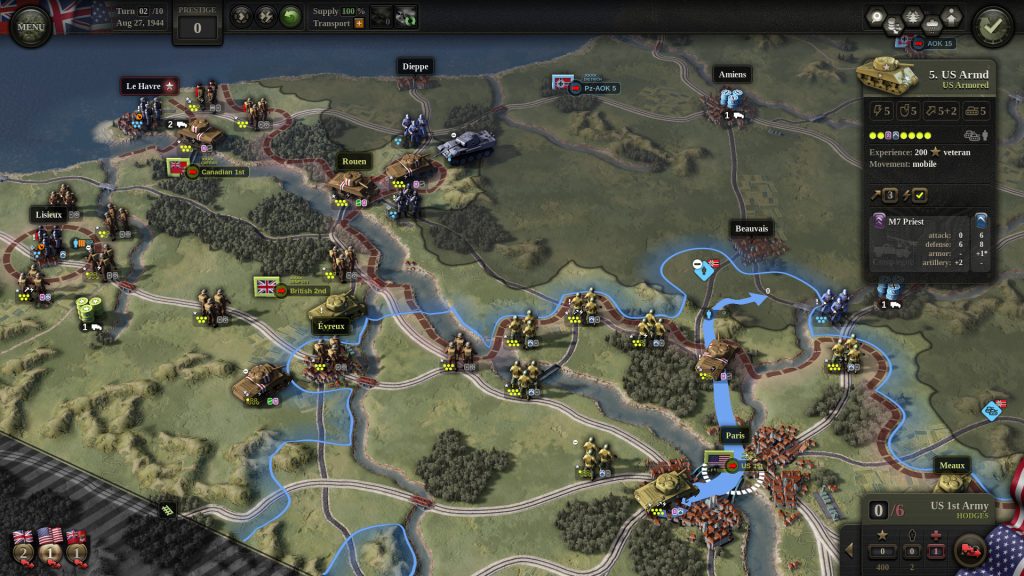
The best single player war strategy games make decisions between battles matter. Choose Unity of Command II if you enjoy supply routes and operational movement, Ultimate General: Civil War if you want to manage an army through a historical campaign, or Graviteam Tactics: Mius-Front if formation deployment and a detailed battlefield simulation are the attraction. Each gives you a different kind of responsibility beyond winning one isolated fight.
This shortlist focuses on the campaign command job, rather than treating a multiplayer game with an AI skirmish as automatically the best solo choice. The recommendations use official campaign and gameplay descriptions. They do not claim a personal comparison of campaign balance, AI quality or total completion time.

On this page
Best Single Player War Strategy Games: Unity of Command II: keep the advance supplied
Unity of Command II puts you in charge of Western Allied divisions during WWII. Its campaign branches, while headquarters support reorganization, bridging and resupply. Fog of war, reconnaissance and enemy stragglers shape the information available before a move.
The solo attraction is that attacking and sustaining an attack are separate problems. Moving deeper behind an enemy line is useful only if your own force remains able to operate. You can also attack the opponent’s logistics and create encirclements. This is the game to choose when tracing routes on the map is as satisfying as taking a city.
Headquarters provide another layer of decisions rather than functioning as background decoration. Their abilities support the force’s condition and movement. Theater assets add reconnaissance, bombing and air supply. The result is a campaign in which a useful plan combines movement, information and support instead of relying on one favored unit type.
The drawback is that this operational focus can frustrate someone who mainly wants to watch tactical firefights. You control divisions on the map, not the aim of an individual tank. Begin with the base Allied campaign and learn the supply logic before treating an expansion campaign as the solution to an unfamiliar system.

Ultimate General Civil War: preserve the army you built
Ultimate General: Civil War combines real-time historical battles with army management. The official description lists a campaign of more than 50 battles and says its course depends on player actions and battle results. Historical battles can also be played separately.
Its campaign appeal is the force between engagements. You control army composition, and surviving soldiers gain experience. Officers develop too, but can be wounded or killed. Heavy losses can leave fewer reinforcements and damage reputation and morale. A battlefield victory therefore does not automatically mean the army is ready for the next task.
Choose it when you want to decide which formations and weapons to develop, then see those decisions on the battlefield. Its command system lets you direct units individually or issue broader goals. Supply protection, terrain and the condition of brigades all belong to the same command problem.
The drawback is the commitment to one historical war and a managed army campaign. If you want modern equipment or a random empire map, this is the wrong setting. The official promotional screenshot used here also carries a beta-era label; it illustrates the game’s terrain and unit presentation, not a claim about the latest interface build.

Mius-Front: deployment carries into a simulated battle
Graviteam Tactics: Mius-Front links a turn-based operational phase to real-time tactical combat. In the operational phase you concentrate forces, resupply, replace units, repair vehicles and refuel. Tactical engagements then ask you to control formations and fight over the terrain.
This is the choice for someone interested in preparing a battalion-level battle and observing the consequences. The official description models soldier experience, stamina and morale, along with visibility, weather and component damage to vehicles. Battlefield remnants persist until the operation ends, giving successive engagements a shared physical context.
Rather than choosing it for constant manual interventions, choose it for deployment, movement modes and fire sectors. Its simulation considers more than whether two units are in range. After a battle, condition and damage reports help you understand what the next operational decision must account for.
Its main cost is learning. A detailed command system and formation simulation take more patience than a simple build-and-attack loop. Start with the included interactive tutorial and a single operation. The store’s four large-scale operations are a starting campaign set, not a reason to buy additional scenarios before you know whether this command style suits you.
Choose the decision you want to revisit tomorrow
Pick Unity of Command II to continue an operational plan, Ultimate General: Civil War to develop a persistent army, or Mius-Front to prepare and assess formation battles. That preference matters more than the generic single-player label. All three offer a solo command task whose appeal does not depend on an assumed live multiplayer population.
If you need to play without internet access, use the separate offline preparation guide. A campaign recommendation and an offline-launch guarantee are different questions, so confirm the intended installation before relying on it while disconnected.
Sources and scope
Official developer/publisher storefront descriptions support the campaigns and mechanics. No measured campaign length, comparative AI benchmark, personal playtest or universal offline guarantee is claimed.
Sources and further reading
Keep exploring

Hearts of Iron 4 occupation laws: control resistance without draining reserves
Match occupation policy to resistance, compliance and a garrison you can actually supply; use stronger control only when the situation justifies its cost.

wargame red dragon radar anti air management: coverage and weapon-state decisions
A source-backed guide to managing specific radar-related weapons within a complete Wargame Red Dragon air defense.
wargame red dragon sead aircraft: choose a mission that helps
A concise source-backed guide to choosing and reassessing a useful SEAD mission in Wargame Red Dragon.