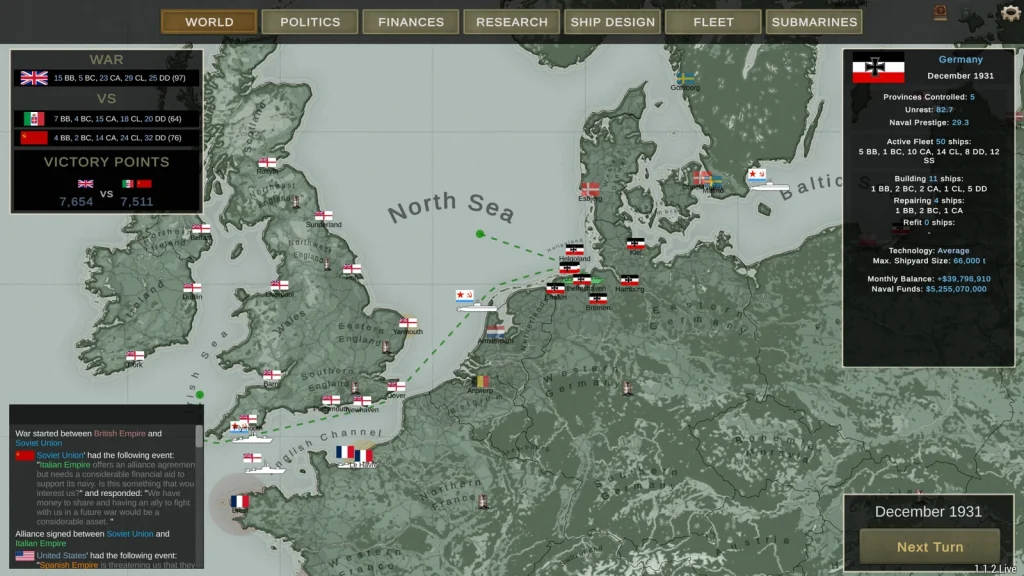
The best war strategy games with naval combat depend on whether you want to design the fleet or run its operations. Ultimate Admiral: Dreadnoughts centers ship construction and fleet development, while War on the Sea focuses on the South Pacific campaign, transports, aircraft and naval engagements. Choose the naval responsibility you want before comparing battle screenshots.
On this page
Ultimate Admiral: Dreadnoughts starts with the ship you build
Ultimate Admiral: Dreadnoughts emphasizes designing warships through hulls, turrets, armor, funnels and other components. The official description connects those choices to speed, maneuverability and weapon effectiveness.

It is the strongest fit here if you want fleet composition to begin in the design screen. A ship is a set of competing decisions about protection, armament and other capabilities, rather than simply a fixed unit selected from a production list.
The naval campaign then gives those designs a broader role. The store describes a global map, fleet movement, task forces, technological development and the possibility of refitting older ships. You need a fleet that can support the campaign you intend to fight.
Choose it when the interesting question is what kind of ship the next operation needs. A powerful design still has to fit the fleet and the strategic situation; putting every desirable component on one hull is not the same as building a useful navy.
The limitation is scope. Its official description presents limited diplomacy and a naval command role, rather than full control over every aspect of the government or land war. Buy for ship design and naval campaigning, not for a comprehensive national grand-strategy replacement.

War on the Sea starts with the operation you must support
War on the Sea sets its campaign around the Solomon Islands struggle in 1942. Its official description asks how you will protect transports carrying troops and supplies, provide carrier air cover and use submarines or surface forces.
This is the clearer choice when you want naval warfare to serve a campaign’s transport and supply problem. The fleet’s purpose is not only to win an attractive surface duel; it must help the required force and cargo reach the place they matter.
Real-time naval battles include aircraft control and ship damage-management tasks such as firefighting, counter-flooding and repairs. That makes the engagement and the condition of surviving ships part of the next operational decision.
The store explicitly describes aircraft control as tactical rather than a flight simulator. Choose it for coordinating ships and aviation inside the naval campaign, not for personally flying every strike or manually aiming every weapon.
The drawback is the interconnected workload. Fleet movement, air cover, transport protection and battle damage can all require attention. A successful engagement can still be a poor campaign result if the important transports are exposed or the fleet cannot support the next task.
Compare one design cycle with one campaign operation
For Dreadnoughts, inspect a current ship-design walkthrough and how that ship joins a task force. For War on the Sea, inspect a transport operation from planning through an engagement. Those sequences reveal more than a close-up of a battleship firing.
Decide whether the work you want is balancing a hull’s capabilities or coordinating forces to secure a route. Both games connect tactical combat with a wider campaign, but they put different decisions at the center.
This assessment uses the official systems and actual game screenshots. It does not rate physical simulation accuracy, quote changing prices or claim tested performance. Check the current release notes and included content on the linked product pages before purchase.
Our strategy game lists compare naval warfare with other command scales when you want diplomacy, a national economy or a turn-based operation to matter as much as the ships.
Sources and further reading
Keep exploring

Hearts of Iron 4 occupation laws: control resistance without draining reserves
Match occupation policy to resistance, compliance and a garrison you can actually supply; use stronger control only when the situation justifies its cost.
wargame red dragon radar anti air management: coverage and weapon-state decisions
A source-backed guide to managing specific radar-related weapons within a complete Wargame Red Dragon air defense.
wargame red dragon sead aircraft: choose a mission that helps
A concise source-backed guide to choosing and reassessing a useful SEAD mission in Wargame Red Dragon.