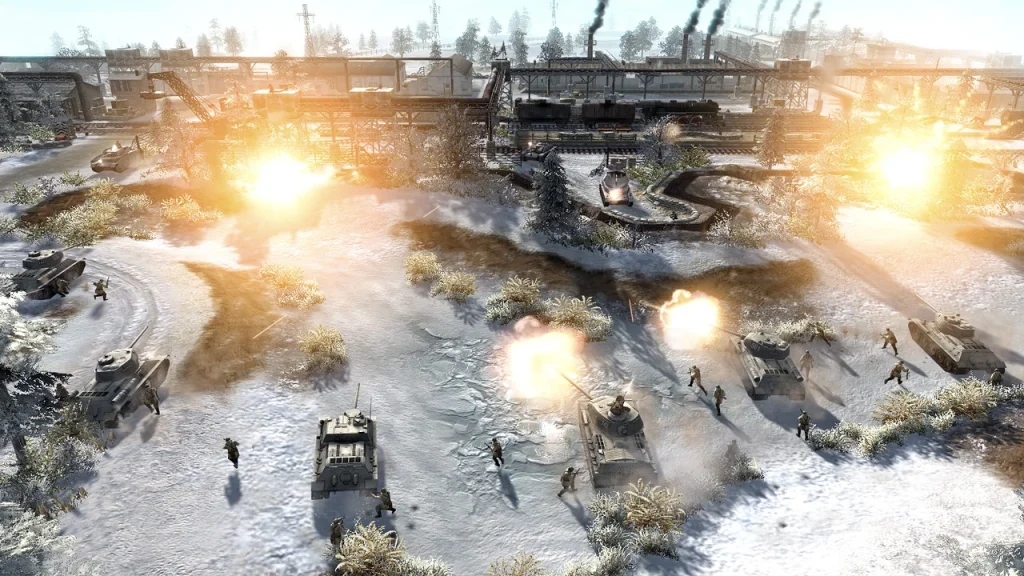
The best realistic WW2 strategy games model different parts of a battle. Choose Men of War: Assault Squad 2 for detailed soldier and vehicle handling, Steel Division 2 for division-based combined arms, or Command Ops 2 for operational command and delayed orders. Decide which decisions should feel plausible before comparing the games’ graphics.
On this page
Best Realistic Ww2 Strategy Games: Three meanings of realism
Tactical detail concerns individual weapons, vehicles and positions. Historical organization concerns which formations and equipment fight together. Command realism concerns information, timing and what a commander can reasonably control. A game can emphasize one while simplifying another.

This shortlist uses the official descriptions of those systems. It has not measured simulation accuracy or tested the games as training tools. The useful comparison is the work each game asks you to do.

Men of War: Assault Squad 2 puts you close to the unit
Men of War: Assault Squad 2 lists individual soldier loadouts, a broad vehicle roster and Direct Control of a soldier or vehicle. It is the strongest fit here if you want to intervene in a particular engagement rather than issue only formation-level orders.
Its missions range from tank assaults to more focused infiltrations, with multiple theaters and factions. That supports a style of play in which the local route, position and condition of a unit matter to the result.
The drawback is the attention required. Direct Control and detailed handling can make the player responsible for a great deal of moment-to-moment work. If your idea of realism is delegating to subordinate commanders, that hands-on focus may be the wrong fit.
Choose it when the most interesting question is what a particular squad or vehicle should do next. Inspect a current mission walkthrough to see whether the interface and pace suit you, rather than choosing only from a cinematic explosion screenshot.

Steel Division 2 makes the formation important
Steel Division 2 centers its base setting on the Eastern Front in 1944 and Operation Bagration. Its battlegroups draw from divisions, and the official description combines real-time tactical battles with turn-based strategic campaigns.
Choose it when you want to compare the capabilities available to a military formation and then coordinate armor, infantry, artillery and support on a larger battlefield. The armory provides a place to inspect units before building a battlegroup.
Army General adds a different layer: battalion movement, supply and decisions about which forces join an engagement. The store explicitly allows campaign battles to be fought tactically or resolved automatically, so you can adjust how much battlefield control you want.
The limitation is abstraction. A historically organized roster and recognizable equipment do not mean every campaign result reproduces history. Availability, game balance and the tactical interface still shape the contest. Choose it for formation-based combined arms rather than individual inventory management.
Command Ops 2 models command as a process
Command Ops 2 emphasizes continuous time and space, command hierarchy and order delays. Its subordinate AI can handle lower-level work while you assess, plan, order and react at corps, division or brigade level.
This is the clearest choice if realism means that a plan takes time to reach and organize its units. Routes, timing, supply priorities and coordination matter, while direct control of every soldier is outside the game’s main emphasis.
The drawback is presentation and learning. Its operational map and information panels demand careful reading, and a plan can fail for reasons less visually obvious than a tank exploding. You need to enjoy analyzing the operation as well as watching it unfold.
Begin with its included tutorial scenario and a small command problem before a large operation. The official page describes the core scenarios separately from additional content; confirm what the current purchase includes.
Choose the level of responsibility you want most often: a unit’s next action, a division’s combined-arms engagement or an operation’s sequence of orders. Our strategy game lists compare other command scales when WW2 history is fixed but the kind of game remains undecided.
Sources and further reading
Keep exploring

Hearts of Iron 4 occupation laws: control resistance without draining reserves
Match occupation policy to resistance, compliance and a garrison you can actually supply; use stronger control only when the situation justifies its cost.

wargame red dragon radar anti air management: coverage and weapon-state decisions
A source-backed guide to managing specific radar-related weapons within a complete Wargame Red Dragon air defense.
wargame red dragon sead aircraft: choose a mission that helps
A concise source-backed guide to choosing and reassessing a useful SEAD mission in Wargame Red Dragon.