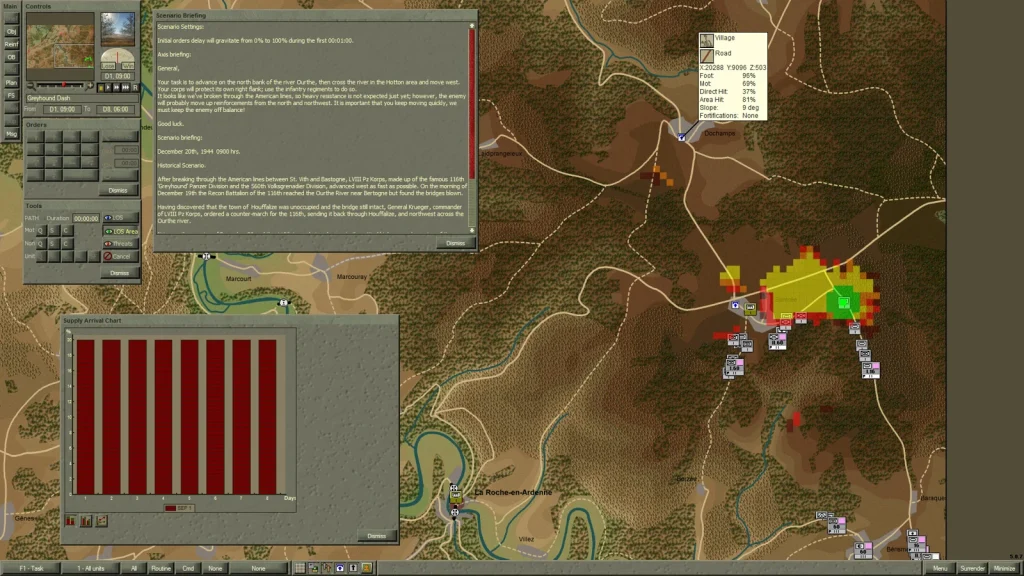
The best operational level war games make the movement and support of formations more important than an individual soldier’s action. Command Ops 2 is the pick for continuous-time plans and subordinate AI, The Operational Art of War IV for a broad scenario library and detailed turn resolution, and Unity of Command II for focused division-level supply problems.
On this page
Best Operational Level War Games: What you command changes the recommendation
| Game | Main attraction | Tradeoff |
|---|---|---|
| Command Ops 2 | Timed orders and delegated execution | Dense operational interface |
| The Operational Art of War IV | Many settings and detailed scenario systems | Scenario scale and rules require study |
| Unity of Command II | Headquarters, supply and clear campaign objectives | A more focused WW2 design |
The shortlist is based on official product descriptions, not an invented playtest. Choose a small scenario in the command model you prefer before judging the size of the full content library.


Command Ops 2: let a plan take time
Command Ops 2 is built around corps, division and brigade command. Its continuous-time simulation models order delay and command structure, and subordinate AI can execute lower-level work.
That makes it useful when the interesting problem is coordinating formations to arrive, attack or rest at the right time. The official description lists route-finding options, order timing controls, supply priorities and a plan dialog for reviewing orders.
You can intervene where needed and delegate elsewhere. The decision is how much control serves the plan, rather than whether you can click every unit quickly enough. Pausing also gives you time to read and revise the operation.
The downside is that the map does not explain itself through cinematic battle scenes. Start with a tutorial and inspect why an order is late or a formation is moving along a particular route. Enjoying that diagnosis is central to enjoying the game.

The Operational Art of War IV: choose the scenario carefully
The Operational Art of War IV offers scenarios from the early twentieth century through modern and hypothetical conflicts. Its product description highlights supply, combat resolution and the scenario editor.
One notable supply distinction is the Overextended state between supplied and unsupplied. Combat rounds and battlefield timing add further constraints to a turn. These are reasons to study the operation’s sequence rather than treat the map as a collection of attacks you can make in any order.
The broad engine is its attraction: choose a period, theater and force scale that suits you. It also means two scenarios can ask for very different amounts of reading and unit handling. More scenarios do not automatically mean a better first lesson.
The drawback is that flexibility carries complexity. Read the scenario briefing, scale and special rules before committing to a long campaign. A small, clearly defined operation is a better introduction than the largest scenario simply because it is famous.
Unity of Command II: protect the operation’s supply
Unity of Command II puts divisions, headquarters and logistics into a WW2 campaign. Headquarters support reinforcement, bridging and special abilities, while fog of war creates a need to discover enemy positions.
Its most direct operational question is whether you can achieve the objective while maintaining supply. Deep advances can threaten an enemy route, but your own formations need a working connection as well. That gives a clear reason to plan encirclement and support together.
The limitation is scope. The base campaign’s Western Allied emphasis and the game’s focused mechanics are a narrower proposition than a general engine spanning many conflicts. Check separately which optional campaigns cover the period you want.
Pick Command Ops 2 for delegated real-time execution, The Operational Art of War IV for scenario breadth, or Unity of Command II for a concentrated supply-and-headquarters challenge. Browse our strategy game lists if you want a tactical or national-scale alternative before settling on operational command.
Sources and further reading
Keep exploring

Hearts of Iron 4 occupation laws: control resistance without draining reserves
Match occupation policy to resistance, compliance and a garrison you can actually supply; use stronger control only when the situation justifies its cost.

wargame red dragon radar anti air management: coverage and weapon-state decisions
A source-backed guide to managing specific radar-related weapons within a complete Wargame Red Dragon air defense.
wargame red dragon sead aircraft: choose a mission that helps
A concise source-backed guide to choosing and reassessing a useful SEAD mission in Wargame Red Dragon.