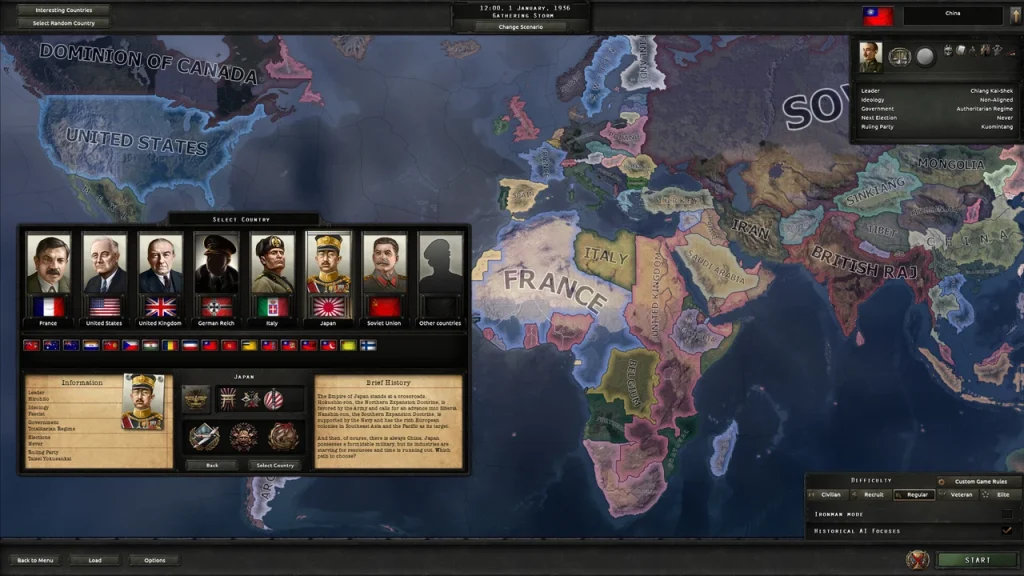
TL;DR: This Hearts of Iron 4 beginner guide connects the army to the industry supporting it. Begin with a manageable front, equip existing formations, research for a clear purpose and inspect supply before attacking. Use offensive plans to organize the army while supervising its actual movement.
Quick answer: A useful first campaign needs a production plan and a limited military objective. More divisions do not fix missing equipment or inadequate supply. Diagnose the specific constraint before expanding the army or continuing a stalled offensive.

The nine-step learning plan below is for a new player working through national management and land operations. Expansions can change national and design options. This is official-source editorial advice, without hands-on campaign results, a universal template or a claim about the strongest current patch strategy.
On this page
Hearts of Iron 4 beginner guide: choose a learning goal
A first campaign should teach a limited problem. You might learn to support a land front, coordinate aircraft with an army or understand industrial expansion. Choosing a country because it is small does not automatically make it easy: a small industry can leave little room to recover from mistakes.
Prefer a setup where the next objective is understandable and you can keep track of the main front. Pause at the start and examine the nation’s factories, resources, research, political situation and available forces. You do not need to change every setting before unpausing.
Connect research to production
The official description highlights research, factory instructions and division templates as connected parts of national planning. Researching equipment only creates a production option; it does not instantly equip an army. Likewise, adding a new type of battalion creates equipment needs that your factories must meet.
- Identify the equipment your current divisions need.
- Check existing stockpiles and shortages.
- Assign production to the important shortage rather than spreading every factory across unrelated projects.
- When research unlocks an improvement, inspect the production change before replacing all existing lines.
Keep resource requirements visible. A production plan can be limited by materials as well as factory capacity. Use the trade interface to understand what a proposed import costs and whether it supports something you urgently need.

Keep early division designs understandable
Inspect a division template before editing it. Look at the equipment it requires, its intended role and the statistics the interface exposes. Adding battalions can make a division more demanding to equip and supply, so a bigger template is not automatically a better beginner choice.
Use a straightforward infantry formation to learn front management before building a complicated force that requires several equipment lines. Add specialized formations when you can explain their job and maintain their requirements. For example, a formation intended to attack should be assessed differently from one holding a quiet section of the front.
Read supply before drawing an offensive
Before ordering the army forward, inspect the supply situation and the route into the target region. Rail connections, hubs, available transport and local conditions can limit what the front can sustain. A successful initial advance may carry your army away from the infrastructure supporting it.
Watch unit condition while the offensive runs. If organization and equipment are deteriorating, stop treating the arrow as a command that must remain active until its final destination. A pause to recover and restore logistics can be more useful than another attack with exhausted formations.
Use fronts without surrendering attention
Front lines and offensive plans help organize many divisions, but they still need supervision. Check where the units actually move, whether one section has become thin and whether the plan sends formations into a difficult approach.
Avoid learning every land, naval and air system simultaneously. Add air support to the relevant region once you understand which aircraft you have and where they can operate. Naval invasions need their own preparation; they are not a replacement for understanding the land front.
Supply and equipment are separate questions. A division can be organized around the intended template but lack the equipment it asks for. It can also have equipment while operating in a position that cannot support it well. Inspect both before deciding that the design itself must be replaced.
Use the production screen to connect a shortage to the relevant line. If demand keeps growing, look for a recent template change, new deployment or continuing combat loss. Changing factories without identifying the source of demand can conceal the problem until the next expansion of the army.
Industrial improvements also need a time horizon. A project that supports a later war is useful for that plan; it does not automatically fix an immediate shortage. Separate the urgent task of equipping the current front from the longer task of improving national capacity.
Paradox’s official Hearts of Iron IV description identifies division templates, research, factory instructions, political objectives and alliances as linked systems. The source supports the game’s planning structure. It does not verify an optimum template, a current combat width or a successful campaign result.
Use the Hearts of Iron IV game hub for further mechanics once the basic loop is understandable. The grand strategy category is a separate route for readers deciding which game to learn next.

Treat political choices as part of the plan
National focuses, laws and diplomatic relationships shape what your country can do. Read the result of the next choice instead of selecting it only because it appears along a visually attractive branch. The official description specifically presents alliances and political objectives as part of waging the war.
Review the campaign when a shortage appears. Ask whether the cause was production, an oversized template, logistics or a decision that committed the country too early. That diagnosis is more useful than restarting with the same habits.

How do you build a first plan without managing every system at once?
Choose one main military task and connect the rest of the country to it. A land-focused learning campaign needs a clear front, equipped divisions and a production plan that can sustain losses. It does not require you to optimize every ship class and aircraft design before understanding the infantry already on the map.
- Pause and identify the country, start conditions and immediate threats.
- Inspect the current divisions and their equipment needs.
- Check stockpiles before expanding those formations.
- Choose research that supports the near-term army and economy.
- Assign factories toward important shortages.
- Read material requirements and the cost of imports.
- Organize a manageable front and inspect supply.
- Choose a limited offensive objective.
- Review losses, equipment and logistics before extending the advance.
This nine-step plan keeps research, production and operations connected. It is not a promise that a named country or a particular focus path is the easiest in every expansion setup. The campaign’s objectives and interface requirements still determine your choices.
For a decision exercise, assume that your existing infantry needs more equipment and your available industry is limited. You can expand the template, begin several unrelated production lines or repair the shortage before creating additional demand. Enlarging every division first can make the problem worse: the army asks for more equipment while the factories already cannot satisfy its existing needs.
Repairing the immediate shortage provides a clearer starting point. Once the stockpile and production trend support it, consider a specialized formation for a defined role. Evaluate what it requires and whether the country can maintain it. The decision should include replacements during fighting, not just the cost of creating the formation once.
Keep training and deployment connected to those conditions. More units can help when they are equipped and can operate on the intended front. A deployment that merely increases the number of under-equipped units adds another object to manage without fixing the original industrial limitation.
Make political choices part of the same plan. If a national focus is intended to improve industry, read what it supplies and when it changes the situation. If a diplomatic or military choice accelerates conflict, ask whether the factory plan can support the resulting commitment. The focus tree is a sequence of consequences, not a decorative route to click through.
What should you inspect when an offensive loses momentum?
Check equipment, organization, supply, terrain and the actual movement of the front. A stalled offensive is not automatically a request for a larger attack order. Continuing to attack while several requirements have deteriorated can deepen the shortage and make the next attempt harder.
| Visible problem | Question to investigate | Response to consider |
|---|---|---|
| Divisions are short of equipment | Does production cover the army’s requirements and losses? | Repair the shortage or reduce new equipment demand. |
| Units recover poorly near the front | Is supply reaching the area in sufficient condition? | Inspect infrastructure, transport and the concentration of units. |
| One part of the line becomes exposed | Did advancing units leave the intended front arrangement? | Reorganize the line and protect the threatened section. |
| Attacks repeatedly fail on one route | Are terrain, support and unit roles suitable? | Choose a different approach or prepare before attacking again. |
| A successful advance suddenly stops | Has the front moved away from its previous support? | Recover and restore the logistics behind the new position. |
Consider a second exercise: the army has advanced beyond its original line and now occupies an area that is harder to supply. The offensive plan still points farther forward, but unit condition is falling. You can leave the order running, add more divisions to the same area or pause the offensive and examine the supporting route.
More divisions do not solve every logistics problem. Concentrating additional units can increase demand on a route that is already insufficient. First establish whether the limitation is equipment, local supply, the connection to the area or the units’ current condition. The correction should address that specific constraint.
Inspect the supply information in your game rather than borrowing an exact transport or hub instruction from a different expansion setup. Read the effect and cost of the available action. The guide deliberately does not assign a universal logistics button sequence to every version.
Check the offensive objective as well. A limited objective can be secured and consolidated before the next advance. An arrow extending across a broad region may hide several different terrain and supply problems. Shortening the task makes it easier to recognize which problem is preventing progress.
Once the line is stable, evaluate air support for the relevant area and whether the assigned aircraft can actually operate there. Do not assume that aircraft on a national roster are helping the battle simply because they exist. Their placement, mission and coverage belong to the operational plan.
Use the pause after a difficult offensive as a learning checkpoint. Record the shortage or movement that first changed the situation. Then ask what earlier check would have revealed it. This produces a specific next habit, such as examining supply before crossing into a new region, rather than an unsupported claim that one template solves the entire game.
Frequently asked questions
Does researching equipment automatically replace old equipment?
No. Research and industrial production are separate steps. Inspect the production lines and stockpiles that support the new equipment.
Is the largest division template always best?
No. A template has to fit its role, equipment supply and battlefield conditions. An unsupported formation can be less useful than a simpler one you can sustain.
Should a beginner use offensive plans?
Yes, as an organizing tool. Watch the actual movements and supply situation instead of assuming the plan understands every change on the front.
Why does a template edit create an equipment shortage?
The edited formation can ask for equipment the earlier design did not require, or require more of an existing type. Inspect the new requirements and the stockpile before applying the change across a large army.
Does adding divisions always fix a stalled front?
No. It adds equipment and supply demand as well as potential strength. Diagnose the existing problem before reinforcing a region that may already be difficult to sustain.
Your next practice task: Choose a limited front and follow the nine-step planning loop. Before the offensive, identify the equipment line supporting the divisions and the supply route behind them. After the first significant advance, inspect both again. If the operation stalls, name the constraint you found before editing templates or adding more units.
A campaign remains a learning exercise even when an operation fails. A useful result is being able to explain whether the failure began in production, logistics, the front arrangement or the decision to attack. That explanation gives the next attempt a change you can actually evaluate.
Sources and further reading
Keep exploring

Hearts of Iron 4 occupation laws: control resistance without draining reserves
Match occupation policy to resistance, compliance and a garrison you can actually supply; use stronger control only when the situation justifies its cost.
Games Like Hearts of Iron 4: choose what you want to command
Choose Stellaris for another empire project, CK3 for personal politics and heirs, or Ultimate General Civil War for tactical army progression.
Stellaris vs Hearts of Iron 4: discovery or industrial war planning?
Choose Stellaris for discovering a galaxy and shaping a space society; choose Hearts of Iron IV for coordinating industry, army design and politics around a WWII nation.