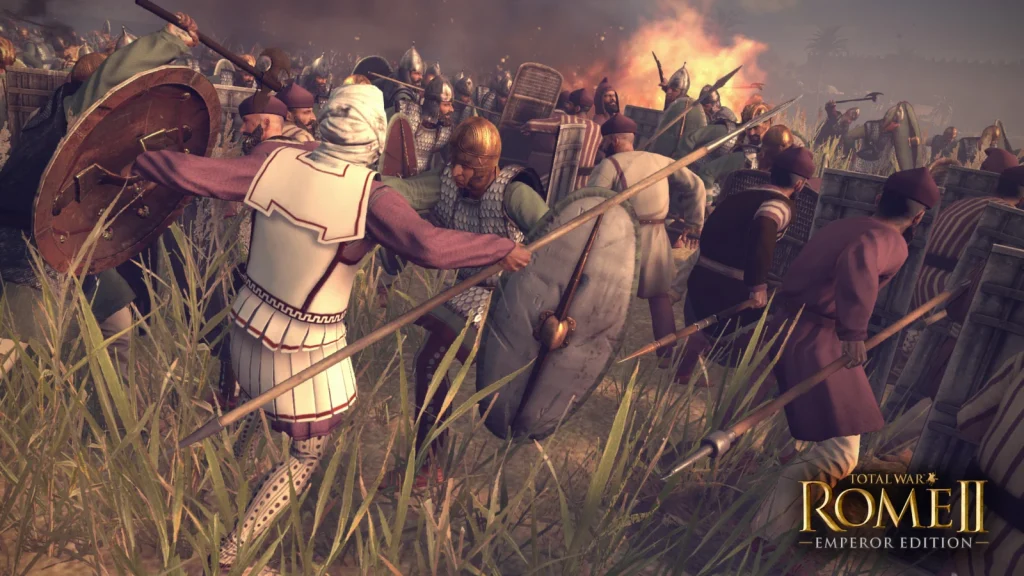
The best war strategy games with historical campaigns depend on whether you want to run a state, preserve an army or direct an operation. Total War: Rome II connects an ancient campaign to tactical battles, Panzer Corps 2 carries veteran units through a branching WW2 campaign, and Steel Division 2 joins Operation Bagration to formation-based combat.
On this page
Historical setting does not fix the outcome
A campaign can use historical leaders, formations or starting conditions while letting the player change what happens next. This shortlist compares the official campaign descriptions rather than claiming that a completed playthrough reproduces history.

Check the campaign included in the current edition. A memorable trailer for an expansion is not evidence that its campaign comes with the base purchase. The screenshots illustrate each game, not a tested campaign completion.

Total War: Rome II spans politics and the battlefield
Total War: Rome II combines a large turn-based campaign with real-time land and sea battles. Its official description includes political relationships, economic decisions and a range of playable ancient civilizations.
Choose it when you want conquest to sit inside a wider state campaign. Recruiting a force and choosing an opponent are part of a sequence that also involves territory, loyalty and the economy supporting the army.
The Emperor Edition listing includes the Imperator Augustus campaign, set in 42 BC after Caesar’s death. Its named factions and divided Roman leadership provide a different starting political problem from treating ancient history as a single generic map.
The tradeoff is the two layers of work. Running the campaign and fighting its battles demand different kinds of attention. Inspect both before choosing Rome II mainly for a period you enjoy, and verify optional campaign packs separately.

Panzer Corps 2 makes the surviving army matter
Panzer Corps 2 offers a branching Wehrmacht campaign across WW2, carrying veteran units between battles. That makes the roster you preserve part of the campaign’s identity.
Choose it when you want a continuing force rather than a fresh collection of units for every mission. The immediate objective still matters, but the losses and experience that follow it affect the next engagement.
The official description lists movement, combat, spotting, weather, encirclement and captured equipment among the mechanics. Those systems provide decisions within a readable turn-based format, without requiring a real-time tactical response to every event.
The drawback is abstraction. This is a designed campaign of hex-based battles, not a comprehensive simulation of every command decision made in the war. Choose it for persistent units and tactical decisions, and inspect expansion descriptions if you want a different national campaign.
Steel Division 2 links the operation to its engagements
Steel Division 2 centers its base setting on Operation Bagration in 1944. Its Army General campaigns use battalion movement and supply on a strategic map, with battles that can be fought in real time or resolved automatically.
It fits the player who wants historical formations to shape the forces available for an engagement. Choosing which battalions can participate is part of the operation; commanding the resulting battlegroup is another layer.
The tactical game emphasizes divisions and combined arms, with an armory and deck-building system for inspecting the available units. That creates a practical link between a formation’s capabilities and the battle plan.
The limitation is commitment. Understanding the campaign map does not automatically teach the real-time battle, and the battle roster does not explain every operational constraint. Start with a manageable campaign objective and learn the two layers separately.
Choose the campaign’s recurring decision
Pick Rome II for statecraft plus ancient battles, Panzer Corps 2 for a persistent WW2 force, or Steel Division 2 for an operation built from military formations. Compare a current campaign walkthrough with the activity you want to repeat most often.
Check the edition, included campaigns and current requirements on the linked official pages before purchase. Our strategy game lists compare other periods and command scales when the historical setting is only the first part of your decision.
Sources and further reading
Keep exploring

Hearts of Iron 4 occupation laws: control resistance without draining reserves
Match occupation policy to resistance, compliance and a garrison you can actually supply; use stronger control only when the situation justifies its cost.
wargame red dragon radar anti air management: coverage and weapon-state decisions
A source-backed guide to managing specific radar-related weapons within a complete Wargame Red Dragon air defense.
wargame red dragon sead aircraft: choose a mission that helps
A concise source-backed guide to choosing and reassessing a useful SEAD mission in Wargame Red Dragon.