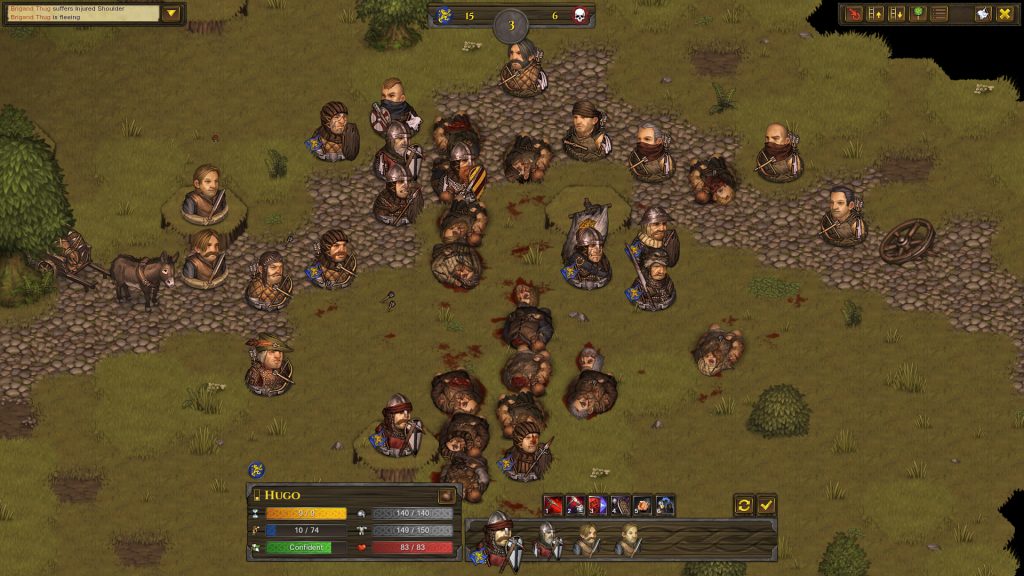
Battle Brothers and Urtuk: The Desolation are the best war strategy games with procedural campaigns on this focused shortlist. Pick Battle Brothers for managing a mercenary company across a generated world, or Urtuk for a survival campaign built around squad tactics and character upgrades. Both have official evidence for campaign generation, rather than only random layouts inside individual battles.
These are turn-based tactical RPGs in harsh fantasy settings. Their strategic appeal comes from preserving a fighting force across many encounters. If your idea of a war campaign requires historical armies, national production or commanding thousands of soldiers, this particular shortlist will not meet that expectation.

On this page
What needs to change between campaigns?
A random battlefield gives you a different local puzzle. A procedural campaign changes the wider journey: where you can travel, which opportunities appear and how you develop your force over time. The distinction matters when buying a game specifically to start several campaigns without repeating the same sequence of missions.
Generation also does not guarantee that every restart will feel better than the previous one. Look for meaningful decisions that carry forward. A wounded fighter, an expensive recruit or a missed opportunity should affect the next encounter enough to make adaptation worthwhile. The recommendations below use advertised systems; they are not based on a claimed playthrough or a measured replayability score.

Battle Brothers: the mercenary company is the campaign
Battle Brothers explicitly describes leading a mercenary company in a “procedurally generated world.” Its official description also identifies dynamically generated contracts from settlements and noble houses. You choose where to travel, which jobs to accept, who to hire and how to equip the band.
This is the stronger fit if you want the journey between battles to matter. Markets, recruits, contracts and faction relationships give you reasons to reconsider your route. The official description includes trade as another source of income, so your company need not pursue every dangerous fight simply because it appears nearby. The strategic question is whether an opportunity justifies its risk and ongoing costs.
Your roster adds another source of variation. Recruits have different backgrounds, attributes and traits, while development is not locked into a rigid class system. Wages and food still need attention when an injured brother rests. That connects a tactical mistake to a campaign decision: keep paying for recovery, field a reserve, or rebuild the company around the fighters available.
The tradeoff is a demanding survival economy alongside punishing combat. Permanent injuries can alter a promising recruit, and the world can face crises such as noble wars or an undead uprising. Choose it because you want to manage consequences across a sandbox campaign, rather than expecting a neatly paced historical storyline.
Urtuk: build a squad around the opportunities you find
Urtuk: The Desolation lists a “procedurally generated survival campaign” among its official features. You guide a band through an open world, recruit followers and take upgrades from defeated enemies. The story follows Urtuk’s search for a cure in a bleak low-fantasy setting.
Choose Urtuk if you want progression to feed directly into positioning and ability combinations. The official systems include pushing enemies onto spikes or over cliffs, shielding allies, counterattacking and providing ranged support during melee attacks. Terrain therefore gives you something to exploit beyond comparing damage totals.
Extracted skills and traits can change a unit’s combat role. The description gives examples including retaliation, avoiding a lethal strike and lifestealing counterattacks. That makes a useful selection test: would you enjoy adjusting your squad around upgrades earned during the campaign, or do you prefer a fixed army roster with predictable progression?
Its boundary is equally clear. This is a small-party survival RPG with a dark fantasy story, not an empire simulator. The advertised procedural campaign establishes the feature fit; it does not establish infinite story branches or prove that every generated route is equally balanced.
Choose the part of the campaign you want to manage
Start with Battle Brothers if contracts, wages, travel and recruitment are the reason you want repeated campaigns. Start with Urtuk if the main attraction is developing a squad whose abilities interact with battlefield hazards. In either case, expect the fighting force to be your central responsibility.
For a broader comparison before choosing this tactical RPG approach, browse our war strategy game guides. Keep your buying test specific: confirm what the game generates at campaign level, then decide whether the persistent decisions are ones you actually want to make again.
Sources and further reading
Keep exploring

Hearts of Iron 4 occupation laws: control resistance without draining reserves
Match occupation policy to resistance, compliance and a garrison you can actually supply; use stronger control only when the situation justifies its cost.

wargame red dragon radar anti air management: coverage and weapon-state decisions
A source-backed guide to managing specific radar-related weapons within a complete Wargame Red Dragon air defense.
wargame red dragon sead aircraft: choose a mission that helps
A concise source-backed guide to choosing and reassessing a useful SEAD mission in Wargame Red Dragon.