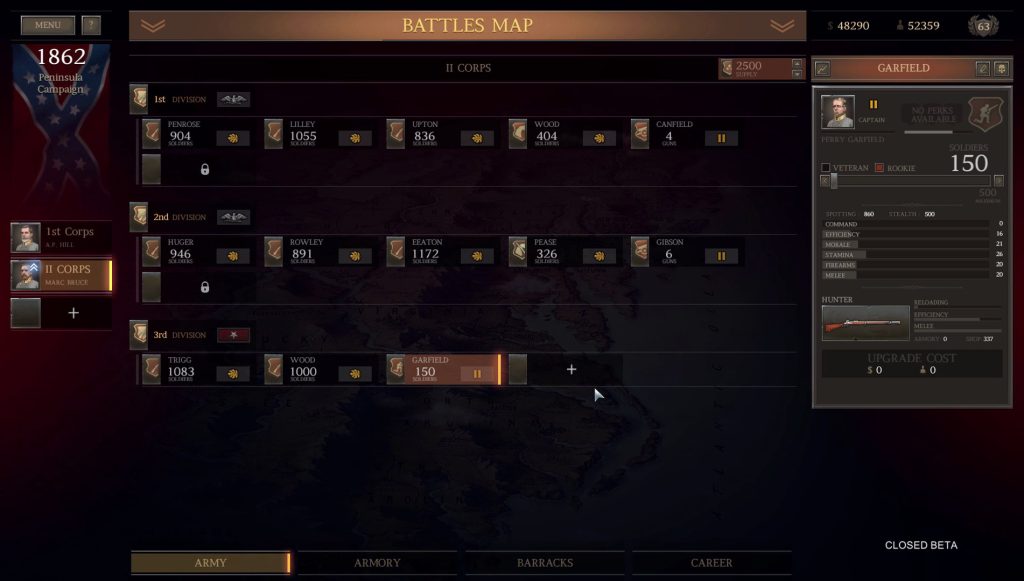
Ultimate General: Civil War and Unity of Command II are the best war strategy games without DLC on this two-game shortlist. Choose Ultimate General for real-time Civil War battles connected by army management. Choose Unity of Command II for a turn-based Allied campaign built around divisions, headquarters and supply. Both advertise substantial campaigns in the base game, so the recommendation starts with content you can buy and play without adding expansion packs.
Here, “without DLC” means the base game offers a worthwhile campaign on its own. It does not mean that every expansion is included, that all games lack a DLC catalog, or that a separate campaign you saw in a video comes with the standard purchase. The useful question is whether the included war and command style are the ones you want.

On this page
Ultimate General: Civil War gives you a campaign and an army to preserve
Ultimate General: Civil War lists a full American Civil War campaign with more than fifty battles, ranging from smaller engagements to major battles that can span several days. Its official base-game description also allows historical battles to be played separately. You can therefore choose between a connected military career and a particular battlefield without buying a separate campaign pack for those advertised modes.
The connected campaign is the stronger reason to choose it. Your army composition, surviving soldiers and reputation continue to matter between engagements. Units improve with experience, while heavy losses can leave you short of the reinforcements needed for later victories. A costly win has consequences beyond the immediate result, which gives army management a purpose throughout the campaign.
On the battlefield, you command formations in real time. The official description offers individual unit orders, defensive lines and drawn flanking movements. Terrain and provisions also matter: forests can conceal movement, hills improve observation, and losing access to supplies can undermine a battle. Pick this if you want to manage brigades and their positions rather than move national production sliders.
The limit is the subject and scale. This is an American Civil War tactical campaign, not a general collection of every nineteenth-century conflict. Its advertised depth comes from fighting battles and developing the army between them. If you mainly want turn-based operational planning or a different historical theater, a long included campaign will not solve that mismatch.

Unity of Command II works as a base-game logistics campaign
Unity of Command II describes a full Allied campaign in its base game, with branching paths and optional objectives. You command Western Allied divisions during the Second World War, manage logistics and use headquarters for tasks such as bridging, reorganization and resupply. These are central advertised systems, not reasons to buy an expansion before learning the game.
Choose it when planning the route to an objective sounds more interesting than controlling every soldier. Keeping a division supplied, opening a crossing and cutting an enemy supply line are connected decisions. Fog of war adds another constraint: the official description identifies reconnaissance and captured stragglers as ways to reveal enemy positions. A promising attack can depend on the information and supply arrangements made before it.
The expansion boundary matters if you want a particular army
The base game’s Allied focus is important. Its description mentions several battles playable from the Axis side, but that does not include every separately marketed Axis campaign. For example, Unity of Command II: Blitzkrieg is separate paid DLC. Its official listing specifies a thirteen-scenario Wehrmacht campaign covering early-war battles from the invasion of Poland through the airborne assault on Crete, plus new units and other additions.
If that early German campaign is your main reason to buy, the base game alone does not provide the advertised Blitzkrieg package. If you want the included Allied campaign and its supply problems, start there. The base game also advertises a scenario editor and Steam Workshop support, although community scenarios should be checked individually for requirements rather than assumed to work with every installation.
Buy the included campaign you actually want
| Your priority | Base-game direction | Content boundary |
|---|---|---|
| Real-time formations and persistent army losses | Ultimate General: Civil War | American Civil War campaign and separately playable historical battles |
| Turn-based divisions, supply and headquarters | Unity of Command II | Full Allied campaign; separately sold campaigns such as Blitzkrieg remain additional purchases |
Before paying, compare the exact campaign name with the base-game listing and any expansion page. Start with the included campaign if its period, army and command style fit. If avoiding extra purchases also means avoiding an upfront price, our free PC war strategy games shortlist offers another starting point.
Sources and further reading
Keep exploring

Hearts of Iron 4 occupation laws: control resistance without draining reserves
Match occupation policy to resistance, compliance and a garrison you can actually supply; use stronger control only when the situation justifies its cost.
wargame red dragon radar anti air management: coverage and weapon-state decisions
A source-backed guide to managing specific radar-related weapons within a complete Wargame Red Dragon air defense.
wargame red dragon sead aircraft: choose a mission that helps
A concise source-backed guide to choosing and reassessing a useful SEAD mission in Wargame Red Dragon.