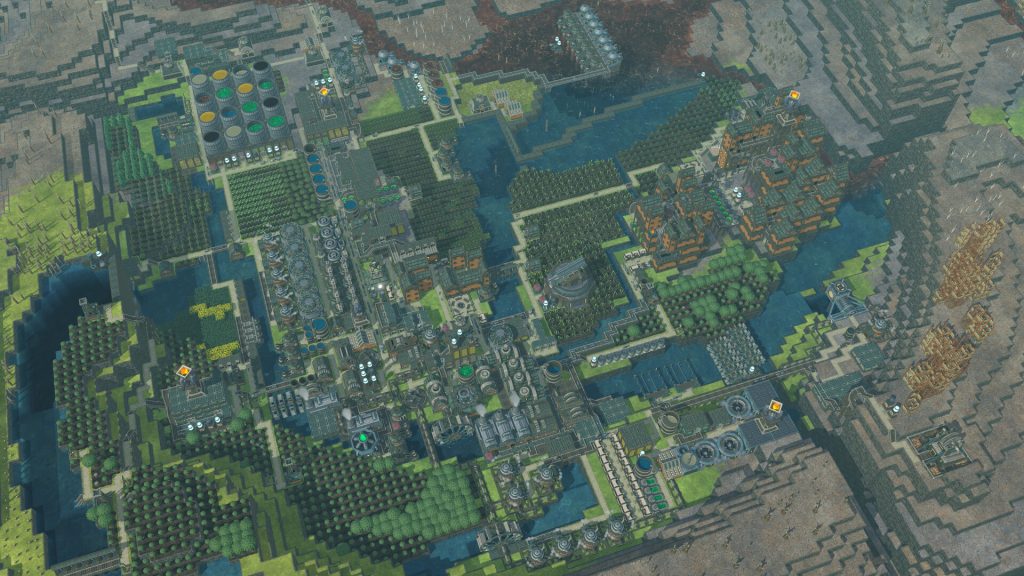
Banished is the pick for managing a town’s people and limited resources. Farthest Frontier suits players who want crops, transport and public health to interact. Timberborn turns settlement growth into a water-engineering problem.
The best settlement management strategy games make expansion a decision rather than a reward for placing another house. Each of these games gives you a different reason to stop building and inspect the existing town. Choose the bottleneck you want to solve: workers, supply chains or a river that cannot support your plans.

These are recommendations from official game descriptions, not a ranked difficulty test. The comparison focuses on what you manage, how the settlement develops, and what makes each option unsuitable for some players. No current prices or performance estimates are assumed.
On this page
Start with the people in Banished
Banished makes the townspeople your primary resource. They are born, age, work, form families and die. New houses alone do not guarantee growth: you also need people able to occupy them and keep the town functioning.
That is the attraction if you enjoy diagnosing a small economy. A beautiful new district can be a poor decision when it demands food and labor that the existing settlement cannot spare. Think about the future workforce as well as the current stockpile. Keep expansion connected to a reason, such as supporting an occupation the town needs, rather than treating every empty plot as a construction target.
The official description lists occupations ranging from farming and hunting to teaching, blacksmithing and healing. It also says there is no skill tree and no money. Structures depend on collected resources, while arriving merchants let you barter for goods such as crops and livestock.
The drawback is that Banished does not give you a large research tree to serve as a checklist. If unlocking the next technology is your main motivation, its open construction rules may feel directionless. Choose it for the consequences of town management itself. It is a single-player recommendation, so it is not the choice for friends who want to run one settlement together.

Follow the goods through Farthest Frontier
Farthest Frontier is the stronger fit for players who want agriculture and logistics in the same town. Its crop system includes fertility, different growing characteristics, frost and heat damage, weeds, rocks and disease. Crop rotation gives farmland a planning problem beyond simply filling an available field.
The town also has to move what it produces. The official page describes villagers carrying goods from distant workplaces, roads and transport wagons, and storage improvements that help prevent spoilage. That makes it useful to ask where a resource starts, where it is processed, and where people need it.
For example, adding production capacity is not a complete answer if the goods still travel awkwardly across the town. Before expanding another chain, inspect the whole route and the workers supporting it. The same approach applies to food: production, storage and delivery belong to one decision.
Its drawback is the number of connected systems. Farming, disease, sanitation, housing development and defensive preparations can compete for attention. The official pacifist option removes combat, and custom difficulty options can reduce other pressures. Use those settings if your goal is learning settlement logistics rather than handling every threat at once. Removing raiders does not make crop planning disappear.

Redesign the landscape in Timberborn
Timberborn is the choice when you want engineering to shape the settlement. Its beaver colonies face recurring droughts and toxic-water seasons, while dams, floodgates, canals and artificial irrigation let you alter the relationship between the town and its water supply.
The useful question is no longer just where to place a workshop. It is whether the water system can keep fields alive when natural flow stops, and whether the layout leaves room for the infrastructure you will need later. Stockpiling food is one response; keeping useful land irrigated is another.
Vertical construction adds a second design challenge. Lodges and workshops can be stacked, with platforms and bridges helping a crowded settlement fit into limited space. The two factions, Folktails and Iron Teeth, also have different buildings and traits. Pick one and learn its needs before treating faction changes as cosmetic.
The drawback is that water and terrain are central to the experience. If you want a conventional human town with farming and trade as the main focus, Farthest Frontier is closer to that request. Timberborn rewards interest in redesigning systems, including later automation; it is a weaker fit if you mainly want to watch a village grow without managing its environment.
Use one question to choose
Ask what you would most enjoy fixing after expansion goes wrong. A shortage of working adults points toward Banished. Food that needs a better production and delivery plan points toward Farthest Frontier. Dry fields and a poorly designed reservoir point toward Timberborn. Start with that game and a modest settlement, then expand after you can explain how its existing resources reach the inhabitants who need them.
Sources and scope
Official Steam descriptions and platform fields were read on November 10, 2026. Each game has its own official link and authentic publisher-supplied image. Recommendations are about feature fit, with no hands-on difficulty, multiplayer, pricing or hardware claims.
Sources and further reading
Keep exploring

Hearts of Iron 4 occupation laws: control resistance without draining reserves
Match occupation policy to resistance, compliance and a garrison you can actually supply; use stronger control only when the situation justifies its cost.

wargame red dragon radar anti air management: coverage and weapon-state decisions
A source-backed guide to managing specific radar-related weapons within a complete Wargame Red Dragon air defense.
wargame red dragon sead aircraft: choose a mission that helps
A concise source-backed guide to choosing and reassessing a useful SEAD mission in Wargame Red Dragon.