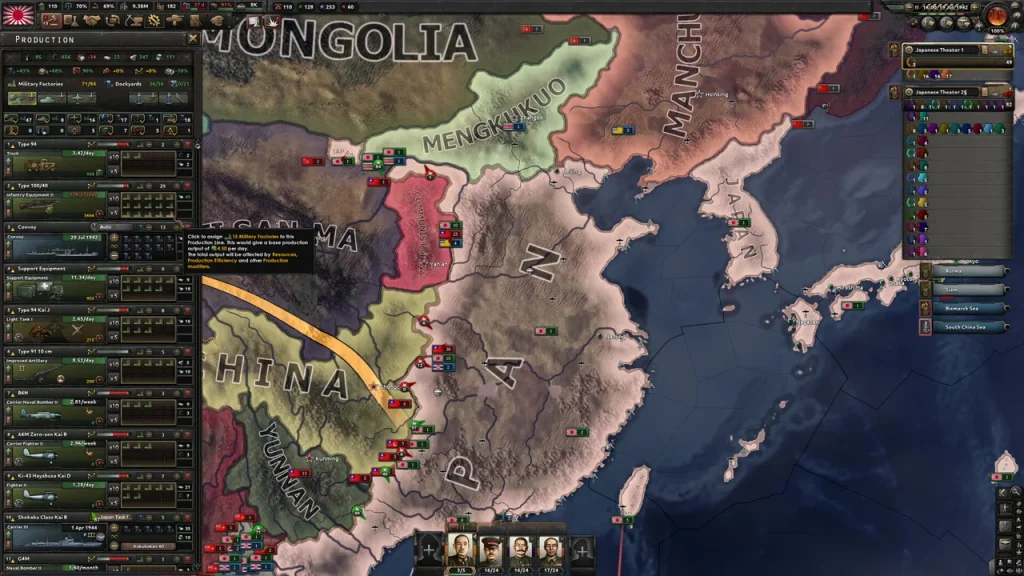
TL;DR: Hearts of Iron 4 production efficiency improves as a production line builds experience. Separate its current efficiency from its cap, growth and retention. Before changing equipment, compare the output you may lose with the equipment your next operation needs.
A high efficiency cap does not mean a new line is already producing at that level. Read the line’s actual output and modifiers, then choose whether to keep it running, upgrade it or establish another line.

The official efficiency explanation describes faster initial growth followed by slower progress toward the cap. Released 1.19.3 and 1.19.4 patch notes distinguish and revise specific production bonuses. This guide uses those mechanisms without presenting old percentages or development previews as current rules.
On this page
Hearts of Iron 4 production efficiency: read the line first
Open production and select one equipment line that appears to be underperforming. Record its equipment type, assigned factories, current efficiency, displayed cap and actual production rate. Look at the tooltip before adding factories or replacing the equipment.
Check when the line started and whether you recently changed it. Low efficiency on a new or changed line calls for a different assessment from unexpectedly low output on a mature line that previously met demand.
Read the equipment stockpile and reinforcement requirement alongside production. The useful question is whether this line supplies what the army needs by the relevant date. Efficiency is part of that answer, rather than the entire objective.
The developer’s military-production discussion describes factories as an interchangeable pool with production priorities. Inspect the order of essential lines too: when available industry shrinks, preserving a priority line matters as well as improving its efficiency.
Separate current efficiency, cap, base and growth
Current efficiency describes the line’s present condition. The cap describes its ceiling. Growth determines how it develops, while base efficiency affects the starting level. Read each available modifier separately.
The 2017 developer explanation changed efficiency from linear growth to faster initial improvement followed by slower progress at higher efficiency. It explicitly identifies base, growth and cap as relevant factors. That supports planning for buildup, without supplying a current universal formula.
| Measure | Question it answers | Planning implication |
|---|---|---|
| Current efficiency | How developed is this line now? | Judge the production actually available |
| Efficiency cap | What ceiling applies? | Do not count the ceiling as immediate output |
| Base and growth | Where does buildup begin and how does it progress? | Allow time for a new or changed line |
| Retention | What efficiency survives a change? | Inspect the cost of switching before committing |
Factory output is another modifier to check. The 1.19.3 notes even change a named Australian effect from production efficiency to output. Treat differently named bonuses as different effects instead of assuming they all immediately raise the efficiency bar.
Choose when to switch equipment
Switch when the new equipment’s operational value justifies the production transition. A researched upgrade creates an option; it does not establish that replacing every mature line immediately is the best choice.
Inspect the proposed change and the efficiency information the interface provides. Retention affects how much production experience survives. Do not use one remembered loss percentage for every equipment change, technology setup or campaign.
Compare the new equipment’s role and cost with the old line’s purpose. A more capable tank model may be worthwhile for the next armored offensive, while reliable production of existing equipment may be more urgent for divisions already missing vehicles.
Consider the deadline. An upgrade begun shortly before a planned attack leaves less time to recover production than one begun during a quiet buildup. Change the operation’s timing if the transition leaves the intended force unready.

Protect essential output while upgrading
Keep necessary equipment flowing while you introduce replacements. Prioritize the shortages that prevent units from doing their assigned jobs, then decide how much industry can support the upgrade.
For an illustrative tank transition, list the vehicles needed to refill existing divisions and those needed for a new formation. Inspect whether the mature line covers the first requirement before moving its factories or changing its model.
One planning option is to retain some existing production while building the new equipment elsewhere. This splits industry and may delay the new model, so compare that cost against the risk of interrupting essential deliveries. It is a recommendation, not a tested universal build.
If you add factories, read the resulting line again. Do not assume the displayed efficiency and daily output behave exactly as they did before the allocation changed. Use the actual new production rate to revise the equipment plan.
Avoid repeatedly switching between models in response to small stockpile changes. The official explanation emphasizes the value of high efficiency and retention; frequent transitions deserve scrutiny because maintaining experienced production has value.
Check resources and technology separately
Inspect resource warnings and their production effects before deciding efficiency is the only problem. A mature line can still disappoint if another displayed constraint is limiting output.
Read the resource requirement for the equipment being produced. When considering a trade or another remedy, compare its cost with the output the interface says is being lost. A higher efficiency ceiling does not, by itself, settle a resource shortage.
For industry research, compare the actual effects offered in your current technology tree. Distinguish cap, growth, retention and output rather than choosing from an old screenshot or assuming one industry branch fits every production schedule.
National bonuses also change. The amended 1.19.4 notes remove a maximum-efficiency bonus from Swiss gold trade and fix specific effects elsewhere. Verify the current national spirit or focus tooltip before counting its benefit.
The separate 2026 Industrial Parks article labels its systems and numbers as subject to further development. It is excluded from these instructions. This guide does not require a production control that exists only in a preview.
Review output against the operation deadline
Measure the result in usable equipment. After a change, revisit the production rate, stockpile and remaining unit requirements. Compare them with the date you intend to deploy or attack.
A short calculation can help: divide the remaining equipment requirement by the current daily output for a rough estimate. Label it a snapshot, because efficiency growth, combat losses, resource conditions and further factory changes can alter the rate.
If the estimate misses the deadline, decide which variable to change. You can postpone the operation, adjust the force being equipped or reconsider industrial allocation. Raising the target efficiency in your notes does not supply missing equipment.
Check the same line after enough production has occurred to see a meaningful change. Compare the new observation with the one you recorded before switching. That gives you a concrete basis for the next allocation decision.
FAQ and the next production decision
Why is efficiency below its cap?
The cap is a ceiling. The line still needs to build efficiency, subject to the current base, growth and other modifiers.
Should every researched model replace the old one immediately?
Inspect retention, the equipment shortage and the operation deadline. A stronger model can still create an inconvenient production transition.
Does high efficiency guarantee enough equipment?
No. Check factories, actual output, resources and demand as well as the efficiency display.
The Hearts of Iron 4 beginner guide covers the wider campaign. For your next production decision, record one line’s output, inspect the proposed change and confirm that the resulting equipment schedule supports the force you intend to use.
Sources and further reading
- https://store.steampowered.com/app/394360/Hearts_of_Iron_IV/
- https://steamstore-a.akamaihd.net/news/externalpost/steam_community_announcements/4249665521683217168
- https://steamstore-a.akamaihd.net/news/externalpost/steam_community_announcements/1839041357038255
- https://steamstore-a.akamaihd.net/news/externalpost/steam_community_announcements/1844115010491691
- https://steamstore-a.akamaihd.net/news/externalpost/steam_community_announcements/1847286114049046
- https://steamstore-a.akamaihd.net/news/externalpost/steam_community_announcements/1842846814455575
Keep exploring

Hearts of Iron 4 occupation laws: control resistance without draining reserves
Match occupation policy to resistance, compliance and a garrison you can actually supply; use stronger control only when the situation justifies its cost.

Games Like Hearts of Iron 4: choose what you want to command
Choose Stellaris for another empire project, CK3 for personal politics and heirs, or Ultimate General Civil War for tactical army progression.
Stellaris vs Hearts of Iron 4: discovery or industrial war planning?
Choose Stellaris for discovering a galaxy and shaping a space society; choose Hearts of Iron IV for coordinating industry, army design and politics around a WWII nation.