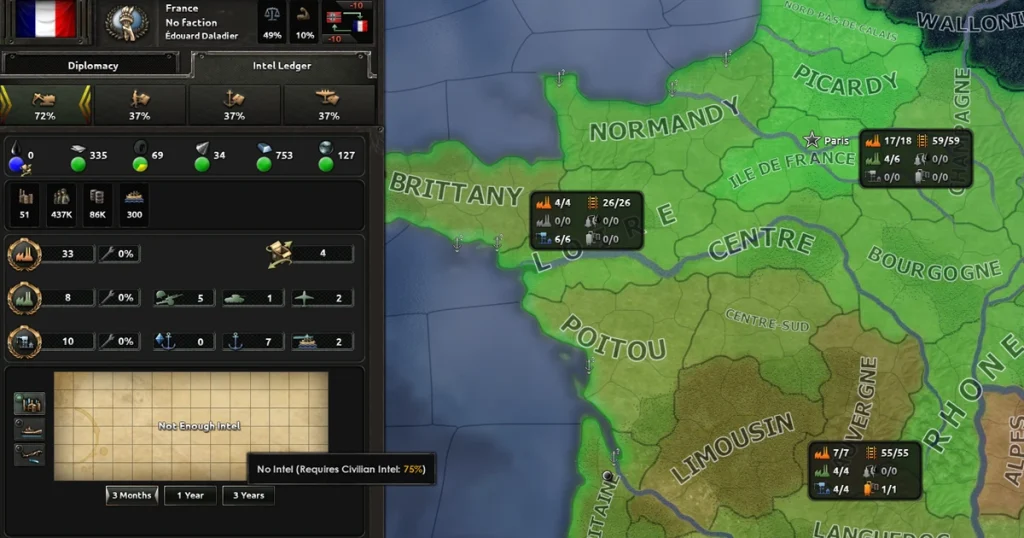
TL;DR: Hearts of Iron 4 recon and intelligence operate at different levels. Division reconnaissance supports battlefield decisions, while national intelligence reveals information about industry, armies, navies and air forces. Choose the category and tool that answers your operational question, then keep the information current.
A recon company, a scout-plane mission and an intelligence-agency upgrade are different investments. Start with what you need to know or improve before assigning equipment, aircraft or civilian industry.

This guide uses the official intelligence-system explanation, division-recon discussion, agency explanation and scout-plane and codebreaking explanation. It excludes historical visibility percentages, fixed agency costs and preview combat bonuses.
On this page
Hearts of Iron 4 recon and intelligence: separate the jobs
Inspect the division designer for tactical reconnaissance and the available intelligence interface for national information. A support company’s battlefield role does not mean it instantly reveals everything about the opposing country.
The official recon explanation connects reconnaissance companies with choosing tactics in combat and generating additional intelligence through fighting. It also distinguishes equipment types with different mobility and resource commitments.
Choose a recon option that fits the division’s job and read its current effects. The later support-company discussion changes recon’s relationship with particular battalion categories. Do not apply one old advertised attack bonus to every division.
Compare the equipment cost, speed and actual relevant bonuses with what the formation needs. An expensive recon choice deserves scrutiny if it consumes vehicles that another part of the force needs more urgently.
Choose the intelligence category that answers the question
Select the information you need before investing in additional intelligence. The developer divides national intel into civilian or industrial, army, navy and air categories.
| Operational question | Relevant category | Useful inspection |
|---|---|---|
| Where is enemy industry concentrated? | Civilian and industrial intel | Available building and production information |
| What force might oppose the offensive? | Army intel | Visible templates, equipment and army information |
| What threatens the sea route? | Naval intel | Available fleet and mission information |
| What air force contests the region? | Air intel | Visible aircraft and air-force information |
The official explanation unlocks more information as intelligence improves. Inspect the current category tooltip to see what is visible and what is still concealed; a figure displayed in a historical diary is not a universal current threshold.
Distinguish knowledge of a template’s existence from knowledge of its contents or prevalence. Those are different observations, and an incomplete view should remain incomplete in your planning notes.
Combine useful sources and keep them current
Check which sources contribute to the relevant intelligence category. The developer lists networks, infiltrated assets, captured operatives, radar, broken ciphers, scout planes and combat among the sources.
The official system explanation gives sources contribution limits and describes decay over time. Repeatedly investing in one source is therefore not automatically the best response to every intelligence gap.
Combine tools that answer the same important question from different directions. For an illustrative maritime operation, inspect naval information already available, then evaluate whether reconnaissance or agency work could fill the remaining gap.
Revisit the information before committing the operation. An assessment made earlier in the campaign can lose value as sources decay and the enemy’s force changes.
The released faction expansion includes shared intelligence. Inspect the available faction information as another part of the current setup, without assuming that membership automatically reveals every ally’s or enemy’s detail.

Treat scout planes as an intelligence mission
Use available reconnaissance aircraft for gathering information, rather than assuming they replace fighters. The scout-plane explanation identifies air recon as their role and explicitly separates it from providing air superiority.
Check the aircraft’s actual mission capability, base and reachable region. Where the relevant equipment and mission are available in your setup, assign them to the area that supports the information you need.
The developer describes reconnaissance over enemy territory as a source of national intel and reconnaissance over trafficked sea regions as a way to obtain naval information. Choose the region deliberately instead of deploying the aircraft wherever a base has space.
Read the results and operating conditions afterward. A reconnaissance order is useful when it improves the information supporting your decision; it should not be judged only by the number of aircraft assigned.
Budget agency work and counterintelligence
Inspect agency availability and its current construction and upgrade requirements. The official agency explanation uses civilian-industry time for creating the agency and improving its capabilities.
That investment competes with other uses of civilian industry. Choose the branch that supports a concrete need before upgrading everything simply because the options are available.
The developer distinguishes naval information gathering, passive defense, operative-support upgrades and cryptology. Their purposes differ, so compare the current branch effects with the problem you are trying to solve.
Counterintelligence deserves its own decision. If enemy operative activity is the concern, inspect defensive capabilities rather than assuming that gathering more offensive intel addresses the same threat.
Verify operative availability and mission requirements in the current interface. This guide does not apply an old spymaster threshold, operative count or expansion-access rule to every installed configuration.
Time codebreaking to a defined operation
Inspect the available cryptology department, enemy cipher work and progress. The developer’s codebreaking explanation distinguishes passive benefits from fully activating knowledge of a broken cipher.
Choose the target whose information matters to the operation. The explanation describes active projects sharing decryption work, which makes the number of simultaneous targets a planning choice.
Read the current activation effects and duration before using a completed cipher. Decide whether the intended attack, landing or other commitment is ready to exploit the opportunity.
The historical description makes activation consequential: the enemy can learn that the cipher has been compromised, and further work may be necessary afterward. It is not simply a permanent information toggle.
For a hypothetical landing, coordinate the intelligence benefit with the force’s readiness and actual sea route. Activating early while transports or troops are still unready can reduce the value of the timing.
Use visible information before committing
Write down what the interface establishes, what remains uncertain and which decision depends on that uncertainty. An incomplete enemy estimate can still support a cautious plan, but it should not be presented as exact knowledge.
If intelligence reveals a stronger defense than expected, change the objective, force or schedule. Gathering the information only helps if you let it affect the operation.
Check direct combat effects separately from information visibility. Better knowledge of the opponent and a division’s tactical-recon contribution are related benefits, but they are not interchangeable measurements.
FAQ and the next intelligence decision
Does a recon company reveal the entire enemy army?
No. Inspect tactical recon and national army intelligence separately. The information visible depends on the relevant intelligence category and sources.
Can scout planes replace fighter cover?
The developer describes scout planes as an intelligence tool that does not provide air superiority. Inspect separate fighter requirements.
Should I activate a broken cipher immediately?
Read its effects and timing, then coordinate activation with an operation ready to use the benefit.
The Hearts of Iron 4 beginner guide covers the wider campaign. For the next decision, identify one information gap, choose a relevant source and reassess the operation using what becomes visible.
Sources and further reading
- https://steamstore-a.akamaihd.net/news/externalpost/steam_community_announcements/2610330338694610356
- https://steamstore-a.akamaihd.net/news/externalpost/steam_community_announcements/2426802943979448127
- https://steamstore-a.akamaihd.net/news/externalpost/steam_community_announcements/5151601211222412251
- https://steamstore-a.akamaihd.net/news/externalpost/steam_community_announcements/2451574645854475127
- https://steamstore-a.akamaihd.net/news/externalpost/steam_community_announcements/2587811707162174863
- https://steamstore-a.akamaihd.net/news/externalpost/steam_community_announcements/1816849002009911
Keep exploring

Hearts of Iron 4 occupation laws: control resistance without draining reserves
Match occupation policy to resistance, compliance and a garrison you can actually supply; use stronger control only when the situation justifies its cost.
Games Like Hearts of Iron 4: choose what you want to command
Choose Stellaris for another empire project, CK3 for personal politics and heirs, or Ultimate General Civil War for tactical army progression.
Stellaris vs Hearts of Iron 4: discovery or industrial war planning?
Choose Stellaris for discovering a galaxy and shaping a space society; choose Hearts of Iron IV for coordinating industry, army design and politics around a WWII nation.