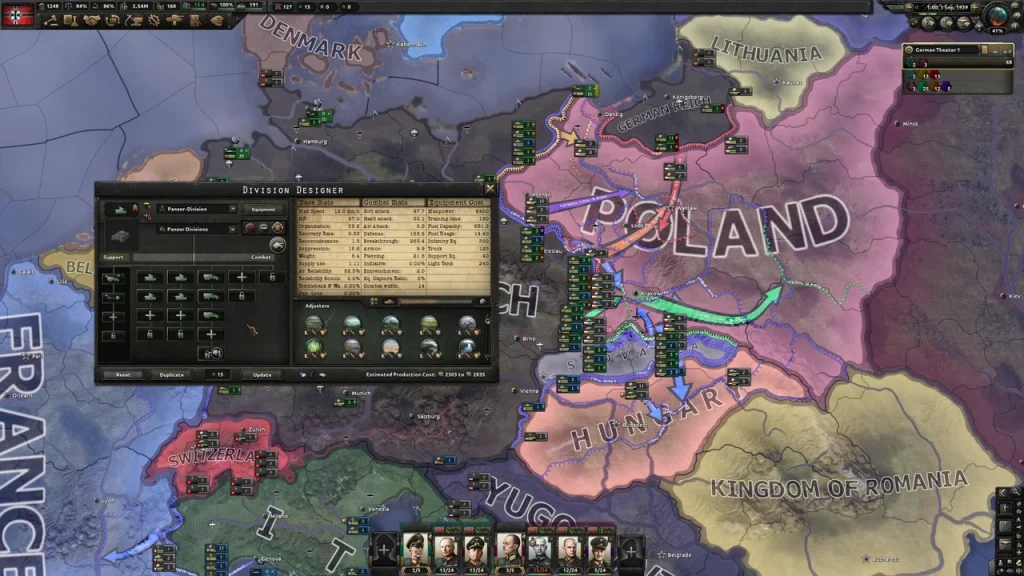
TL;DR: Hearts of Iron 4 combat width is a fit problem between the battle’s available space and the width of the divisions participating. Read the actual terrain, battle capacity and division widths, including current modifiers. Then check whether a failure comes from overcrowding, reinforcement, equipment or supply before redesigning the army.
A division width that fits one battle well can fit another poorly. Treat an old fixed 20- or 40-width recommendation as a claim to examine, rather than a universal answer for every terrain and role.

This guide uses the official terrain-width explanation, combat-meta discussion and amended 1.19.4 width and display fixes. Historical terrain numbers and preview damage formulas are excluded.
On this page
Hearts of Iron 4 combat width: read the battle first
Open the relevant land battle and inspect its available width and participating divisions. Read the actual display rather than inferring capacity only from the number of units ordered to attack.
Then inspect the template or division’s width. The two measurements answer different questions: how much space the battle offers and how much space a formation uses.
Check which divisions are fighting and which are waiting. Units assigned to the same attack do not necessarily all contribute on the battle line at the same time.
Read any displayed over-width penalty before deciding that width is causing the problem. A battle can perform badly because of terrain, equipment or supply even when the chosen formations fit its capacity.
Record the current observation. For example: the battle is overcrowded, a useful division remains in reserve, or the force fits but lacks equipment. That gives you a more precise starting point than changing every template immediately.
Use terrain and attack approaches in the comparison
Inspect the terrain of the defended province and the battle’s actual width. The official rework varies capacity across terrain types specifically to weaken the idea of one formation size fitting everywhere.
Read the effect of additional attack approaches where relevant. The developer’s width explanation distinguishes base and reinforcement width; use the current battle display to see the capacity the actual attack receives.
Do not use the old preview table as the current terrain rulebook. It explicitly labels its numbers as provisional, and later updates can change modifiers and formation sizes.
Compare your common operating terrain before choosing a specialized template. A formation intended for a narrow defensive area can have different priorities from one expected to fight across varied provinces.
An additional approach also needs usable troops and supply. Increasing available fighting space is not automatically beneficial if the force sent through that approach cannot perform its job.
Work through a hypothetical fit calculation
Use a simple calculation to understand the fit, then read the game’s actual participation and penalties. The following numbers are invented for illustration, not current terrain statistics.
Imagine a battle offering 60 width and a formation using 18. Three such formations use 54, leaving six unused. Four would require 72, which is more than the assumed capacity.
| Illustrative commitment | Total width | Fit against an assumed 60 |
|---|---|---|
| Two formations of 18 | 36 | 24 remains |
| Three formations of 18 | 54 | Six remains |
| Four formations of 18 | 72 | Exceeds capacity by 12 |
This arithmetic does not establish that the engine will admit a fourth formation or apply a particular penalty. Inspect actual admission and modifiers in the battle.
Compare another proposed width using the same method. A cleaner fit can be useful, but the equipment, organization and battlefield role of the alternative still matter.
Do not delete useful battalions solely to make the arithmetic exact. The official design discussion accepts imperfect fit as part of the tradeoff, rather than making every leftover point proof of a failed template.

Separate width from reinforcement
Inspect reserve participation and reinforcement information separately from total space. Having room in the battle and having a waiting unit join it are different conditions.
The developer’s combat-meta discussion treats reinforcement chance as part of choosing which waiting divisions enter combat. It also describes changing the older preference based on the order units arrived.
Use that distinction to avoid diagnosing every waiting formation as a width problem. Read its current condition and the relevant reinforcement information before changing battalion counts.
Likewise, ordering many additional units to attack does not prove that useful width has increased or that all those units are participating. Check the battle after the order takes effect.
Consider support or doctrine choices through their current descriptions, not the preview’s promised reinforcement impact. A meaningful improvement should address the actual condition you observed.
Balance fit against equipment and supply
Choose the width as part of a complete formation design. Compare the unit’s role, equipment requirements, organization, mobility and logistical demands alongside its fit.
A wider division can require more resources to equip and sustain. A smaller alternative can create different deployment and support requirements. Judge the force you can actually field, not an imagined fully equipped version.
The developer’s combat discussion also changes targeting and damage distribution in relation to width. That is another reason not to reduce the decision to a simple claim that larger or smaller is always stronger.
For an illustrative operation, compare two designs against the terrain you expect, then inspect whether production and the local network can sustain the intended number of divisions.
If the existing force fits but is short of supply, repair the logistics problem before assuming a new width will solve it. Template requirements and a disconnected hub are different causes.
Recheck after doctrine and support changes
Read the actual division width again when relevant modifiers change. The amended 1.19.4 notes revise infantry-width reductions in doctrine rewards, so the same battalion list can require a fresh inspection.
The updated division-designer explanation and released regimental-support feature also change how players inspect and support formations. Read the current arrangement instead of relying on a legacy designer screenshot.
The 1.19.4 notes fix a display issue that tied division width to equipment or manpower fulfillment. Do not interpret missing equipment as a deliberate way to obtain free fighting space.
After making a justified template change, inspect its equipment requirement and behavior in the relevant battle. A better fit is useful when the resulting formation can still perform the role you need.
FAQ and the next template decision
Is there one best width for every battle?
The official design varies terrain capacity and emphasizes opponent and location. Compare the actual role and battle instead of assuming one universal size.
Why are divisions waiting despite available width?
Inspect reinforcement and unit condition separately. Available space does not prove immediate entry.
Does a perfect fit guarantee victory?
No. Read equipment, organization, terrain, support and supply as well as width.
The Hearts of Iron 4 beginner guide covers wider preparation. Start the next design decision from one actual battle, identify the constraint and change the template only when the evidence points to its fit.
Sources and further reading
- https://steamstore-a.akamaihd.net/news/externalpost/steam_community_announcements/4072920612498047055
- https://steamstore-a.akamaihd.net/news/externalpost/steam_community_announcements/3938951840876523620
- https://steamstore-a.akamaihd.net/news/externalpost/steam_community_announcements/1833334318568855
- https://steamstore-a.akamaihd.net/news/externalpost/steam_community_announcements/1835236783561023
- https://steamstore-a.akamaihd.net/news/externalpost/steam_community_announcements/1847286114049046
Keep exploring

Hearts of Iron 4 occupation laws: control resistance without draining reserves
Match occupation policy to resistance, compliance and a garrison you can actually supply; use stronger control only when the situation justifies its cost.
Games Like Hearts of Iron 4: choose what you want to command
Choose Stellaris for another empire project, CK3 for personal politics and heirs, or Ultimate General Civil War for tactical army progression.
Stellaris vs Hearts of Iron 4: discovery or industrial war planning?
Choose Stellaris for discovering a galaxy and shaping a space society; choose Hearts of Iron IV for coordinating industry, army design and politics around a WWII nation.