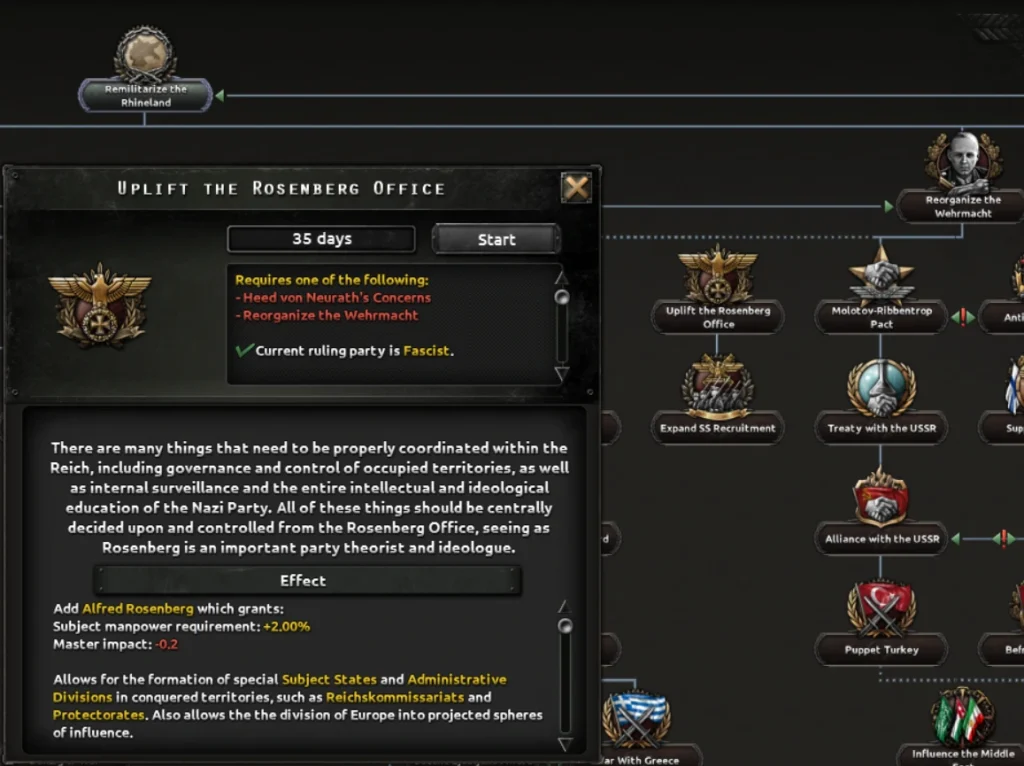
TL;DR: Hearts of Iron 4 puppet management starts with the subject’s actual type, autonomy level and current rights. Read what moves its autonomy before relying on resource trade, subject troops or construction. Then decide whether investment, closer integration or a more independent relationship serves the campaign.
A subject is not simply free industry and manpower. The relationship can change as you use its contributions or invest in it, and different subject types can have different rules.

This guide uses the official autonomy explanation. The current base-game purchase description includes Together for Victory; the older article’s expansion announcement is not a current instruction to buy it separately.
On this page
Hearts of Iron 4 puppet management: read the subject
Open the subject relationship information and identify the country’s actual subject type, autonomy level and progress. Read the rights and obligations shown for that relationship.
The developer replaces the older free-or-puppet distinction with levels along an autonomy scale. Those levels affect the interaction between the overlord and subject rather than representing only a cosmetic label.
Inspect the current trade, troop, diplomatic and industrial arrangements. Do not apply one historical industry-share percentage or resource price to every subject type.
Check national focuses or special conditions relevant to the relationship. The foundational explanation itself allows focus-tree actions to modify some obligations, so a general description should not override a specific current rule.
Write down what you want from this subject: a useful source of resources, a supported military contribution, a strategic partner or eventual integration. That purpose gives you a basis for evaluating the next action.
Understand what moves autonomy
Read the current sources of autonomy change. The official explanation describes a tug of war in which overlord investment and subject contributions can pull the relationship in different directions.
Overlord construction in a subject reduces autonomy in that design. Using subject troops, trading for its resources and its wartime contribution can move autonomy the other way.
Lend-lease can also affect autonomy. Inspect the direction, equipment conditions and actual current effect rather than treating every shipment as equivalent.
The source describes continuous focuses and national focuses that influence the relationship too. Read the options actually available to the country before counting them as tools you can use.
| Action to inspect | Foundational relationship effect | Current check |
|---|---|---|
| Overlord construction | Can reduce subject autonomy | Project eligibility and actual progress effect |
| Resource and military contributions | Can increase subject autonomy | Relationship-specific contribution and change |
| Lend-lease | Depends on direction and conditions | Equipment and current autonomy information |
| Relevant focuses | Can push autonomy or modify the relationship | Availability, cost and actual effect |
Judge the combined result. An action useful for the war can still move the relationship away from the autonomy level you intended to preserve.
Choose construction for a useful purpose
Build in a subject when the project has an operational or economic purpose as well as a relationship effect. Inspect the actual construction option and the subject receiving the project.
For an illustrative campaign, improving a useful connection or productive state can serve the force you intend to support. Compare that benefit with construction you could complete elsewhere using the same industry.
The developer notes a longer-term tradeoff: investment can lower autonomy while making the subject stronger and better able to contribute. Those later contributions can affect autonomy in turn.
Do not count a project only as a way to move the bar. Consider whether it strengthens a useful partner, fixes a real logistics constraint or provides industry the relationship can actually use.
Revisit the subject information after the investment takes effect. Use the observed progress and relationship state to choose the next project.

Check resource and troop contributions
Read the actual trade terms before relying on a subject’s resources. The autonomy explanation changes the overlord’s access across levels, but its historical example rates are not universal current prices.
Inspect both the resource benefit and the contribution to autonomy. Taking more from the subject can help immediate production while changing the relationship over time.
Where subject recruitment or military contributions are available, inspect the template, equipment and manpower arrangement. A nominally available formation still needs the conditions required to become useful.
The developer connects military contribution and war participation with autonomy progress. Plan the military benefit and its political consequence together instead of treating them as unrelated systems.
For a hypothetical resource-rich subject, compare the production supported by its trade with the autonomy change and the alternative cost of obtaining the resource. The best choice depends on the relationship you want to maintain.
Compare integration with keeping the subject
Read what changes at the next autonomy level before pushing toward it. Closer control, continued partnership and full annexation create different outcomes.
The official explanation requires both sufficient autonomy progress and a political action to move between levels. Reaching the end of a bar does not, by itself, establish that the country has already changed status.
Inspect the current action cost, requirements and resulting relationship. Do not assume that a fixed political-power amount from another guide applies to this subject.
Annexation ends the subject as a separate country in the foundational model. Compare that outcome with the contributions and strategic role the existing arrangement provides.
A desire for more control is not a complete reason to integrate immediately. Judge the actual rights gained and the campaign resources spent, then choose the relationship that supports the objective.
Monitor changes and special subject rules
Recheck the relationship after major trade, construction, military or political changes. The current autonomy state can differ from the one used to make the original plan.
Inspect special subject types separately. The official German Systems discussion connects particular German subjects with national economic systems, illustrating why a general autonomy example is not the complete rulebook for every country.
This guide does not apply the preview’s special German bonuses to every current subject. Use the actual relationship and national effects present in your campaign.
If you are playing the subject, reverse the planning perspective: inspect which contributions, focuses and actions increase autonomy, then compare their cost with the independence or rights you are pursuing.
Keep the practical objective visible. More autonomy, less autonomy and more military output are different goals, and one action can advance one while complicating another.
FAQ and the next relationship decision
Why does using a subject’s resources change autonomy?
The foundational system links contributions to autonomy progress. Inspect the actual trade effect for the relationship.
Does a full bar automatically change the subject level?
The developer describes a separate political action with requirements. Check whether that action is available and completed.
Is annexation always better than keeping a subject?
Compare actual rights, costs and useful contributions. The existing relationship can serve a different strategic purpose.
The Hearts of Iron 4 beginner guide gives wider campaign context. Before the next subject action, read its autonomy effect and decide which relationship you want the resulting country to have.
Sources and further reading
Keep exploring

Hearts of Iron 4 occupation laws: control resistance without draining reserves
Match occupation policy to resistance, compliance and a garrison you can actually supply; use stronger control only when the situation justifies its cost.
Games Like Hearts of Iron 4: choose what you want to command
Choose Stellaris for another empire project, CK3 for personal politics and heirs, or Ultimate General Civil War for tactical army progression.
Stellaris vs Hearts of Iron 4: discovery or industrial war planning?
Choose Stellaris for discovering a galaxy and shaping a space society; choose Hearts of Iron IV for coordinating industry, army design and politics around a WWII nation.