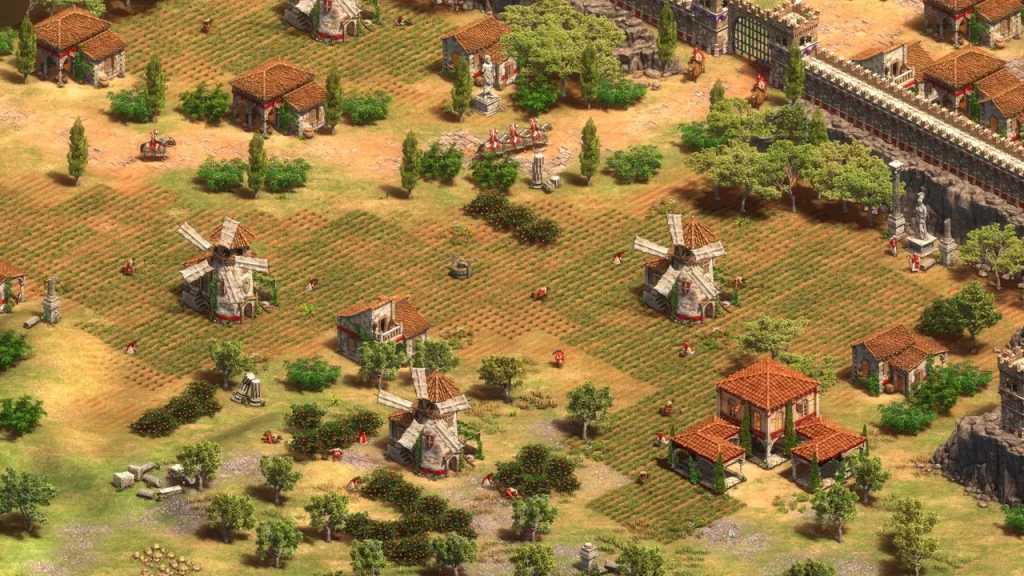
TL;DR: Use a roomy 22-population practice opening, meaning 21 Villagers and your starting Scout Cavalry. Gather 500 food for Feudal Age, finish a Barracks during the transition, build a Stable after advancing, and reserve food for both Villagers and additional scouts.
An Age of Empires 2 Definitive Edition scout rush build order turns an early food economy into Feudal Scout Cavalry production. The ordinary scout costs 80 food and comes from a Stable, which requires a Barracks. This guide gives you a repeatable worker ledger and purchase sequence; its population target is a teaching choice, not a promise of the fastest ranked opening.

Use a standard land skirmish in Age of Empires II: Definitive Edition, with Byzantines and an AI difficulty you can manage. The checked technology tree confirms the baseline costs and availability used below. Other civilizations, map resources, settings, and installed balance changes can require adjustments. The numbered worker assignments count Villagers only, while the population target includes the starting scout.
On this page
Age of Empires 2 Definitive Edition scout rush build order: seven steps
1. Put Villagers one through six on nearby food
Select the Town Center and queue Villagers when you have the 50 food needed for each. Put the first six workers on the food being gathered near the Town Center. For a conventional sheep start, bring the animals into a convenient drop-off area and keep the workers focused on the current source. Use the starting scout to find additional food before you need it.
Build opening Houses with designated workers and return the builders to gathering. A standard House costs 25 wood and gives five population spaces. Watch capacity while workers are queued, not only after they appear. The exact opening placement depends on the map, but the objective is consistent: workers should be gathering, the Town Center should have room, and the scout should be finding useful information.
2. Send Villagers seven through nine to wood
Villager seven builds a Lumber Camp near a usable forest, then joins the wood line. Villagers eight and nine gather there too. The camp costs 100 wood, so include it in the opening construction budget. Keep the walk from trees to the camp short and avoid a site that is obviously exposed or hard to reach from your base.
Three early woodworkers start paying for the Mill, Houses, and the later Barracks. This exercise adds more woodworkers before the age click instead of relying on a very tight competitive schedule. If a worker is temporarily building a House, remember that the worker is not gathering wood during construction. Return that builder to the assigned group when the task finishes.
3. Use Villagers ten through eighteen for food
Villager ten can build a needed House and bring the first boar toward the Town Center when that food source exists and you can perform the lure safely. Keep nearby workers ready to gather it. Do not start a dangerous lure solely to preserve the worker number in this ledger; use an available safer food source if your control of the action is still uncertain.
Villager eleven builds the Mill by berries, with Villagers twelve through fourteen joining that source. The Mill costs 100 wood. Villager fifteen handles the next hunt when the first source is close to exhaustion and conditions allow it. Villagers sixteen through eighteen join food near the Town Center. Avoid finishing two hunt animals at once merely because two worker numbers mention hunting.
At this stage the ledger places fifteen workers on food and three on wood. Food gathering includes different sources, and temporary builders or lure workers may be moving rather than collecting. Check the actual workers on screen instead of assuming every assigned worker is currently contributing. A missed food transition can interrupt Villager production long before you reach the age target.
4. Add Villagers nineteen through twenty-one to wood and advance
These three workers join the forest, bringing the planned allocation to fifteen on food and six on wood. With 21 living Villagers and one starting scout, the population counter reads 22 before other population-consuming units are added. This is the guide’s practice target. If you lost a scout or worker, the same population number no longer describes the same economy.
Consider Loom before exposure or advancement. It costs 50 gold and improves Villager durability, while temporarily occupying the Town Center’s research queue. Once you have 500 food and two completed eligible Dark Age building types, click Feudal Age. The Lumber Camp and Mill satisfy this route’s building requirement. Houses do not count toward it, regardless of how many you constructed.
5. Build the Barracks during the transition
Reserve 175 wood for a Barracks and assign a builder while Feudal Age is researching. Also retain enough wood for the next House and the 175-wood Stable you intend to construct afterward. This is a building chain, so do not wait until you have arrived in Feudal Age to discover that the Stable button still needs a Barracks.
If construction wood is short, move a few foodworkers to the forest temporarily. A simple drill adjustment is moving three, making nine planned woodworkers during the transition. Treat that as a temporary reassignment rather than a new permanent ratio. After the needed buildings are funded, food must again support both the Town Center and the Stable. Builders should rejoin a resource task when finished.
6. Build one Stable and train funded scouts
After reaching Feudal Age, construct a Stable for 175 wood. Using two builders is an optional teaching convenience; it also means two workers are gathering nothing while construction continues. Return them to their resource jobs afterward. Select the completed Stable and inspect the Scout Cavalry button, then train an additional scout when you can spend 80 food without losing the next Villager purchase.
For a small production exercise, three new scouts cost 240 food in total. Add your starting scout separately if it is still alive. Do not call three new units a four-scout group unless that original unit is actually present. Continue checking Houses as military units enter the population counter. A unit queue and a worker queue can both become blocked by the same missing House.
7. Restore food income and review the opening
Send most newly trained Villagers to food while scouts share that resource demand. As natural sources decline, add Farms gradually. Each baseline Farm costs 60 wood and requires the Mill you already built. Do not spend the entire wood stockpile on Farms if that leaves no capacity for Houses or no room to replace a poorly positioned drop-off building.
Stop the first drill after you have produced the chosen scout group while keeping the Town Center supplied. Review where food or population interrupted either queue. That observation gives you a specific improvement for the next attempt. A later drill can include controlled unit movement against the AI, but it should not hide an economy that repeatedly stopped while the camera was elsewhere.
Keep the worker ledger honest
The intended age-click allocation is fifteen foodworkers and six woodworkers. Food includes six opening workers, Villager ten, four berry workers, Villager fifteen, and Villagers sixteen through eighteen. Wood includes Villagers seven through nine and nineteen through twenty-one. These assignments total 21 workers. No early gold or stone miners are required to pay the ordinary 80-food Scout Cavalry cost.
The ledger is a planning aid, not a statement that every map gives identical gathering. Hunt availability, walking distance, civilization bonuses, worker losses, and time spent constructing all affect the result. If the food stockpile has not reached 500 at the target count, keep gathering rather than clicking a nonexistent button. Extra workers are preferable to leaving the Town Center idle for a prolonged wait.

Separate buildings, units, and research
Barracks and Stable together cost 350 wood. The Lumber Camp and Mill cost another 200 wood, before Houses or Farms. That construction total explains why a food-focused opening still needs a real wood line. The Stable’s food-only unit does not make the supporting economy food-only. Wood shortages often appear when the first farms and military building are demanded together.
A newly trained Villager costs 50 food, and a scout costs 80. Reserving both purchases requires 130 food. This is a simple purchasing example, not an income benchmark or a production-timing claim. If you have only enough food for one purchase, prioritize the exercise’s continued worker production and wait for the next scout. A full Stable queue is not the only sign of a successful opening.
Double-Bit Axe at the Lumber Camp costs 100 food and 50 wood and increases baseline wood gathering speed by 20 percent. Horse Collar at the Mill costs 75 food and 75 wood and improves Farm food capacity. These technologies can help sustain later spending, but researching both immediately consumes food that could have paid for workers or scouts. Budget them when the building and food situation support the choice.
Use the starting scout for information
Locate your food sources, forest positions, and the opponent’s general location while maintaining the economy loop. Avoid treating the starting unit as disposable before it has found the resources your workers need. Return the camera to the Town Center frequently. A well-explored map does not compensate for several missing Villagers caused by an unnoticed idle queue.
The checked Scout Cavalry description identifies Spearman-line units and Camel Riders as unfavorable opponents. Use that information to recognize a reason to change movement or production rather than assuming every visible enemy is a good target. Keep this first guide focused on building and funding units. Exact combat results depend on numbers, upgrades, positioning, and player control; no matchup test is claimed here.
When to change the opening
If the nearby food is difficult to collect, use what the map actually offers and accept a later Feudal click. A farm replacement has a wood cost, so adding woodworkers may be necessary. If nearby enemy activity makes a hunt unsafe, preserve workers instead of following the ledger into danger. The purpose of the build is to create a usable economy, not to keep a written worker number at any cost.
Do not add a second Stable simply because one is finished. Another 175 wood creates more production capacity and more pressure on food. Add it only when you intend to use that capacity and can maintain the worker queue. Likewise, a transition to a different unit route needs its own buildings and resource assignments; a large food stockpile does not automatically fund Archers.

Troubleshooting the scout opening
If Feudal Age is late, check foodworkers, completed prerequisites, and idle Town Center time separately. A missing Mill is a building problem, while unfinished food gathering is an income problem. If you paused workers to force the 500-food reserve, note that decision during review. It may achieve an age click while leaving the subsequent economy smaller than expected.
If the Stable button is missing, confirm that Feudal Age has completed and that a Barracks exists. If the building is available but construction cannot start, check wood and placement. If Scout Cavalry production stops, check food and population. A gold miner will not solve the ordinary scout’s missing food, and a second Stable will not solve a blocked population counter.
If your Farms consume all available wood, build them in smaller groups and keep the next House reserve visible. If gatherers seem numerous but stockpiles remain small, inspect walking distance and idle workers. Foodworkers assigned to an exhausted source contribute nothing until you move them. A new drop-off site or resource reassignment can be more useful than another production building.

Scout build-order questions
Does 22 population mean 22 Villagers?
No. In this example it means 21 Villagers plus the starting Scout Cavalry. Count the actual surviving units, especially after a loss or an extra military purchase. A population label alone does not reveal the worker count.
Must I mine gold before making scouts?
Not for ordinary Scout Cavalry, which costs 80 food in this baseline. Loom costs 50 gold, and other purchases may require gold later. Read the individual button rather than extending the scout’s food-only price to every Stable technology.
Is this the fastest scout rush?
No fastest-time claim is made. The additional early woodworkers and flexible food transitions make this a learning exercise. Competitive openings need civilization-specific choices and actual performance review, which are outside the evidence available for this draft.
What counts as a good first attempt?
Reach Feudal Age, complete the Barracks-to-Stable chain, and train your planned scouts while continuing Villager production. Write down the first interrupted queue and its cause. Repeat the same settings with that one problem corrected before trying to compress the opening.
Sources and further reading
- https://www.ageofempires.com/games/age-of-empires-ii-definitive-edition/
- https://store.steampowered.com/app/813780/
- https://aoe2techtree.net/
- https://raw.githubusercontent.com/SiegeEngineers/aoe2techtree/e56728e76b7d08301fba7b18d5f16bc8554c109a/data/data.json
- https://raw.githubusercontent.com/SiegeEngineers/aoe2techtree/e56728e76b7d08301fba7b18d5f16bc8554c109a/data/locales/en/strings.json
- https://raw.githubusercontent.com/SiegeEngineers/aoe2techtree/e56728e76b7d08301fba7b18d5f16bc8554c109a/data/trees/BYZANTINES.json
Keep exploring
Age of Empires 2 Definitive Edition vs Total War Rome 2: choose your scale
Choose a historical RTS scenario library or an ancient territorial campaign linked to real-time battles.
Age of Empires 2 Definitive Edition vs Age of Empires 4: where to start
Choose campaign breadth in AoE II DE or documented onboarding and newer presentation in AoE IV.
Age of Empires 2 Definitive Edition vs Total War Shogun 2: match or campaign?
A comparison of immediate RTS development and the continuing clan campaign in SHOGUN 2.