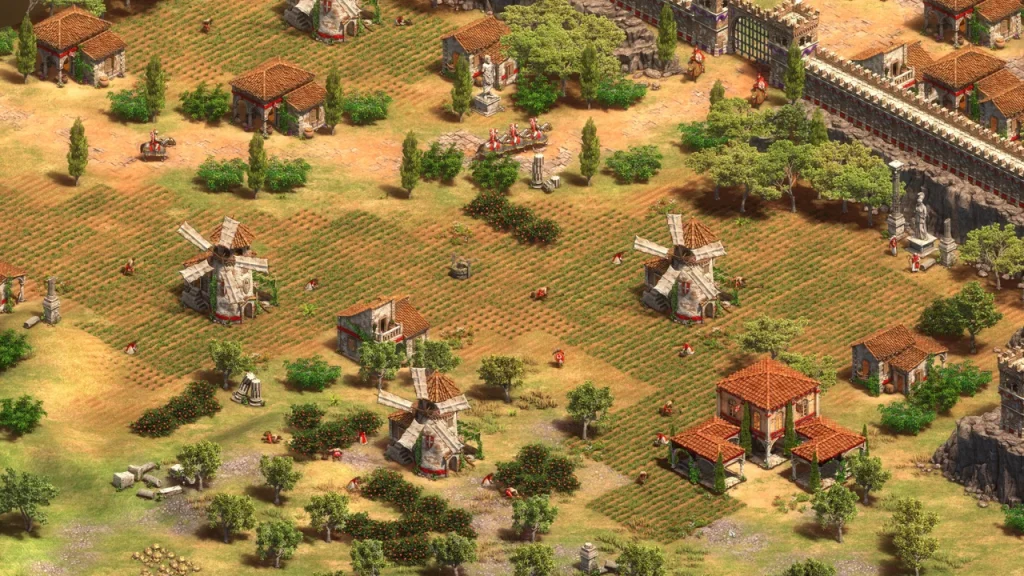
TL;DR: Practice reaching Feudal Age with 27 Villagers and the starting scout, then add two Villagers while completing a Market and Blacksmith. Reserve 800 food and 200 gold for Castle Age; the buildings cost 325 wood together and satisfy the two eligible Feudal building-type requirement.
An Age of Empires 2 Definitive Edition fast Castle build order concentrates spending on two age advances rather than a large Feudal army. The essential chain is 500 food and two eligible Dark Age building types for Feudal, followed by 800 food, 200 gold, and two eligible Feudal building types for Castle. Researching Castle Age does not require constructing a stone Castle.

This is a forgiving 28-population teaching route for a standard land skirmish in Age of Empires II: Definitive Edition. Use Byzantines and manageable AI settings to keep the selected baseline costs consistent. The English technology-tree reference supports the costs and prerequisites. No fastest completion time, ranked success rate, or firsthand match test is claimed for this exercise.
On this page
Age of Empires 2 Definitive Edition fast Castle build order: seven steps
1. Put Villagers one through six on nearby food
Start the worker economy at the Town Center. A standard Villager costs 50 food, so keep enough gathering there to continue production when population allows it. With a conventional sheep start, gather close to the Town Center and position the next food source before the current one finishes. Workers standing beside an exhausted animal do not help the age reserve.
Build opening Houses with designated workers, then return the builders to their food jobs. Each standard House costs 25 wood and supplies five population spaces. Use the starting scout to find nearby food and useful forest positions. This drill needs the economy to remain active during exploration, so make short camera trips and return to the Town Center instead of following the scout indefinitely.
2. Send Villagers seven through ten to wood
Villager seven constructs a Lumber Camp for 100 wood at a usable forest. The other three workers join wood gathering there. Keep the camp close to active trees and notice when a builder is away from the line. The four-worker assignment describes the planned job distribution; it is not a guarantee that all four are collecting during every moment of the opening.
Wood pays for the Mill, Mining Camp, Houses, and the later 325-wood Market-and-Blacksmith pair. This fast Castle route does not need a Barracks merely to unlock those two buildings. Avoid constructing one automatically unless the actual match gives you a reason to need its units or later building chain. An optional purchase can postpone the wood needed for the selected age route.
3. Assign Villagers eleven through twenty-one to food
Villager eleven handles a first boar lure when the map offers the resource and you can manage it safely. Villager twelve constructs a Mill by berries for 100 wood, with Villagers thirteen through fifteen gathering there. The Mill supplies another eligible Dark Age building type and satisfies the later Market prerequisite. Place it for usable gathering rather than solely to unlock a button.
Villager sixteen can bring the next hunt as the earlier source declines. Villagers seventeen through twenty-one join food near the Town Center. These assignments bring the planned food group to seventeen workers: the first six, Villager eleven, four berry workers, Villager sixteen, and five later foodworkers. If hunting is unavailable or unsafe, use another source and include any replacement Farm wood in the budget.
4. Add wood and gold workers before the Feudal click
Villagers twenty-two through twenty-four join wood, creating a seven-worker forest allocation. Villager twenty-five builds a Mining Camp by gold for 100 wood; Villagers twenty-six and twenty-seven join gold gathering. The intended distribution is now seventeen food, seven wood, and three gold, totaling 27 workers. Add the living starting scout to get the 28-population teaching target.
Budget Loom if you select it, then collect 500 food and click Feudal Age after the Lumber Camp and Mill are completed. Loom costs 50 gold and improves Villager durability, while occupying the Town Center’s research queue during the purchase. Do not count Houses as the required Dark Age building types. If food is short at the target count, continue gathering and worker production rather than forcing a long idle pause.
5. Save transition wood for the Market and Blacksmith
During the Feudal research period, prepare the 325 wood needed for the pair: 175 for the Market and 150 for the Blacksmith. Keep a separate reserve for the next House. If wood income is short, temporarily move foodworkers to the forest, then return the economy toward food once construction is funded. Your next age still demands a substantial food stockpile.
Do not build the Market before its age unlock or forget its Mill prerequisite. The Blacksmith does not need a Barracks in this selected chain. Those details make the route different from an early Stable or Archery Range opening. You are paying for two eligible Feudal building types, not preparing a military production building that will automatically create units for you.
6. Produce two more Villagers and complete the building pair
Once Feudal Age is complete, queue two additional Villagers when their combined 100-food price can be paid. Assign them to food for this exercise, giving a planned count of 29 Villagers before losses or other changes. Construct the Market and Blacksmith while continuing to watch the food and gold reserves. Builders temporarily gather nothing, so return them to useful jobs afterward.
With the starting scout still alive and no extra units, 29 Villagers mean 30 population. That number is a count explanation, not a required final score. The route’s initial 28-population label refers to the earlier Feudal click. Keep worker count, military count, and building capacity separate so that replay notes describe what actually happened rather than mixing two stages of the opening.
7. Reserve 800 food and 200 gold, then click Castle Age
The completed Market and Blacksmith satisfy the standard two eligible Feudal building-type requirement. Select the Town Center, confirm the 800-food and 200-gold reserve, and start Castle Age research. The standard tooltip also lists Stable and Archery Range as eligible alternatives, but this exercise deliberately uses the Market-and-Blacksmith pair. Two copies of one type are not the intended substitute.
During the research, decide what you want the new age to enable and preserve resources for that purchase. Completing Castle Age does not supply a trained unit, complete another building, or restart every gathering job. Check Houses, food transitions, and existing idle workers before the age finishes. An active economy at arrival is more useful than an age label followed by empty stockpiles and stalled production.
Understand the two age reserves
The two standard advances consume 1,300 food in total: 500 for Feudal and 800 for Castle. Villagers, Loom, optional economic research, and any units are separate spending. You do not need all 1,300 food stored at the beginning; the economy gathers between purchases. Keeping the costs separate helps explain why the stockpile falls sharply after a click even while foodworkers continue gathering.
Castle requires 200 gold in its reserve. If a standard start gives you 100 gold and you spend 50 on Loom with no other gold purchases, you need another 150 gathered to hold the required 200. That calculation applies to those exact assumptions. Different starting settings, an additional technology, or buying resources at the Market changes the amount you still need.
Food often becomes the limiting resource because it pays for both Villagers and age advancement. Inspect the workers who have finished sheep, hunt, or berries before deciding that the build needs fewer workers. Reassigning idle gatherers may solve the reserve problem without a prolonged production pause. If Farms replace natural food, the wood requirement also grows; the food solution becomes a wood planning task.

Use the Market deliberately
The Market allows resource buying and selling, but the exchange is not a universal fixed-price shortcut. Prices and available stockpiles affect the tradeoff. Read the current buttons before making a purchase and compare the resources sold with what those resources were meant to fund. Selling wood can supply another resource while leaving you unable to construct your intended follow-up.
For a first drill, try the planned gathering economy before relying on trades to repair every shortage. That reveals whether the gold assignment, food transition, and construction reserve work. In a later attempt, note each trade and its purpose. A route with trades is still reviewable when the assumptions are explicit; pretending the resources appeared without a cost makes the build harder to repeat.
The Market is also an age prerequisite in this example, so completing the building can be useful even when you choose not to trade. Separate its unlock function from its economic menu. Buying an unrelated resource is not required to activate Castle research once the eligible buildings and reserve are present. Inspect the Town Center button to see which specific requirement is missing.
Decide whether the match supports this route
A concentrated age opening spends resources that could otherwise support Feudal units. If nearby enemy activity threatens workers or gathering sites, reassess rather than continuing every age-saving step unchanged. An AI practice setting can make the sequence easier to learn, but neither a closed map nor existing walls guarantee that all interruptions disappear. Read the actual situation in your match.
If you add military production or defensive spending, write the extra cost into the plan and accept that the original age target can move. A Barracks, Stable, units, and replacement workers all consume resources and builder time. The useful skill is deciding why the added expense is needed. Reaching Castle later with a functioning economy can be a better exercise result than advancing while vital gathering collapses.
Plan the first Castle purchase before arrival
Choose whether the next exercise is expanded economy, a particular production route, or another newly available mechanic. Inspect the relevant builder and production menus when the age completes. The ordinary additional Town Center costs 275 wood and 100 stone when construction is available in your match, and its Villagers still require 50 food each. Budget continuing production as well as construction.
A military route has its own prerequisites and resource mixture. Having a Market and Blacksmith does not mean a Stable or Range was built earlier, and those buildings need the Barracks chain. If you intend to use that route after arrival, include the missing construction in the plan. Castle Age unlocks options; the opening’s chosen building pair does not automatically satisfy every follow-up.
Avoid using the remaining stockpile on several unrelated buildings simply because their icons have appeared. One funded next step is easier to evaluate than three incomplete intentions. Keep the Town Center and gathering jobs active while you learn the new menu. Record which specific age unlock you used, what you spent, and whether the economy could support it afterward.

Troubleshoot a stalled advance
If Feudal Age is unavailable with 500 food, confirm that the Mill and Lumber Camp are completed and eligible. If Castle Age is unavailable with 800 food and 200 gold, inspect the Market and Blacksmith rather than counting your Dark Age structures again. The two stages have different building lists. Unfinished construction and duplicate building types can explain a reserve that seems sufficient but a button that remains disabled.
If gold is short, check the selected miners, their deposit, and the Mining Camp rather than immediately transferring a large group. A long walking route or idle miner can imitate a small workforce. If food is short, check depleted natural sources and builder assignments. The seventeen-foodworker ledger loses practical meaning when several of those workers have no active source.
If wood is short for the building pair, inspect optional purchases and large farm batches. Keep the 175-wood Market, 150-wood Blacksmith, and next House as separate reserves. Pause optional spending or adjust wood gathering. A rushed resource trade can solve the food number while making the unfinished-building problem worse, so check both prerequisites and reserves before clicking exchange buttons.

Fast Castle questions
Do I need to construct a Castle to enter Castle Age?
No. Castle Age is a Town Center research purchase. This route uses 800 food, 200 gold, and completed Market and Blacksmith buildings. A stone Castle is a different construction action with its own requirements and cost.
Why does the guide use two different population numbers?
The teaching target is 27 Villagers plus the starting scout at the Feudal click. Two later Villagers raise the intended worker count to 29 before Castle research. Population includes the surviving scout and any extra units, so count workers separately during review.
Is Market plus Blacksmith the only eligible pair?
No. The standard Castle tooltip lists Archery Range, Stable, Blacksmith, and Market as eligible Feudal building types. This exercise uses Market and Blacksmith because it avoids the Barracks prerequisite required for the Range or Stable chain. Different plans can use another valid pair.
What should I measure in the replay?
Record idle worker-production periods, missed Houses, inactive foodworkers, the completion of both prerequisite buildings, and resources spent outside the plan. Correct the earliest repeated interruption on the next attempt. Treat a faster completion as a measured result of your own session, not a timing guaranteed by this guide.
Sources and further reading
- https://www.ageofempires.com/games/age-of-empires-ii-definitive-edition/
- https://store.steampowered.com/app/813780/
- https://aoe2techtree.net/
- https://raw.githubusercontent.com/SiegeEngineers/aoe2techtree/e56728e76b7d08301fba7b18d5f16bc8554c109a/data/data.json
- https://raw.githubusercontent.com/SiegeEngineers/aoe2techtree/e56728e76b7d08301fba7b18d5f16bc8554c109a/data/locales/en/strings.json
- https://raw.githubusercontent.com/SiegeEngineers/aoe2techtree/e56728e76b7d08301fba7b18d5f16bc8554c109a/data/trees/BYZANTINES.json
Keep exploring
Age of Empires 2 Definitive Edition vs Total War Rome 2: choose your scale
Choose a historical RTS scenario library or an ancient territorial campaign linked to real-time battles.
Age of Empires 2 Definitive Edition vs Age of Empires 4: where to start
Choose campaign breadth in AoE II DE or documented onboarding and newer presentation in AoE IV.
Age of Empires 2 Definitive Edition vs Total War Shogun 2: match or campaign?
A comparison of immediate RTS development and the continuing clan campaign in SHOGUN 2.