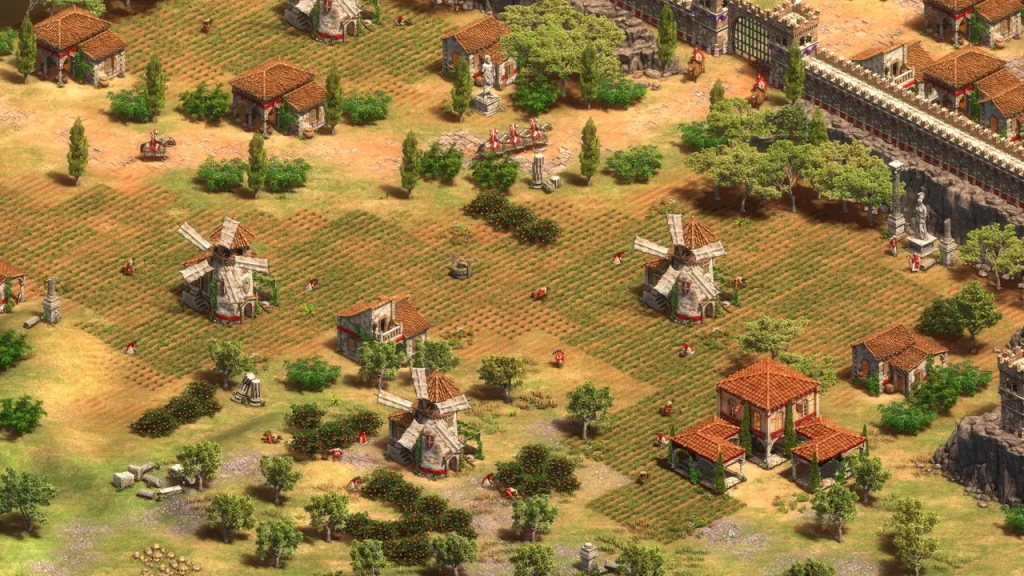
TL;DR: Build a Barracks in Dark Age, fund a small Militia group, and save the separate Feudal Age reserve. After advancing, research Man-at-Arms at the Barracks while maintaining Villager production and preparing one affordable follow-up route.
An Age of Empires 2 Definitive Edition men at arms opening begins with Militia and upgrades that unit line in Feudal Age. In the checked baseline, each Militia costs 50 food and 20 gold, while the Man-at-Arms upgrade costs another 100 food and 40 gold. The unit purchase, upgrade, and age advance are separate expenses; paying one does not complete the others.

Use a standard land skirmish in Age of Empires II: Definitive Edition and a manageable AI setting for this teaching exercise. Byzantines provide the ordinary infantry availability and prices discussed here. Costs were checked against the English technology tree; use your installed purchase panel if a later update or modified match differs. This sequence is a practice plan without a guaranteed competitive timing.
On this page
Age of Empires 2 Definitive Edition men at arms opening: six steps
1. Start food gathering and keep Villagers queued
Put Villagers one through six on food near the Town Center. For a conventional sheep start, keep the current source conveniently placed and bring the next animals into position before gathering finishes. A standard Villager costs 50 food, so military spending must leave enough food for the worker queue. Designate opening House builders and return them to gathering afterward.
Use the starting scout to find useful food and forest locations. Build another House before population capacity fills; a standard House costs 25 wood and provides five spaces. The planned Militia will use population too. Watching only the number of workers can miss the capacity consumed by an army that is already being trained.
2. Establish wood and additional food sources
Villager seven builds a Lumber Camp near a usable forest, with Villagers eight and nine joining wood gathering. The camp costs 100 wood. Villager ten can handle a first hunt when that source exists and you can perform the action safely. Villager eleven builds a Mill by berries, with Villagers twelve through fourteen joining that food source.
The Mill costs 100 wood and supplies another eligible Dark Age building type for advancement. Villager fifteen can handle the next hunt as the current source declines. Do not finish fresh food merely because the ledger reaches that worker number. Keep foodworkers collecting, replace exhausted sources promptly, and adapt to the resources actually present on the map.
3. Add gold and complete the Barracks
Send Villager sixteen to a gold deposit with a Mining Camp when you can fund its 100-wood construction. Villagers seventeen and eighteen join food, and nineteen through twenty-one join wood. The resulting teaching ledger is fourteen foodworkers, six woodworkers, and one goldworker. Construction and movement temporarily reduce the workers actually gathering, so check their jobs on screen.
Construct a Barracks for 175 wood and plan a small Militia purchase. Three units cost 150 food and 60 gold in this reference. Train them as the food budget allows rather than abandoning the Town Center queue. One early goldworker is a starter assignment, not a guarantee of a particular timing; the gold stockpile must cover the purchases you select.
4. Save Loom and the Feudal reserve separately
Loom costs 50 gold and improves Villager durability. If you take it, include that cost alongside Militia and the upcoming upgrade. Three Militia, Man-at-Arms research, and Loom require 150 gold altogether: 60 for units, 40 for the upgrade, and 50 for Loom. With a standard 100-gold start and no other purchases, that plan needs another 50 gold gathered.
Feudal Age costs 500 food and requires two eligible Dark Age building types. Your Lumber Camp and Mill satisfy this example. The Militia food purchase does not count toward the age reserve, and Houses do not satisfy the building list. Keep gathering until the reserve and prerequisites are ready; the worker ledger is not a command to click at an exact timestamp.
5. Research Man-at-Arms after Feudal completes
Select the Barracks once Feudal Age is reached and pay 100 food and 40 gold for the Man-at-Arms unit-line upgrade. Inspect the research queue and wait for completion before treating your Militia as upgraded units. A Barracks occupied by research is not simultaneously completing another item from that same production queue.
Keep checking the Town Center, Houses, and foodworkers while attention moves to the army. A small unit group can consume a large share of a new player’s camera time. Use a simple control group, give a purposeful instruction, and return to the economy. The exercise is successful when the upgrade is funded alongside continuing worker production, rather than after the economy has stopped.
6. Choose a funded follow-up
Decide whether to continue the infantry route, add an Archery Range, or prepare another production plan. A standard Range costs 175 wood and already has its Barracks prerequisite satisfied. Ordinary Archers cost 25 wood and 45 gold, so a transition requires a larger gold income than this opening’s initial one-worker assignment may provide.
If you choose another route, budget its building and units before adding optional research. A Stable also costs 175 wood, but ordinary Scout Cavalry consumes 80 food each, sharing food with Villagers. Adding both a Stable and Range without supporting resources creates two unfinished intentions. Pick the next purchase that your actual economy can sustain.
Count army population as well as workers
Twenty-one Villagers and the starting scout make 22 population only before the Militia are added. With three surviving Militia too, that same worker economy uses 25 population. The later unit-line upgrade changes the infantry type rather than creating three extra population-consuming units. Losses or further purchases change the total, so review the actual surviving units.
This distinction explains unexpected House blocks in an infantry opening. You can follow the worker assignments correctly and still run out of room if you used a capacity plan intended for a worker-and-scout-only opening. Keep a House reserve visible while military units are queued. Both Barracks production and Town Center production draw from the same population capacity.

Understand the opening’s resource commitments
Three Militia and their upgrade consume 250 food and 100 gold in the checked baseline, before Loom, worker production, or Feudal research. The Feudal purchase adds another 500 food. These totals are budgets accumulated across the opening, not a requirement to hold all resources at once. What matters is preserving the reserve needed for the next chosen action.
Wood supports the Barracks, camps, Mill, Houses, and any Farms needed when natural food runs low. A standard Farm costs 60 wood and requires a Mill. Do not spend the whole forest stockpile on a large farm batch while expecting it to fund the follow-up Range too. Smaller farm additions can keep the worker economy supplied without exhausting construction money.
Older guides or different balance versions may show a different Militia price. The source checked for this draft lists 50 food and 20 gold before modifiers. Match your calculations to the installed unit button instead of mixing an old unit cost with a newer upgrade cost. Civilization-specific benefits and unusual starting settings can also change the spending sequence.
Use infantry with a clear purpose
The checked Militia-line description presents all-purpose infantry with a building role and warns about ranged opponents at long range. Recognize that limitation when choosing where to move the group. A completed upgrade does not make the units useful against every army composition, and preserving production matters more than following one group across the map without checking home.
Avoid assuming a fixed combat result from the unit name alone. Numbers, upgrades, terrain, support, and control affect engagements. This guide does not supply a tested damage threshold or winning ratio. In the first AI exercise, focus on producing the planned group, completing the upgrade, and keeping foodworkers active while you use the army interface.
If the opponent shows ranged units, reassess the next production purchase instead of adding infantry automatically. If your gathering sites are threatened, protecting workers may be more useful than preserving the planned movement. Every replacement worker also costs food and production time. A useful opening should leave an economy able to adapt after the initial group is created.
Troubleshoot late units and missing upgrades
If Militia cannot be queued, inspect Barracks completion, population space, food, and gold. These are separate checks. A missing House will not be solved by another goldworker, and the right gold reserve will not help an unfinished Barracks. Return workers from completed construction to gathering before deciding the economy needs a large reassignment.
If the Man-at-Arms upgrade is unavailable, confirm Feudal Age, the Barracks panel, and the research price. If it is queued but not finished, check what is ahead of it. Do not count the group as upgraded merely because the age has changed. Record the actual research completion when reviewing a replay, along with any worker-production pause caused by its food purchase.
If the follow-up production stalls, compare its resource needs with your current worker jobs. The early single goldworker was intended for a limited infantry-and-upgrade budget, not unlimited Archers. Reassign or add goldworkers when changing the plan, while keeping enough food for Villagers. A second production building cannot solve a resource shortage inside the first one.


Men-at-Arms questions
Can I train Man-at-Arms immediately in Dark Age?
This standard route trains Militia in Dark Age and researches the Man-at-Arms upgrade in Feudal Age. Civilization-specific exceptions require checking that civilization’s own tree. Do not generalize an exception to this ordinary teaching sequence.
Does the upgrade require a Blacksmith?
The unit-line upgrade is a Barracks research purchase. Blacksmith technologies are separate military upgrades with their own costs. Building a Blacksmith does not replace the Man-at-Arms research, and completing that research does not automatically buy Blacksmith technologies.
Is three Militia a compulsory target?
No. It is a small example that makes the spending and population arithmetic easy to review. Adjust the purchase if food, gold, safety, or the next production route requires it. Record the change rather than assuming the original budget still applies.
What should I practice next?
Repeat the same settings and correct the first missed House, empty queue, or exhausted food source. Then practice one follow-up building with its resource assignments. Improving that transition is more useful than assuming an unmeasured fastest opening will solve every interruption.
Browse the guide library for the next economy or production topic, then keep the same practice settings while learning that follow-up.
Sources and further reading
- https://www.ageofempires.com/games/age-of-empires-ii-definitive-edition/
- https://store.steampowered.com/app/813780/
- https://aoe2techtree.net/
- https://raw.githubusercontent.com/SiegeEngineers/aoe2techtree/e56728e76b7d08301fba7b18d5f16bc8554c109a/data/data.json
- https://raw.githubusercontent.com/SiegeEngineers/aoe2techtree/e56728e76b7d08301fba7b18d5f16bc8554c109a/data/locales/en/strings.json
- https://raw.githubusercontent.com/SiegeEngineers/aoe2techtree/e56728e76b7d08301fba7b18d5f16bc8554c109a/data/trees/BYZANTINES.json
- https://raw.githubusercontent.com/SiegeEngineers/aoe2techtree/e56728e76b7d08301fba7b18d5f16bc8554c109a/data/trees/BURMESE.json
- https://raw.githubusercontent.com/SiegeEngineers/aoe2techtree/e56728e76b7d08301fba7b18d5f16bc8554c109a/data/trees/BENGALIS.json
- https://raw.githubusercontent.com/SiegeEngineers/aoe2techtree/e56728e76b7d08301fba7b18d5f16bc8554c109a/data/trees/PERSIANS.json
- https://raw.githubusercontent.com/SiegeEngineers/aoe2techtree/e56728e76b7d08301fba7b18d5f16bc8554c109a/data/trees/KHMER.json
Keep exploring
Age of Empires 2 Definitive Edition vs Total War Rome 2: choose your scale
Choose a historical RTS scenario library or an ancient territorial campaign linked to real-time battles.
Age of Empires 2 Definitive Edition vs Age of Empires 4: where to start
Choose campaign breadth in AoE II DE or documented onboarding and newer presentation in AoE IV.
Age of Empires 2 Definitive Edition vs Total War Shogun 2: match or campaign?
A comparison of immediate RTS development and the continuing clan campaign in SHOGUN 2.