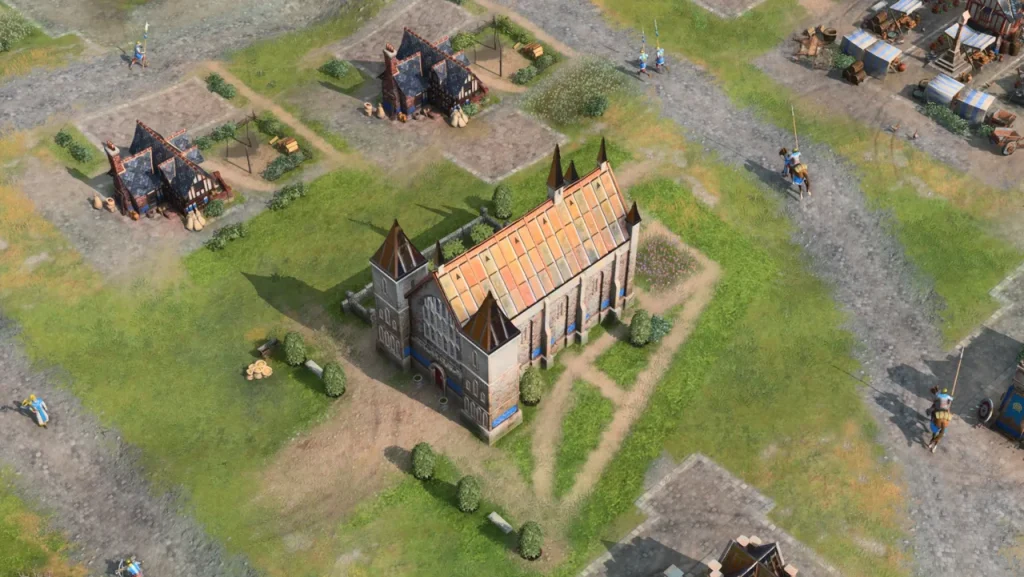
TL;DR: This Age of Empires 4 English build order is an AI practice route: establish food income, add gold and wood workers, build the Council Hall for the Feudal Age, then produce a small Longbowman group while keeping Villager production funded. Add farms and upgrades for a specific resource need rather than buying every available improvement.
Quick answer: The Council Hall is the selected landmark for this route. The checked game-data entry costs 400 food and 200 gold and acts as an Archery Range. Completing the landmark advances the age and opens its production menu; it does not automatically train the Longbowmen you intend to use.

The official English civilization page supports the civilization’s farming and Longbowman identity. Production and cost details were checked against AoE4 World building data and its original-English unit and technology files on November 8, 2026. This is a researched learning sequence, not a tested ranked opening or a promised arrival minute. Use a standard land skirmish and read the installed game’s purchase cards if its version differs.
On this page
Age of Empires 4 English build order: seven practice steps
1. Establish food income and the Town Center queue
Select the Town Center and queue a Villager. The checked unit data lists a 50-food cost, so the food reserve needs to support both continuing workers and the landmark you are saving for. A large total resource balance does not substitute for the specific food this queue uses.
For this drill, aim to keep six workers gathering a nearby food source while assigning new arrivals to the next required resource. This is a manageable practice distribution, not a measured optimum for every generated map. Keep the Scout’s resource-discovery task separate from the workers gathering at home.
Use the beginner guide if selecting the Town Center and assigning new workers are still unfamiliar. The first milestone is a functioning food supply and a worker actually appearing from the queue.
2. Build a House and open gold gathering
Use one Villager to construct a House before the current population space is exhausted, then return that worker to a resource task. The checked English House costs 50 wood. Treat that as part of the opening’s wood budget rather than assuming all starting wood is available for another structure.
Build a Mining Camp near the chosen gold deposit and aim for two gold workers in this learning route. The camp costs another 50 wood and accepts both gold and stone, but these workers should gather the resource needed by your selected landmark.
Watch their resource assignment after construction. Completing a drop-off building gives them a place to deliver resources; it is not itself gold income. Do not send early workers to stone merely because the Mining Camp can accept it when this route is saving for a food-and-gold landmark.
3. Add a small wood economy
Construct a Lumber Camp beside a suitable wood line and assign three workers to wood as the opening develops. Its checked cost is 50 wood. Adjust the position as the trees recede rather than accepting a long walk back to an old drop-off point forever.
The first House, Mining Camp and Lumber Camp together use 150 wood in the checked entries. A Mill or Barracks would be an additional expense. This simple separation makes it easier to see why the wood balance can be small even while workers are gathering steadily.
Continue adding food workers when the Town Center or age-up reserve needs them. The distribution is a guide to the next purchase: gold funds the landmark, food funds workers and the landmark, and wood funds infrastructure and the later Longbowman queue.
4. Advance through the Council Hall
When the food and gold purchase requirements are funded, select Villagers and choose the Council Hall from the landmark construction options. For this exercise, assign four builders so you can follow one construction task while the remaining economy continues gathering.
Four is a practice choice, not a verified fastest timing. More builders are temporarily removed from resource collection; fewer builders leave more workers gathering while construction proceeds. Judge the choice through the economy you can maintain rather than copying an unexplained timestamp.
The checked entry lists 400 food and 200 gold. Allow for any queued Villagers or other purchases before treating the displayed reserve as uncommitted. Once the landmark is complete, inspect the age indicator and its own production card, then return its builders to the resources the next queue requires.
5. Produce a small Longbowman group
Select the completed Council Hall and queue one Longbowman, then build toward a group of four for this drill. Confirm each production entry before planning a larger roster. The exercise is about understanding the building and resource demand, not claiming four is the best army size.
The checked Council Hall acts as an Archery Range with its units and technologies and has its own faster-production and Longbowman-discount effects. You therefore do not need to construct a second Archery Range merely to discover the same basic Longbowman production option.
The original-English unit file lists a Longbowman’s base cost as 40 food and 50 wood. The Council Hall has an additional landmark-specific discount, so use its displayed purchase card for the actual modified amount. Do not copy a base-unit value into a landmark budget without accounting for that difference.
At those base entries, four Longbowmen represent 160 food and 200 wood before the landmark modifier. Four additional Villagers would use another 200 food. The comparison shows why the ranged queue and worker queue can compete even when the food reserve looked sufficient for only one of them.
6. Add the production branch you actually need
If the practice roster needs melee infantry, construct a Barracks and inspect its available units. The checked building costs 150 wood. That expense competes with more ranged units and the farm transition, so add it for a defined menu option.
English Men-at-Arms are available earlier than those of many other civilizations. Their Barracks entry and upgrade path are distinct from the Council Hall’s ranged-unit menu. Owning a Council Hall does not make every English unit producible from that landmark.
For a calm menu exercise, inspect the Barracks choices and explain which one you would produce next. You may defer the building if the immediate learning goal is maintaining the Council Hall and Town Center queues. A second production structure is useful only when you can fund and manage its planned units.
7. Choose one improvement before extending the opening
Review whether the current shortage is food, wood, population space or a particular unit improvement. Select the corresponding menu instead of opening several research buildings and buying the first familiar icon.
For a wood-heavy continuation, inspect Double Broadax at the Lumber Camp. The checked Feudal technology costs 50 food and 100 gold and improves wood gathering. If the task is expanding a farm economy, inspect the Mill’s food technologies and farm placement instead.
A Blacksmith is another 150-wood structure with its own research expenses. Building it does not complete its upgrades. End this first drill with one deliberate improvement or one explained decision to defer research; the working economy and production queues remain the main outcome.
Plan the English food transition around the Mill
The English have cheaper farms and a gathering benefit for farms near Mills, supported by both the official overview and the checked civilization data. That makes a farm transition easier to plan, but it does not mean the farms cost no wood or feed workers without assignments.
Build a Mill where the intended farms can use its influence, then assign one Villager to each completed Farm. The building data explicitly says only one Villager can work each Farm. Several workers standing around one farm are not the same economy as several individually assigned plots.
Start with a small group when nearby food is running short. The wood used for farms is also wood you might otherwise spend on Longbowmen, a House or another production building. Staging the transition lets you keep producing while replacing the food source.
Keep the Mill’s influence and the general food-gathering technology separate. Horticulture is a Feudal Mill research with its own cost and applicability; the checked description excludes hunted meat. A farm plan and a hunting plan should not assume every food improvement affects their workers in the same way.

Separate economy research from unit upgrades
Wheelbarrow is available at the Mill in the checked data, while Double Broadax belongs to the Lumber Camp. Their costs consume different combinations of the reserve. Early research is a timing choice because gold spent on an improvement is gold unavailable for the selected landmark until gathering replaces it.
The Council Hall contains its own ranged production and technology menu. Later Veteran and Elite upgrades are age-dependent unit development, not another Feudal landmark purchase. A new age opening an upgrade is different from research actually completing.
For the Blacksmith, inspect the units an improvement affects before buying it. Steeled Arrow is a ranged-damage technology in the checked English file; it does not perform a Villager economy upgrade. A correct purchase begins with the thing you want to improve, followed by the building that provides it.
Keep this menu distinction in your practice record: unit production, unit development, broad military research and economic research. That is more useful than recording a long series of upgrade names without remembering which queue or worker group each one affected.
Practice case: farms consume the next production reserve
Imagine the Council Hall is complete and the opening’s food source is nearly exhausted. You spend much of the available wood on several Farms, then wonder why the intended Longbowman group is not growing.
Read the production card and compare its wood requirement with the remaining balance. The farm purchase solved part of the food transition but consumed a resource also needed by the ranged queue. It did not make the Council Hall stop working.
Check which completed farms are actually assigned. If some are idle, the wood has been spent without delivering the expected food income. Assign the intended workers before adding more plots, then resume the ranged queue when its resources are funded.
For the next attempt, stage a smaller farm group and keep a named wood reserve for the next unit or House. Record the competing purchases. The lesson is balancing two real menus, not abandoning farms or assuming every English opening can fund them all immediately.
Troubleshoot the opening
The age-up option remains unfunded. Compare the remaining food and gold with the Council Hall cost. Include queued Villagers and any Mill research already purchased.
The Longbowman card is missing. Verify that you selected the Council Hall and reached the required age. The Town Center worker queue is a different menu.
The base cost differs from the landmark card. Inspect the Council Hall’s modifier. The checked landmark specifically discounts its Longbowmen.
Farm construction has not restored food income. Check the individual worker assignments and Mill placement. Owning plots is different from having villagers gather from them.
Military research delayed the economy. Name the building and resource expense, then compare it with the House, food transition or unit purchase you postponed.


Frequently asked questions
Is this the strongest current English opening?
It is a source-checked AI learning route. No current ranked-meta claim, measured win rate or tested arrival timing is made.
Must I choose the Council Hall?
It is this exercise’s selected production landmark. Abbey of Kings is the alternative age-up choice with a different function.
Should I build farms immediately?
Plan them around food availability, Mill influence and the wood needed for the next production purchase. Cheaper farms still use resources.
What should I repeat next?
Repeat the same setup while improving one queue or farm-transition decision. The Age of Empires 4 beginner guide supplies the surrounding controls.
Sources and further reading
- https://www.ageofempires.com/games/age-of-empires-iv/civilizations/english/
- https://github.com/aoe4world/data/blob/main/buildings/english.json
- https://github.com/aoe4world/data/blob/main/units/english.json
- https://github.com/aoe4world/data/blob/main/technologies/english.json
- https://github.com/aoe4world/data/blob/main/civilizations/english.json
Keep exploring
Games Like Age of Empires 4: economy, settlement or tactics?
Northgard fits resource and victory planning; Manor Lords fits settlement design; COH3 fits tactical combat with a campaign layer.
Age of Empires 2 Definitive Edition vs Age of Empires 4: where to start
Choose campaign breadth in AoE II DE or documented onboarding and newer presentation in AoE IV.
Age of Empires 4 Siege Unit Counters: 6 Role Checks
A current unit-role comparison that replaces old Springald anti-siege assumptions and separates role evidence, supporting conditions and proposed tests.