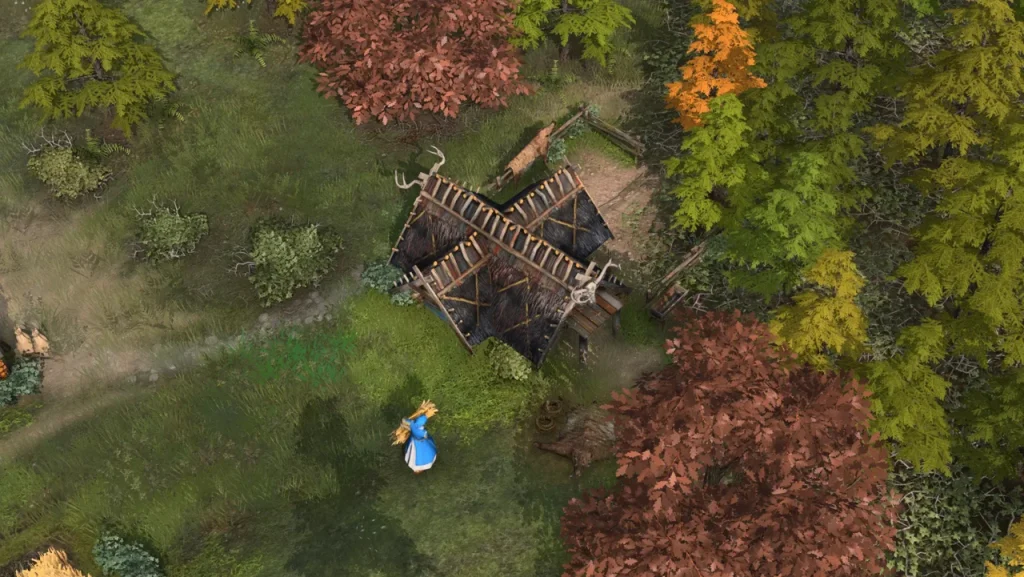
Age of Empires 4 Rus bounty mechanics currently reward gathering from animals, with economic thresholds at 100, 400, and 1,000 total bounty in the retrieved civilization data. Hunting Cabin forest gold is a separate income system. Plan safe animal-food gathering and useful Cabin placement instead of relying on an older Scout kill-count opening.
Bounty thresholds improve Villager food gathering and Hunting Cabin gold generation. A Hunting Cabin also accepts food, researches food technologies, and produces Scouts. Its nearby-tree income does not mean that placing the building automatically supplies the animal bounty needed for the next threshold.

This guide covers the original Rus civilization in an AI land skirmish. It uses checked civilization and item descriptions, not a recorded ranked build order or a measured gold conversion rate. Start with the Age of Empires 4 beginner guide if resource gathering and worker drop-offs are unfamiliar.
On this page
Age of Empires 4 Rus bounty mechanics in 6 checks
Track three things separately: the bounty total, spendable gold, and the income shown by each Hunting Cabin. Their relationship matters, but they are not interchangeable numbers. A good practice opening lets you identify the source of an increase instead of attributing every gold payment to hunting.
1. Read the current bounty rule
The retrieved Rus description says gathering from animals earns bounty gold. Older guides and the older official overview describe earning it by killing wildlife. Those describe a different trigger. For this current-data guide, food-gathering activity is the basis of the plan; a Scout kill count does not establish the income you will receive.
Check the civilization panel in your installed game before applying numerical advice from another date. This guide does not provide a payout table for individual animals or assume a fixed gold-to-food conversion. The useful first decision is whether your workers can safely gather the animal food you have found.
2. Scout food and access routes
Use the Scout to find food, reveal approaching routes, and reduce uncertainty about a worker move. A visible animal-food source is useful only if you can send workers, gather, and return resources without losing the group. Keep an escape route toward friendly protection rather than moving everyone into an unseen corner.
The Scout’s checked description includes exploration, wildlife hunting, and herding Sheep. Those functions explain its map role, but they do not justify importing an old animal-kill bounty table. Watch the current bounty counter while workers gather and treat the Scout’s exploration as support for that economy.
3. Place a Hunting Cabin for two actual jobs
A Hunting Cabin costs 75 wood. It accepts food drop-offs and generates gold based on nearby trees. Place it where the gathering route is short and the surrounding forest makes the building useful. A forest-rich spot far from your workers can be a poor food drop-off even if its gold potential looks appealing.
The building also contains food research and Scout production. Select it after construction to inspect these menus and the income display. Do not assume it has started producing a Scout just because the building is complete. A Scout must be purchased, and that purchase competes with other food spending.
4. Observe gathering and the first threshold
Assign workers to safe animal food and watch the bounty panel as they gather. Maintain Town Center production and ordinary housing. The purpose of the exercise is to connect gathering with bounty, not to stop the economy while watching a counter. Inspect the panel between normal worker and production actions.
At 100 bounty, the checked description lists a 10% Villager food-gathering bonus and 10% more Hunting Cabin gold. These are economic effects at a threshold, not a new military unit or free landmark. Continue to budget food, wood, and gold for purchases rather than treating the threshold as a complete opening plan.
5. Avoid counting overlapping trees twice
The Hunting Cabin description says trees in overlapping areas are counted only once. A second Cabin beside the first therefore does not promise the same full forest contribution again. Check the existing Cabin’s position and the displayed income before spending another 75 wood to cover the same patch.
An additional Cabin can still serve a new food source or a different forest area. Give it a clear purpose and choose a site you can protect. The overlap rule is a placement constraint, not a reason to send builders across hostile territory just to find an untouched circle of trees.
6. Reassess at 400 and 1,000 bounty
The next checked thresholds are 400 and 1,000. At 400, the listed bonuses are 15% food gathering and 25% Hunting Cabin gold; at 1,000, they are 20% and 40%. Read these as the threshold’s displayed bonus levels rather than adding every percentage together into an unsupported cumulative multiplier.
By then, the map and your economy may need a different food plan. Do not expose a large worker group just to cross a counter threshold. Compare the safe gathering available, the army required to hold it, and your next funded purchase. The bonus helps an economy that remains able to work.
Bounty gold versus Hunting Cabin forest gold
Animal gathering advances the bounty system in the checked description. A Hunting Cabin’s forest-based generation is separate, and the bounty threshold modifies that Cabin income. This distinction explains why your usable gold can rise even when the animal-gathering situation or bounty total has not changed in the same way.
For a simple observation drill, first inspect a Cabin’s gold display and the bounty total. Then assign workers to animal food and inspect the two again during normal play. Record what changed. This is a proposed test for the reader, not evidence that a specific payout rate or completion timing has already been measured.
Spendable gold is also affected by mining and purchases. Research or a unit queue can lower the stockpile while a bonus is working correctly. When saving for a landmark, check the actual gold reserve instead of using the bounty total as a substitute. A cumulative progress counter is not an unspent bank balance.
Use the current game’s income display to compare Cabin sites. This guide does not promise a fixed gold amount per tree or a universal spacing distance. The number and overlap of nearby trees are relevant, but their practical displayed value is the clearer guide to whether another placement solves your economic need.

Survival Techniques and Scout purchase budgets
Survival Techniques is researched at a Hunting Cabin and costs 25 wood and 75 gold in the checked entry. It improves hunted-meat gathering by 15%. That effect concerns the worker’s gathering activity, so choose it with the actual food source in mind rather than treating it as a generic upgrade to every kind of food.
One Cabin plus that research costs 100 wood and 75 gold, excluding workers, housing, and any unit production. The calculation is 75 wood for the building plus 25 wood and 75 gold for research. Keeping those costs separate helps you see whether the purchase delays the next production building or landmark reserve.
An ordinary Scout costs 65 food and can be produced at the Hunting Cabin. Two additional Scouts therefore require 130 food before any other spending. A Cabin queue can provide Scouts without using the Town Center’s queue, but the food commitment still competes with Villager production and your planned age advance.
Choose additional Scouts for a defined scouting or food-management task. More Scouts do not replace the Villagers needed to gather resources. Avoid copying an old many-Scout opening only because its author counted wildlife kills toward obsolete bounty thresholds. First identify the current mechanic and the map work those extra units will perform.
High Trade House is a later landmark decision
High Trade House costs 1,200 food and 600 gold as a Castle-transition landmark. Its description says it generates gold like a Hunting Cabin with a larger value, does not claim trees, provides a food drop-off, and produces huntable Deer. Those functions make it relevant to the later economy, not a free opening structure.
Its tree rule differs from ordinary Hunting Cabin overlap. Do not assume the landmark consumes the same tree allocation merely because both descriptions mention forest gold. Read the specific landmark entry and compare the current displayed income at the intended site before deciding how it fits with your existing Cabins.
The supplied Deer still need workers to gather their food. The landmark description does not turn that food into an instantly available stockpile. Safe access and gathering capacity remain part of the plan, just as with a natural animal-food source. Protect the workers and keep their drop-off route practical.


Troubleshooting and quick answers
Why did killing wildlife not match an older bounty guide? The current retrieved rule is based on gathering from animals. The older kill-based overview and its associated opening instructions should not be used as the numerical model for this guide. Check the installed civilization panel if your game version differs.
Why are the thresholds different from 100, 250, and 500? The checked original Rus data lists 100, 400, and 1,000. An old threshold list is not a current target. Read the actual bounty panel before deciding that a gathering group has reached the next bonus.
Why is a second Cabin less useful than expected? Check forest overlap and its real food-drop-off role. The description counts overlapped trees only once. Another Cabin can serve another area, but placing two beside one another does not prove the forest income will double.
Do farms advance animal bounty? Farms are a separate food source, so do not plan farm construction as animal gathering. A food-gathering threshold bonus and the activity that earns bounty are different parts of the system. Check both when transitioning from animal food to a longer-term economy.
Should I move workers out just to reach 400 bounty? First scout and secure the route. A threatened food group can lose more economic value than the next threshold adds. Keep a safe fallback and fund the army needed to hold the gathering area.
For your next practice run, identify one animal-food gathering group, one Cabin’s forest income, and one reached threshold. Mechanics were checked on November 8, 2026 against the official Rus overview and AoE4 World civilization data. Current in-game descriptions control later differences.
Sources and further reading
- https://www.ageofempires.com/games/age-of-empires-iv/civilizations/rus/
- https://github.com/aoe4world/data/blob/main/buildings/rus.json
- https://github.com/aoe4world/data/blob/main/units/rus.json
- https://github.com/aoe4world/data/blob/main/technologies/rus.json
- https://github.com/aoe4world/data/blob/main/civilizations/rus.json
Keep exploring
Games Like Age of Empires 4: economy, settlement or tactics?
Northgard fits resource and victory planning; Manor Lords fits settlement design; COH3 fits tactical combat with a campaign layer.
Age of Empires 2 Definitive Edition vs Age of Empires 4: where to start
Choose campaign breadth in AoE II DE or documented onboarding and newer presentation in AoE IV.
Age of Empires 4 Naval Combat: 6 Dock and Fleet Checks
A Dock-menu guide separating English combat, fishing, transport and trade ships, current per-item prices and unmeasured performance.