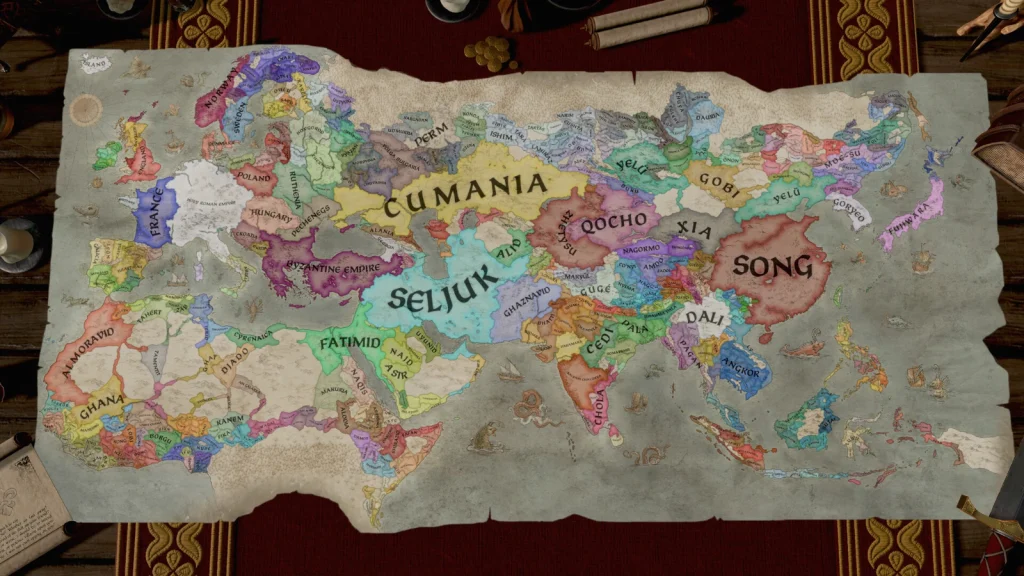
The best grand strategy games without combat micro are strongest when you want a campaign to revolve around politics and resources rather than a manually controlled battlefield. Start with Crusader Kings III for dynasties and realm relationships, or Europa Universalis IV for nations, diplomacy and trade. Both still require military decisions; the useful distinction is avoiding a separate tactical battle layer.
On this page
Decide which military work you want to avoid
If combat micro means aiming weapons, selecting individual soldiers or constantly repositioning formations inside a 3D battle, these games fit the request. You command at campaign scale instead.

If it means never raising an army, choosing a target or moving a force, neither is a complete escape. Wars still have costs and timing. A game can remove tactical control while leaving demanding choices about where and when to fight.
This shortlist is based on official game descriptions, not a test of how little input a campaign can survive. Pick the nonmilitary systems you enjoy because they are what fill the space left by manual battles.

Crusader Kings III: keep the dynasty at the center
Crusader Kings III puts a noble house, its heirs and its realm relationships at the center of a medieval campaign. Its official description presents war as one tool alongside diplomacy, intrigue and realm management.
Choose it when a marriage, succession or vassal relationship is more interesting than a tactical formation. The campaign follows people and titles across generations, so losing a ruler does not simply end the strategic story.
Characters have traits, lifestyles and schemes. Faith and culture add further ways to shape the realm. Those systems provide meaningful decisions during periods when you are not pursuing a war, and can change what a useful war would accomplish.
Military planning remains. The official page names men-at-arms, knights, raiding, mercenaries and Holy Orders. You still need to understand the force you raise and the objective it can afford to pursue. A ruler focused on intrigue cannot assume the borders defend themselves.
The drawback is that avoiding tactical micro does not make the game simple. Titles, succession and political relationships can create more uncertainty than a conventional battle. Choose it if you want that dynastic complexity rather than only a quieter combat interface.
Europa Universalis IV: manage the country behind the army
Europa Universalis IV is the stronger fit when you want a nation rather than a family to anchor the campaign. Its official description covers four centuries of diplomacy, trade, development, religion and military change.
A useful plan can involve trade power, alliances, spending monarch power or preparing for a political opportunity. The military supports those national goals. You are not asked to enter a separate battlefield and personally control every volley.
The map still demands army management. Choosing an opponent, moving the force and sustaining the campaign remain part of war. If those are the exact chores you want to eliminate, inspect current gameplay carefully before choosing EU4.
The appeal is continuity at national scale. A campaign can mix peaceful development with selective wars and diplomatic maneuvering. That suits players who want to decide whether war helps the state rather than make the battle itself the evening’s central activity.
The limitation is breadth. Several interacting systems still need attention, and the included expansion package can change over time. Read the current official purchase description instead of assuming an old base-game comparison describes today’s edition.
Choose the kind of campaign that replaces micro
Pick Crusader Kings III for rulers, heirs and relationships. Pick Europa Universalis IV for state development and world politics. In either case, begin with a manageable realm or nation and use a limited military objective while learning its wider economy.
Browse our strategy game lists if you want to compare pauses, shorter campaigns or operational delegation. Those can solve a different problem from removing direct battlefield control.
Sources and further reading
Keep exploring

Hearts of Iron 4 occupation laws: control resistance without draining reserves
Match occupation policy to resistance, compliance and a garrison you can actually supply; use stronger control only when the situation justifies its cost.

wargame red dragon radar anti air management: coverage and weapon-state decisions
A source-backed guide to managing specific radar-related weapons within a complete Wargame Red Dragon air defense.
wargame red dragon sead aircraft: choose a mission that helps
A concise source-backed guide to choosing and reassessing a useful SEAD mission in Wargame Red Dragon.