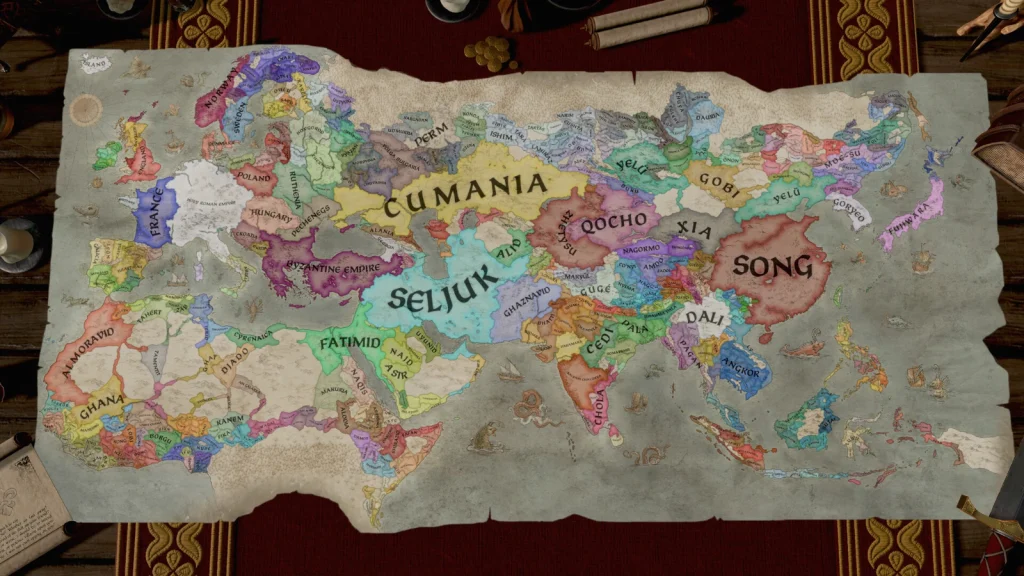
The best war strategy games with diplomacy make a deal change the military situation. Crusader Kings III puts rulers and dynastic relationships first, Europa Universalis IV organizes diplomacy around states, and Total War: Three Kingdoms connects alliances and character relationships to conquest. Choose whose interests you want to manage before choosing the largest map.
On this page
Crusader Kings III: the person behind the agreement
Crusader Kings III treats a ruler’s relationships as part of a dynastic campaign. Its official description includes marriage, intrigue, vassals and titles alongside war, giving political choices a role before and after an engagement.

It suits players who want a military opportunity to depend on people and succession. A relationship can outlast the current war, while a ruler’s death or a change of heir can alter the plan you thought you had secured.
The appeal is the connection between private and public interests. A character can be a family member, rival, vassal or useful political contact, and those roles create competing reasons to support or oppose a plan.
The drawback is instability. Dynastic relationships are not a permanent substitute for understanding the realm or maintaining a defense. Choose it when the political story is the attraction, not when you want every agreement to behave like a predictable production contract.

Europa Universalis IV: the state behind the agreement
Europa Universalis IV puts nations, alliances, trade, development and military change into a campaign spanning several centuries. The official description highlights royal marriage and flexible alliances as tools of state strategy.
Choose it when diplomacy should help the country achieve a broader goal. A military partner can change the choice of opponent, while trade and development affect what the state can afford to sustain.
The useful question is whether a relationship supports the national plan. An ally is not valuable merely because it is strong; its position and interests should fit the objective you intend to pursue. Diplomacy and war should solve the same strategic problem.
The limitation is the number of interacting systems. A diplomatic opportunity can arrive while the economy, religion or military situation is unsettled. Inspect the wider state before committing to an agreement that creates another obligation.

Total War: Three Kingdoms: relationships inside conquest
Total War: Three Kingdoms connects a turn-based campaign with real-time battles. Its official description puts friendships, alliances, betrayal and Guanxi character relationships at the center of the setting.
It fits players who want political deals to sit beside repeated tactical battles. Characters can command armies or govern provinces, and their positive or negative relationships influence the campaign you are developing.
The setting’s competing warlords make the diplomatic picture more than a list of abstract states. Building trust or exploiting a rivalry can give conquest a different context from simply attacking the nearest neighbor.
The drawback is the attention required by both layers. Enjoying negotiations does not automatically mean you want to fight every battle, and tactical success does not remove political problems. Inspect how the campaign and battlefield interact before buying mainly for one side.
Give the next agreement a purpose
Choose a concrete objective: protect a border, support a succession plan or reduce the risk of a war you are not ready to fight. Then compare whether the proposed relationship helps that objective and what it asks you to accept in return.
This is a research-based shortlist from official diplomatic and campaign descriptions. It does not claim a tested measure of AI negotiation quality or promise that every deal lasts. Our strategy game lists compare command scale and campaign workload when those are another part of choosing the right political war game.
Sources and further reading
Keep exploring

Hearts of Iron 4 occupation laws: control resistance without draining reserves
Match occupation policy to resistance, compliance and a garrison you can actually supply; use stronger control only when the situation justifies its cost.

wargame red dragon radar anti air management: coverage and weapon-state decisions
A source-backed guide to managing specific radar-related weapons within a complete Wargame Red Dragon air defense.
wargame red dragon sead aircraft: choose a mission that helps
A concise source-backed guide to choosing and reassessing a useful SEAD mission in Wargame Red Dragon.