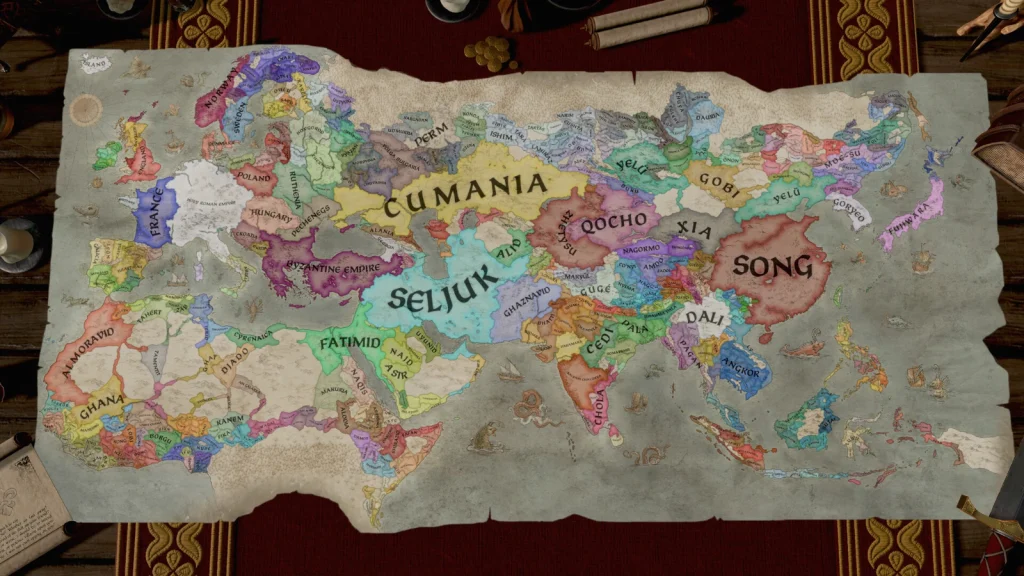
The best war strategy games with long campaigns give you a reason to care about what carries forward. Crusader Kings III follows a dynasty through generations, Total War: Three Kingdoms links characters and statecraft to conquest, and Stellaris develops an empire across a procedural galaxy. Choose the continuing story you want to manage, not an unsupported promise of a specific completion time.
On this page
What should survive the next battle?
| Game | Continuing campaign thread | Main commitment |
|---|---|---|
| Crusader Kings III | Rulers, heirs and the realm | Political and dynastic relationships |
| Total War: Three Kingdoms | Heroes, armies and the state | Campaign decisions plus tactical battles |
| Stellaris | The developing galactic empire | Exploration, economy, technology and fleets |
These are research-based recommendations from official game descriptions. Campaign length depends on settings, scope, pace and your stopping point. No timed playthrough or guaranteed number of evenings is claimed.


Crusader Kings III follows the family beyond one ruler
Crusader Kings III puts a noble house at the center of its medieval campaign. The official description makes a ruler’s death part of the lineage’s continuation rather than automatically the end of the story.
This suits players who want military gains to become political obligations. Land, titles, heirs and vassals remain to be managed after a war. A useful victory can still create a difficult succession or a relationship that needs attention.
Characters, faith, culture and schemes provide decisions between wars. That gives the campaign more than a sequence of battles and makes peaceful preparation meaningful to the next generation.
The drawback is uncertainty. A long campaign can change direction when a ruler dies or relationships shift. Choose it when that evolving dynastic story is part of the appeal, not when you need a perfectly controlled route to a predetermined ending.

Total War: Three Kingdoms connects the heroes to conquest
Total War: Three Kingdoms combines a turn-based campaign of empire building and statecraft with real-time battles. Its official description emphasizes named warlords, supporting characters and the relationships between them.
It is the pick when you want to keep commanding battles while a broader campaign makes their consequences matter. Heroes can lead armies or govern provinces, and friendships or rivalries give the political plan a human dimension.
The setting begins from a fractured China and asks you to build a new political order. Military, economic and diplomatic decisions contribute to that continuing objective rather than reset after each tactical fight.
The limitation is the workload of two layers. A long campaign requires both strategic administration and an approach to repeated battles. Inspect current gameplay from each layer before choosing only because the historical setting interests you.
Stellaris follows the empire as the galaxy opens
Stellaris begins with a civilization discovering interstellar travel. Science ships explore, construction ships develop new territory, and encounters lead to diplomacy or conflict.
Choose it when the continuing project is an empire you customize and expand. New technologies, colonies, species and fleets can change the strategic possibilities over the campaign instead of keeping the military problem fixed.
The procedural galaxy gives the exploration a different context each time. Alliances and competing powers add reasons to adapt the economy and fleet plan to the neighbors you actually meet.
The drawback is breadth. Managing a larger empire can increase the number of decisions that need attention, and current purchase bundles may include different expansions from an older guide. Check the edition and settings before starting the campaign you intend to maintain.
Give the campaign a manageable first goal
Begin with one ruler’s stable realm, one useful regional conquest or one secure galactic neighborhood. Keep notes on the next objective when ending a session so returning does not require reconstructing the entire plan.
Browse our strategy game lists if you want a shorter operational campaign or a different command scale. A long campaign works best when its recurring decisions are the reason you want to return.
Sources and further reading
Keep exploring

Hearts of Iron 4 occupation laws: control resistance without draining reserves
Match occupation policy to resistance, compliance and a garrison you can actually supply; use stronger control only when the situation justifies its cost.

wargame red dragon radar anti air management: coverage and weapon-state decisions
A source-backed guide to managing specific radar-related weapons within a complete Wargame Red Dragon air defense.
wargame red dragon sead aircraft: choose a mission that helps
A concise source-backed guide to choosing and reassessing a useful SEAD mission in Wargame Red Dragon.