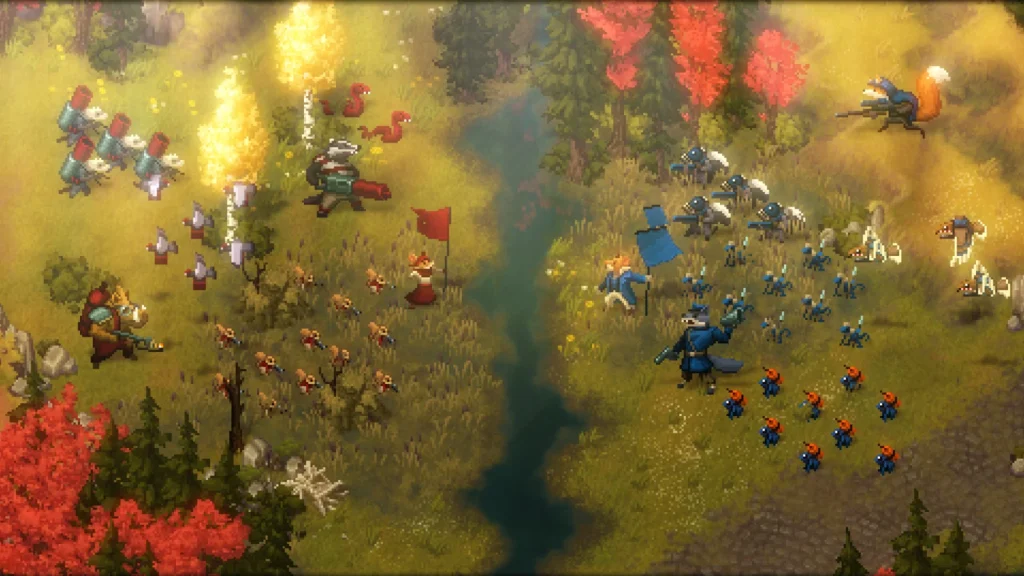
The best war strategy games with short matches should fit the time you actually have. Tooth and Tail explicitly advertises five-to-twelve-minute matches; Bad North offers compact island defenses, and Into the Breach lets you think through small turn-based battles. The latter two are single-player encounters rather than a promise of a fixed-length multiplayer match.
On this page
Tooth and Tail has the clearest duration claim
Tooth and Tail is the first choice when a short competitive RTS match is the requirement. The official description gives a five-to-twelve-minute range and lists online competitive play, split-screen and controls designed for a gamepad.

The game still has a base, an army and a map to manage. Procedurally generated terrain and customizable factions ask you to adapt a plan rather than repeat one fixed route. A compact match can contain a complete strategic contest.
That fits an evening built around several attempts, each with one lesson about expansion or engagement. It is easier to name a single change for the next match when the previous contest was brief.
The limitation is that the advertised range is not a personal guarantee. Setup, learning and finding the session you want take additional time. Check current online activity separately if competitive matchmaking is the only reason you are buying.

Bad North turns one island into the immediate problem
Bad North is a real-time tactics roguelite about defending small islands from landing attackers. The official description emphasizes broad positioning commands, troop relocation and decisions about evacuation.
It suits a short-session player who wants a clear local task: place the defenders, react to landings and keep the commanders alive. The island’s shape gives the battle its own problem without a sprawling economic build order.
Commanders and losses carry consequences into the broader attempt, so an island is not completely detached from the campaign. That makes surviving the encounter meaningful while keeping the immediate battlefield readable.
The drawback is pressure and permanence. The official description warns that losing a commander is permanent and losing everything ends the attempt. A small battlefield does not mean a relaxed outcome, and this article does not assign an unmeasured number of minutes to every island.

Into the Breach removes the running clock
Into the Breach uses compact turn-based mech battles with telegraphed enemy attacks. Civilian buildings power the force, so defending them is part of deciding what each mech should do.
Choose it when your available time is uncertain and reaction speed is the problem. You can inspect the threatened tiles and compare a counter before taking the turn. The useful short-session quality is the focused decision space rather than a claimed fixed battle duration.
New weapons, pilots and mech squads give future attempts different tools. The larger run links those battles together, but each encounter presents a relatively small set of positions and threats to solve.
The limitation is that thinking time can be substantial. A small grid can still produce a difficult puzzle, especially when several objectives compete. Choose it if deliberate turns fit your session, not because you need every battle to finish within an exact timer.
Choose the stopping point before starting
Leave a little time after the encounter to identify its decisive choice. A short session is more useful when you can return with one clear adjustment instead of only remembering the outcome.
For multiplayer, leave time for the whole match and its setup. For a single-player run, decide whether the stopping point is one encounter or the end of the attempt, and check the game’s current save behavior before relying on interruptions.
This shortlist distinguishes an official match-duration claim from a practical small-encounter recommendation. No personal timing benchmark was run. Browse our strategy game lists when you want short campaigns, cooperative sessions or fully turn-based command instead.
Sources and further reading
Keep exploring

Hearts of Iron 4 occupation laws: control resistance without draining reserves
Match occupation policy to resistance, compliance and a garrison you can actually supply; use stronger control only when the situation justifies its cost.

wargame red dragon radar anti air management: coverage and weapon-state decisions
A source-backed guide to managing specific radar-related weapons within a complete Wargame Red Dragon air defense.
wargame red dragon sead aircraft: choose a mission that helps
A concise source-backed guide to choosing and reassessing a useful SEAD mission in Wargame Red Dragon.