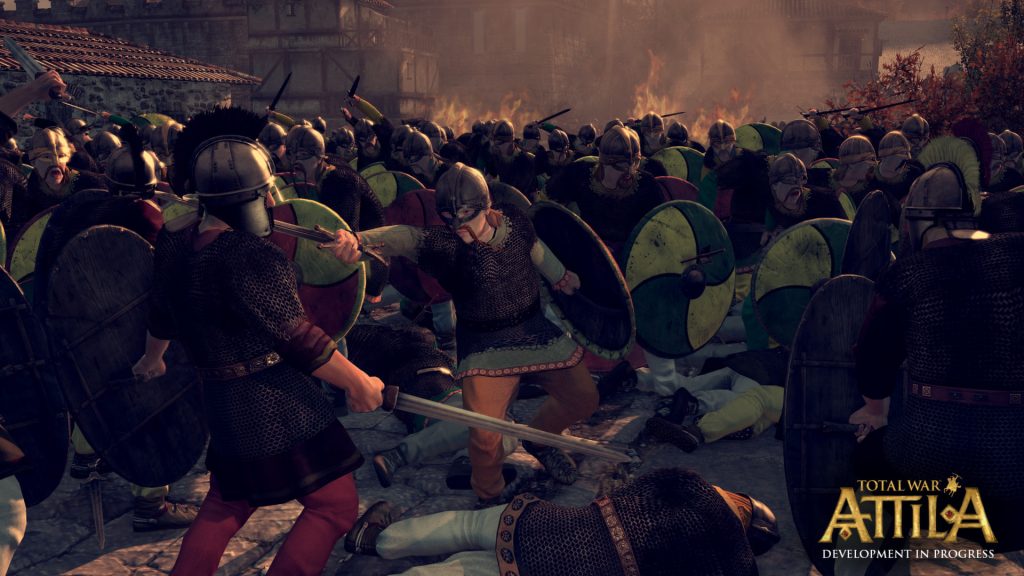
Choose Total War: ROME II if you want to build a classical empire through conquest, politics and settlement development. Choose Total War: ATTILA if a threatened late-Roman world sounds more compelling, especially a Western Roman Empire campaign that begins with extensive territory already in danger. Both combine turn-based campaigns with real-time battles. The useful distinction in Total War Rome 2 vs Total War Attila is the campaign you want those battles to serve.
ROME II invites you to pursue power in the ancient world. ATTILA asks how far you will go to survive in its 395 AD setting. That framing gives you a better starting point than assuming the newer title must be a straightforward upgrade.

On this page
What kind of empire would you enjoy managing?
| Your preference | ROME II | ATTILA |
|---|---|---|
| Historical focus | Classical conquest and the Roman world | Late antiquity, beginning in 395 AD |
| Campaign attraction | Expand through military, economic and political means | Survive turmoil or establish a new kingdom |
| Documented management systems | Emperor Edition politics and building-chain updates | Politics, family tree, civic management and technology |
| A concrete campaign hook | Imperator Augustus and the divided Roman Republic | The Western Roman Empire’s vulnerable starting territory |
| Destruction emphasis | Historical land and sea combat | Battle fire and campaign-map razing |
These are design differences documented by the official descriptions, rather than rankings of difficulty. A familiar historical period can make a campaign more inviting without making its systems objectively easier.
ROME II gives expansion a political purpose
ROME II’s campaign allows military, economic and political routes to domination. Emperor Edition specifically describes an improved politics system and overhauled building chains. Prefer it when deciding how to develop conquered territory is part of your interest in warfare, and when the Roman Republic or a rival ancient civilization gives you a reason to keep expanding.
The Imperator Augustus campaign offers a particularly clear historical choice. The archived Emperor Edition description places it in 42 BC, after Caesar’s murder, with members of the Second Triumvirate competing for Rome’s future. That is an attractive starting premise if you want internal Roman rivalry to explain the next war. Check the current edition listing for campaign access when buying.
The official ROME II Emperor Edition page describes its campaign and battle systems. If ancient armies are the attraction, pay attention to the civilizations presented there rather than treating Rome as the only possible campaign identity.

ATTILA makes the territory you already own a problem
The Western Roman Empire is ATTILA’s strongest example of its survival theme. Its official description says you begin with vast territories, weakened by political in-fighting and threatened on all sides. The appeal is therefore different from simply choosing where an expanding empire should go next: a large starting realm creates obligations before you have won your first new province.
ATTILA also documents fire that can set buildings ablaze in battle and a raze mechanic that can wipe cities and regions from the campaign map. These features make destruction part of its campaign identity. They are reasons to prefer its setting if the fate of settlements interests you as much as a successful attack, rather than evidence that every battle requires the same approach.
Its political, family-tree, civic and technology systems give that survival story more than a battlefield dimension. A buyer drawn to the late-Roman crisis should consider the governing layer as part of the attraction. The Western Roman Empire is one specific starting situation; it does not describe every faction, since the official page also offers the prospect of carving out other kingdoms.
Read the official ATTILA product description for those starting conditions and destruction mechanics.
Use the next turn as your deciding test
Imagine returning to the campaign after a real-time battle. In ROME II, would you want to decide how the victory advances your classical state’s political and economic ambitions? In ATTILA, would you rather reconsider which commitments a vulnerable realm can sustain? This is a planning exercise based on their documented premises, not an account of a tested campaign.
Pick ROME II when ancient civilization, empire growth and Roman political rivalry are your main reasons to play. Pick ATTILA when late-antique upheaval, destructive warfare and the challenge of holding a threatened realm are the story you want. For a first campaign, choose the premise you can explain to yourself in one sentence; that gives the management and battles a shared purpose.
Sources and scope
This comparison uses archived official Steam descriptions and personally inspected official screenshots. It does not report hands-on play, measured performance, current prices or multiplayer population. Check the linked product pages for current editions and campaign access.
Sources and further reading
Keep exploring

Total War Warhammer 3 vs Total War Attila: fantasy or survival?
Choose WARHAMMER III for fantasy races and Legendary Lords; choose ATTILA for late-antique survival, vulnerable territory and destructive warfare.

Total War Attila vs Total War Shogun 2: survive or reunite?
ATTILA offers late-antique survival and destructive warfare; SHOGUN 2 centers a clan campaign on reunifying Japan.
Total War ATTILA Mod Installation: Workshop to Launch
Install one ATTILA Workshop mod with its required dependencies, confirm the download and launcher selection, then verify the intended change in a fresh session.