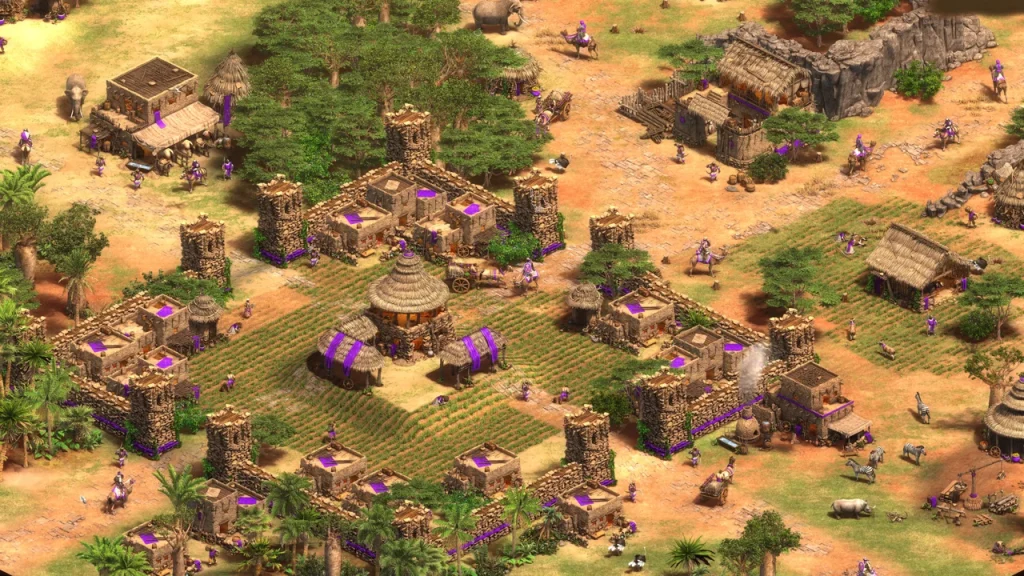
TL;DR: Practice a 23-population Feudal opening with 22 Villagers and the starting scout. Complete a Barracks, establish gold income during the age transition, then build one Archery Range and fund Archers, Houses, and Fletching while keeping Villagers in production.
An Age of Empires 2 Definitive Edition archer rush build order needs more than a fast age click: ordinary Archers cost 25 wood and 45 gold each, and the Range requires a Barracks. This guide uses a deliberately manageable one-Range exercise. A second Range is a later capacity decision, not a required purchase before you can afford the first queue.

Choose a standard land skirmish in Age of Empires II: Definitive Edition. Byzantines provide the baseline availability checked for this guide, but the choice is for consistency rather than competitive superiority. The English technology-tree reference supplies the selected costs and prerequisites. Worker assignments below are a teaching plan, with no fixed fastest timestamp or firsthand ranked test claimed.
On this page
Age of Empires 2 Definitive Edition archer rush build order: eight steps
1. Assign Villagers one through six to opening food
Keep the Town Center training Villagers whenever 50 food and population space permit. For a conventional sheep start, gather near the Town Center and bring additional animals into a convenient position before the current source finishes. Use selected workers to complete opening Houses, then send them back to gathering. A standard House costs 25 wood and adds five population spaces.
Use your starting scout to locate the nearby food and forest before exploring farther. The worker sequence assumes a standard land start with usable natural food. If your map or scenario provides something different, adapt the source rather than expecting the same food income. The first six workers should have useful jobs; their assignment number does not justify leaving them at an exhausted animal.
2. Put Villagers seven through ten on wood
Villager seven builds a Lumber Camp by a suitable forest, then joins the other three assigned woodworkers. The standard camp costs 100 wood. This opening gives wood a larger early role because Archery Range construction, Archer production, Houses, and later Farms all use it. Keep the drop-off point close enough to the active trees to limit unnecessary walking.
Build the next House before the population counter fills. If a woodworker takes that construction task, return the worker to the forest afterward. Four assigned woodworkers do not mean four are gathering continuously while one is building. Pay attention to the actual stockpile and gathering jobs rather than assuming the ledger automatically supplies every later construction purchase.
3. Put Villagers eleven through nineteen on food
Villager eleven handles a first boar lure when the map offers that resource and you can control the action safely. Keep the existing foodworkers ready to gather near the Town Center. Villager twelve constructs a Mill near berries; Villagers thirteen through fifteen join that source. The Mill costs 100 wood and also establishes the prerequisite for Farms you may need later.
Villager sixteen can handle a second hunt as the first is depleted, while Villagers seventeen through nineteen join food under the Town Center. Do not kill a fresh hunt animal simply because the written sequence reached that worker number. Food availability and your ability to keep gatherers working matter more than rigidly executing an action before it is needed.
4. Send Villagers twenty through twenty-two to wood and advance
With those three added woodworkers, the planned distribution is fifteen on food and seven on wood. The living worker count is 22, and the starting scout makes 23 population before you add other units. Check the actual survivors if a hunt or enemy action caused a loss. A population number with fewer workers represents a different economy.
Budget Loom if you intend to take it; the baseline technology costs 50 gold and improves Villager durability. Then reserve 500 food for Feudal Age, with two eligible Dark Age building types completed. Your Lumber Camp and Mill meet that requirement. Houses do not. Do not leave the Town Center unproductive for a long wait simply to force the chosen population target into the replay.
5. Build a Barracks and establish gold during the transition
The Barracks costs 175 wood and is required for the Archery Range. Construct it while Feudal Age is researching if you can fund the building and upcoming Houses. Separately, build a Mining Camp near a usable gold deposit for 100 wood. Transfer three foodworkers to gold as a first practice assignment, leaving the planned distribution at twelve food, seven wood, and three gold before temporary builders.
Those three goldworkers are an initial teaching allocation rather than a guarantee that every production plan will be sustained. Walking distance, worker time spent building, and purchases from the starting gold stockpile all affect the result. Watch how quickly the gold stockpile recovers after an Archer purchase. Add gold income later if the actual queue shows a persistent shortage.
6. Construct one Archery Range in Feudal Age
After Feudal Age completes, build an Archery Range for 175 wood. The finished Barracks must already satisfy its prerequisite. Return the Range builders to their jobs and continue Villager production. Select the Range and inspect the ordinary Archer button. The baseline cost is 25 wood and 45 gold, so both resource icons must be affordable before a new unit can be queued.
For a small first batch, four Archers cost 100 wood and 180 gold. This is an example budget, not a claim that four units are always the correct group. Keep the next House funded as population grows. If the Town Center and Range are both blocked at the same capacity limit, gold mining is not the missing action; you need additional population space.
7. Build a Blacksmith and budget Fletching
A standard Blacksmith costs 150 wood. Fletching inside it costs 100 food and 50 gold and adds attack and range to the affected ranged units. Purchase the technology when you can support it without abandoning necessary workers or capacity. A completed Blacksmith does not automatically apply Fletching; construction and research are separate resource commitments.
Four Archers plus Fletching require 230 gold in total, as well as the Archers’ 100 wood and the technology’s 100 food. The Blacksmith construction is another 150 wood. Keep those sums separate in your notes. Starting gold, Loom, and any other research change the amount you must gather, so read your current stockpile rather than assuming the full total is still needed from the mine.
8. Maintain production before adding another Range
Send newly trained Villagers toward the resource that actually stops your chosen queue. Add Farms as natural food declines, remembering the standard 60-wood cost per Farm and its Mill prerequisite. A batch of five Farms costs 300 wood, which can consume the money you had mentally assigned to another military building. Stage this transition to keep Houses and Archer purchases affordable.
Review the first exercise after the chosen Archer batch and Fletching are funded. If the original Range repeatedly stops from missing gold or wood, do not add a second one as the first correction. Another Range costs 175 wood and allows more simultaneous spending. Add it when you want that capacity and the current economy can pay for the additional queue.
Use the worker ledger as a check, not a timer
The pre-Feudal ledger contains six opening foodworkers, Villager eleven, four berry workers, Villager sixteen, and Villagers seventeen through nineteen. Those fifteen foodworkers combine with seven woodworkers for 22 Villagers. Moving three foodworkers to gold during transition changes the resource distribution without changing the worker count. Builders temporarily reduce the number actually gathering at a given moment.
This distinction helps explain why an age click can feel correct but the first Archer arrives late. Several foodworkers may be building a Mining Camp, Barracks, House, and Range instead of collecting. If construction has consumed more attention or wood than expected, restore the needed jobs and continue the worker queue. The ledger does not eliminate the need to observe what your economy is doing.

Budget the opening’s wood demand
Barracks and Range cost 350 wood together. Adding the Blacksmith makes 500 wood for that production-and-research chain. Lumber Camp, Mill, and Mining Camp add 300 wood before Houses, Farms, and the units themselves. Some of those expenses are paid from starting resources and ongoing gathering, but the total shows why this route needs sustained wood income.
Avoid buying every visible economic technology at once. Double-Bit Axe costs 100 food and 50 wood and raises baseline wood gathering speed by 20 percent, while Horse Collar costs 75 food and 75 wood and improves Farm food capacity. They can support the economy, but their immediate price competes with Fletching, Villagers, and construction. Choose a purchase order from the actual shortages you see.
Reserve food even though ordinary Archers do not cost it. Villagers still need 50 food each, and Fletching needs 100. Later Castle Age requires 800 food and 200 gold. A large gold stockpile beside an empty food stockpile is not a balanced economy for that future goal. Plan the next step while keeping the current Range and Town Center affordable.
Understand what Fletching changes
The checked Fletching tooltip covers Archery Units, Skirmishers, specified ranged ships and fortifications, with a separate Town Center attack effect. For this guide, the relevant point is its attack-and-range improvement for your Archers. Do not assume that the name of any visible ranged unit proves every technology applies in the same way. Use the actual unit and technology tooltips when changing production.
Fletching is different from the later Crossbowman unit-line upgrade. Reaching another age, building a Blacksmith, and completing a particular technology are three separate events. If you plan a Castle transition, inspect which research becomes available at the Range and what it costs in your installed game. The Feudal exercise finishes with ordinary Archers and funded research rather than an implied automatic unit transformation.
Keep army attention from interrupting the economy
Use a simple control group for the Archer group, then return regularly to the Town Center and Range. Give units a purposeful movement instruction and check whether the resource jobs remain active. Long periods following the group with the camera can leave finished foodworkers idle, hide a missed House, or allow both production queues to empty without being noticed.
The checked Archer description warns about Skirmishers, the Mangonel line, and opponents closing to short range. Recognize those as reasons to reassess a move rather than assuming an Archer group is useful against everything. Exact engagements depend on numbers, technology, terrain, and control. This guide supplies a production foundation and source-checked roles; it does not claim replay-tested combat outcomes.

Troubleshoot missing resources and disabled buttons
If the Archery Range cannot be built, check Feudal completion and the Barracks prerequisite before changing the economy. If construction is allowed but cannot be paid for, check wood spent on camps, Houses, and Farms. A disabled unit button inside a completed Range is another question: inspect the unit price and population space rather than treating every unavailable button as an age problem.
If gold runs out, verify that miners are working at the assigned deposit and that their drop-off site is nearby. A worker sent toward a mine but left idle does not create income. If wood is the bottleneck, look for a large farm batch or unused construction capacity. Pause optional expansion while preserving the worker economy and the one Range you already own.
If Fletching is delayed, check the completed Blacksmith, then its 100-food and 50-gold price. It shares gold with Archers and food with Villagers. Decide which next purchase is most useful for the exercise rather than trying to queue everything at once. Record that choice during replay review so you can distinguish a deliberate tradeoff from a shortage you failed to notice.

Archer opening questions
Does 23 population mean 23 workers?
No. This example uses 22 Villagers plus the starting scout. Extra units and losses change the relationship, so count workers separately when checking the build. The resource ledger should describe living Villagers, not an assumed population label.
Are two Archery Ranges required?
No. The practice route starts with one so you can observe the resource demand. A second Range costs another 175 wood and adds production capacity. Buy it when the economy can use the extra queue, rather than expecting it to fix an unfunded first Range.
Can I skip the Blacksmith?
You can produce ordinary Archers without it, but you cannot complete this guide’s Fletching research until the Blacksmith is built. Keep the building’s 150 wood and the technology’s 100 food and 50 gold as separate purchases in your plan.
What should I change on the next attempt?
Choose the first clear bottleneck: a population block, missing Barracks, late gold income, empty food source, or unfunded research. Repeat the same civilization and settings with that one issue corrected. Compress the opening only after the resource assignments and production chain work consistently.
Sources and further reading
- https://www.ageofempires.com/games/age-of-empires-ii-definitive-edition/
- https://store.steampowered.com/app/813780/
- https://aoe2techtree.net/
- https://raw.githubusercontent.com/SiegeEngineers/aoe2techtree/e56728e76b7d08301fba7b18d5f16bc8554c109a/data/data.json
- https://raw.githubusercontent.com/SiegeEngineers/aoe2techtree/e56728e76b7d08301fba7b18d5f16bc8554c109a/data/locales/en/strings.json
- https://raw.githubusercontent.com/SiegeEngineers/aoe2techtree/e56728e76b7d08301fba7b18d5f16bc8554c109a/data/trees/BYZANTINES.json
Keep exploring
Age of Empires 2 Definitive Edition vs Total War Rome 2: choose your scale
Choose a historical RTS scenario library or an ancient territorial campaign linked to real-time battles.
Age of Empires 2 Definitive Edition vs Age of Empires 4: where to start
Choose campaign breadth in AoE II DE or documented onboarding and newer presentation in AoE IV.
Age of Empires 2 Definitive Edition vs Total War Shogun 2: match or campaign?
A comparison of immediate RTS development and the continuing clan campaign in SHOGUN 2.