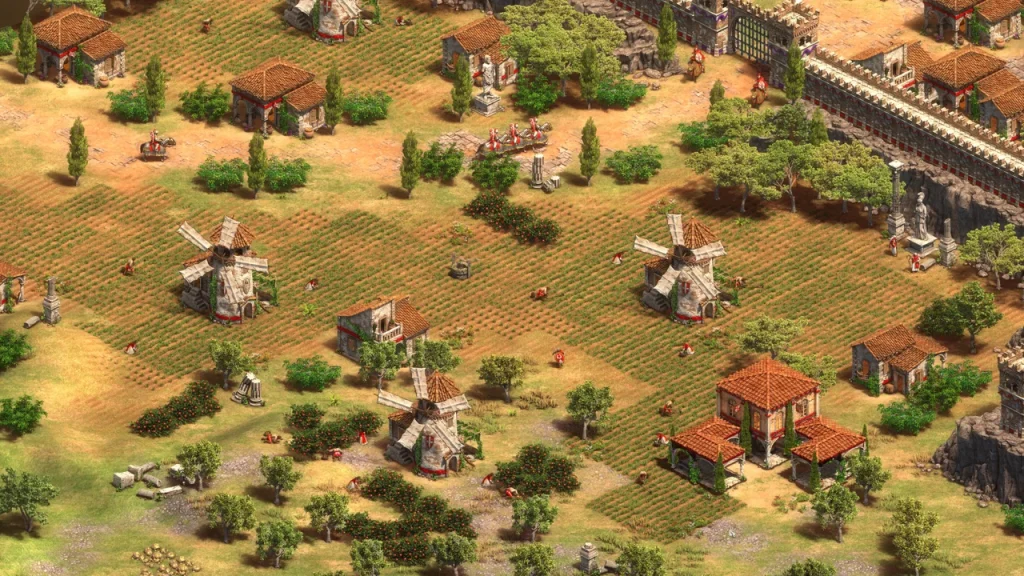
TL;DR: Keep your Town Center producing Villagers, gather food near a drop-off point, and build Houses before the population counter fills. Reach Feudal Age with two eligible Dark Age building types and 500 food, then choose one military production route you can afford.
This Age of Empires 2 Definitive Edition beginner guide starts with the economy loop that supports every opening: produce a worker, give that worker a job, and prepare the next purchase. Your first practice target is a working economy and an unlocked Feudal production building. A specific rush or fast Castle schedule becomes easier once those actions feel familiar.

The instructions below use a standard land skirmish in Age of Empires II: Definitive Edition. Choose Byzantines for this teaching exercise and use a manageable AI difficulty. This choice supplies the ordinary buildings and units discussed here; it is not a claim that Byzantines are the strongest beginner civilization. Campaign missions, unusual starting resources, mods, and civilization bonuses can change the sequence.
On this page
Age of Empires 2 Definitive Edition beginner guide: first-session steps
1. Select the Town Center and queue a Villager
A standard Villager costs 50 food. Select the Town Center, inspect its production panel, and queue a worker when that food is available. Keep returning to this panel during the opening. An idle Town Center quietly slows the economy even when the rest of your screen looks busy, so make checking its queue a repeated habit.
Give the newly created worker an immediate gathering task. For a conventional sheep start, food under the Town Center is a useful first assignment because workers can deposit it nearby. Keep your opening food workers together on the current animal instead of scattering them across several distant animals. Bring additional food sources closer when the map and your controls allow it.
2. Build Houses before production becomes blocked
A standard House costs 25 wood and supplies five population spaces. Watch both numbers in the population counter: current use and capacity. A worker being trained still needs room when production completes, and later military production competes for the same capacity. Place the next House while you still have space rather than waiting for a blocked queue.
Send the House builder back to work afterward. Construction is a task, not a permanent resource assignment. If the builder remains idle beside the finished House, your economy loses the gathering you expected. Avoid surrounding your Town Center with badly placed structures that make worker movement harder; leave routes to food, forests, and future farms.
3. Establish wood and a second food source
Build a Lumber Camp near a usable forest and a Mill near berries when those resources are available. Each standard building costs 100 wood. These drop-off buildings reduce unnecessary travel and establish two eligible Dark Age building types for the Feudal advance. Several Houses do not satisfy that requirement, even though they were built during Dark Age.
For a first exercise, put a small group on wood and maintain enough workers on food to pay for Villagers. Add berry workers gradually instead of sending the entire economy away from the Town Center. Use your starting scout to locate nearby resources and map edges. Finding food before the current source runs out is more useful than moving randomly across unexplored ground.
4. Prepare the Feudal purchase and its prerequisites
The standard Feudal Age advance costs 500 food and is researched at the Town Center. The checked English technology-tree reference lists Lumber Camp, Mining Camp, Mill, Dock, and Barracks as eligible Dark Age buildings. Have two different eligible types completed, then inspect the age button. Your Lumber Camp and Mill already meet this teaching route’s building requirement.
Choose Loom deliberately. It costs 50 gold and adds Villager durability, but research occupies the Town Center while it runs. That means the same production panel cannot simultaneously complete a Villager and the research. On an exposed map, Loom is a sensible safety purchase before sending workers into danger. It does not remove the need to notice danger or bring workers home.
5. Choose one Feudal production building
A Barracks is required before a Stable or Archery Range. Each of those three standard buildings costs 175 wood, so a Barracks plus either follow-up costs 350 wood before units, Houses, farms, or research. Build the Barracks during your age transition if you intend to use one of those routes, and keep its builder accounted for in your worker plan.
In Feudal Age, a Stable produces ordinary Scout Cavalry for 80 food each. An Archery Range produces ordinary Archers for 25 wood and 45 gold each. Choose one route for the exercise. The Stable shares its food demand with Villagers; the Range needs both wood and gold. A production building without the resources for its units teaches you where the budget needs adjustment.
Give each resource a clear job
Food supports Villagers, age advancement, and many units or technologies. Wood funds the buildings and farms that let that food economy keep working. Gold pays for Archers, Loom, later age advancement, and many other purchases. Stone has important later uses, but a basic opening does not require assigning miners to it simply because the resource exists.
Assign workers for your next planned purchase. If your next goal is Feudal Age, extra gold mining cannot replace the missing 500 food. If your goal is an Archer queue, food alone cannot pay the 45 gold per unit. Read the resource icons on the actual button, then check which income stream is short. That is more reliable than trying to memorize a fixed ratio for every game.
Separate stockpiles from income. Having enough wood to construct a Range once does not prove that you can continuously train Archers and add farms. Similarly, a large food stockpile can disappear after age research and several Scout Cavalry purchases. When a queue stops, ask whether the purchase was expensive, the gathering rate was low, or workers were temporarily building instead of gathering.

Understand the farming transition
Natural food sources eventually run out or become inconvenient. A standard Farm costs 60 wood, requires a Mill, and supports one Villager at a time. Add farms in batches your wood income can support. Five Farms cost 300 wood, which is more than a Stable and competes with your next House, production building, and wood upgrade.
Place farms around convenient drop-off points and avoid sending every food worker to a far corner of the base. When a worker finishes a natural source, decide where that worker should go next. A planned move to a nearby Farm is better than leaving the worker idle while you handle units elsewhere. Check the farm reseeding controls available in your installed game and keep enough wood for the choice you make.
Horse Collar is researched at the Mill for 75 food and 75 wood in the checked baseline. Its tooltip describes an additional 75 food for new Farms and a smaller amount for existing Farms. Budget the technology alongside farm construction rather than assuming that the research itself places new farms. For a first session, understanding this spending conflict matters more than chasing a perfect research second.
Read age advancement as an unlock
Castle Age requires 800 food, 200 gold, and two eligible Feudal building types. The checked tooltip lists Archery Range, Stable, Blacksmith, and Market. Your Barracks does not count toward this Feudal requirement, and two copies of the same production building do not create two different types. A Market and Blacksmith are one possible pair; a Stable and Blacksmith are another.
Reaching Castle Age opens further options, but research does not automatically supply an army or a second economy. Inspect the newly available buttons and decide what you can fund. Building a stone Castle and researching Castle Age are separate actions. Do not spend your food and gold advancing, then assume that the resulting age label will pay for the next production queue.
Use the builder menu to check when additional Town Centers are available in your actual match. The ordinary Town Center entry costs 275 wood and 100 stone, and workers trained afterward still cost food. Expansion therefore creates several expenses: construction, additional worker queues, Houses, and food gathering. Add capacity when you can use it, rather than building because a later age has arrived.
Buy upgrades that support your current plan
The Blacksmith costs 150 wood and contains military technologies. For the baseline Archer route, Fletching costs 100 food and 50 gold, adding attack and range to the affected ranged units. Inspect the tooltip to distinguish that research from unit-line upgrades. A ranged technology does not make an ordinary Archer into a Crossbowman, nor does it replace the production building that trains the unit.
At the Lumber Camp, Double-Bit Axe costs 100 food and 50 wood and increases Villager wood gathering speed by 20 percent in the checked reference. It can support a wood-hungry economy, but its purchase still competes with workers and construction. If you research it while unable to finish a needed House, the immediate population block may erase much of the benefit you expected.
Open a building’s panel with a specific question: what problem does this purchase solve now? Avoid buying every affordable technology just because a button is visible. A first exercise becomes easier to review when it has one unit route, a small number of relevant technologies, and an explicit plan for replenishing the resources you spend.

Keep the interface manageable
Learn the commands for selecting your Town Center, finding idle Villagers, and returning to a production building. Check the hotkey settings in your installation because presets and personal bindings differ. Use a small number of control groups for the workers or units you repeatedly select. Adding many groups at once creates another memory task before the economy loop is comfortable.
Practice camera movement in short trips. Look at the scout, give it a useful instruction, then return to the Town Center and resource assignments. Do the same after selecting military units. The goal is to keep economy maintenance going while attention moves elsewhere. Long stretches watching one unit often explain an unexpectedly small worker count or several unnoticed idle gatherers.

Fix the common opening problems
If the Town Center repeatedly stops, check food, population capacity, and the production queue in that order. These are different failures. More farms will not solve a filled population cap until you add capacity, and a House will not solve an empty food stockpile. Check whether workers are still gathering the source you assigned or have finished it and become idle.
If Feudal Age is unavailable with 500 food, inspect eligible building types and completion status. An unfinished Mill does not solve the prerequisite, and your collection of Houses is irrelevant to that particular button. If a Stable or Range is unavailable after advancing, check the Barracks. Treat a disabled button as a specific dependency question instead of spending on unrelated buildings.
If the first military queue empties, return to the purchase’s resource icons. For scouts, compare food committed to units with food reserved for Villagers. For Archers, check gold miners and the wood used by farms. Add income or slow the military purchases. Constructing a second production building usually makes an unfunded first queue harder to support.
Beginner questions
Should I start with campaigns or skirmishes?
Use campaigns for their scenario objectives and a standard skirmish for repeating a controlled opening. Mission-specific starts can teach different mechanics, so do not judge a skirmish build order by a campaign that begins with a developed base or restricted buildings.
How many Villagers should I make?
Keep producing during the opening when food and capacity permit. This guide does not prescribe a universal final worker count. For your first review, check whether every worker had a job and whether you could pay for the next worker without abandoning the planned advance.
Do I need to gather all four resources immediately?
No. Assign gatherers according to the purchases you intend to make. A basic Scout Cavalry exercise does not need gold miners for the 80-food unit, while an Archer route needs a dependable gold supply. Stone mining is a separate decision for later spending.
What should I practice next?
Repeat the same map settings and civilization, then choose either a scout production opening or an Archer production opening. Change one habit per session, such as earlier Houses or fewer idle workers. Save and review the replay if available; record what actually interrupted the economy rather than assuming the problem was simply speed.
Sources and further reading
- https://www.ageofempires.com/games/age-of-empires-ii-definitive-edition/
- https://store.steampowered.com/app/813780/
- https://aoe2techtree.net/
- https://raw.githubusercontent.com/SiegeEngineers/aoe2techtree/e56728e76b7d08301fba7b18d5f16bc8554c109a/data/data.json
- https://raw.githubusercontent.com/SiegeEngineers/aoe2techtree/e56728e76b7d08301fba7b18d5f16bc8554c109a/data/locales/en/strings.json
- https://raw.githubusercontent.com/SiegeEngineers/aoe2techtree/e56728e76b7d08301fba7b18d5f16bc8554c109a/data/trees/BYZANTINES.json
Keep exploring
Age of Empires 2 Definitive Edition vs Total War Rome 2: choose your scale
Choose a historical RTS scenario library or an ancient territorial campaign linked to real-time battles.
Age of Empires 2 Definitive Edition vs Age of Empires 4: where to start
Choose campaign breadth in AoE II DE or documented onboarding and newer presentation in AoE IV.
Age of Empires 2 Definitive Edition vs Total War Shogun 2: match or campaign?
A comparison of immediate RTS development and the continuing clan campaign in SHOGUN 2.