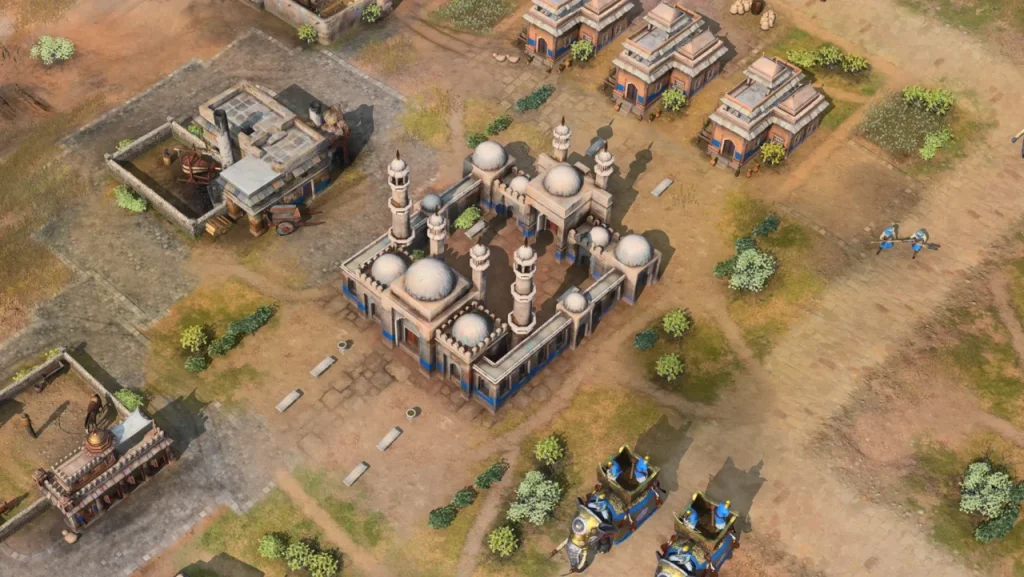
Age of Empires 4 Delhi Sultanate research costs no resources, but takes longer and depends on Scholar support for faster completion. Build a Mosque, garrison its first Scholar, and keep the relevant research buildings inside influence. Start useful technology queues early, then check their progress before committing to a plan that needs the finished upgrade.
The Delhi Sultanate’s free technologies do not make Scholars, buildings, military units, or age-up landmarks free. In the checked unit data, a Scholar costs 135 gold at a Mosque and 80 gold at Dome of the Faith. Moving a Scholar to heal or support production also changes how that unit is contributing to your research system.

This guide covers the original Delhi civilization in an AI land skirmish. It uses retrieved item and civilization data rather than a recorded competitive timing. Review the Age of Empires 4 beginner guide if you need the basic worker, construction, and queue controls first.
On this page
Age of Empires 4 Delhi Sultanate research in 6 steps
Treat research as a set of building queues supported by a shared Scholar system. To learn it, identify each technology’s building, confirm the building’s influence connection, and observe the actual progress bar. A free button is useful only when the upgrade finishes in time to serve your plan.
1. Construct the first Mosque
A Mosque costs 100 wood. The first Mosque constructed provides a Scholar in the checked building description. Place it where it can support the economy buildings you intend to use, leaving room for construction and worker paths. Inspect influence coverage instead of assuming the bonus covers every building on the map.
You still need a food economy, housing, and ordinary resource drop-offs. Spending the Mosque’s wood should fit alongside those needs. After construction, locate the Scholar and select the Mosque’s menu. Confirm the support unit’s position before starting a long queue and assuming it is already accelerated.
2. Garrison the Scholar for research support
Put the Scholar inside the Mosque. The checked civilization description says garrisoned Scholars in Mosques, Madrasas, or Docks accelerate technology research for buildings within influence, using the globally garrisoned Scholar count. The relevant connection is therefore the research building’s influence status as well as the Scholar’s garrison state.
A Scholar standing beside a Mosque is not the same as a garrisoned Scholar. Select the building and check its occupants. If the unit leaves to heal an army or move toward a Sacred Site, inspect research progress again. The same support unit cannot remain inside the Mosque while performing a distant task.
3. Start technology at its actual building
Wheelbarrow is researched at a Mill. Double Broadax is at a Lumber Camp, while Horticulture is at a Mill after its age requirement is met. The checked Delhi entries list zero resource costs for these technologies. Their menus still belong to their respective buildings; the Mosque does not replace every research venue.
Choose research that fits the gathering you are doing. Double Broadax improves wood gathering. Horticulture improves food gathering but excludes hunted meat in its description. Wheelbarrow improves carrying capacity and worker movement. A technology name is not enough to judge its value; read the affected action and check whether workers are using it.
4. Choose and fund the Feudal landmark
Dome of the Faith costs 400 food and 200 gold, acts as a Mosque, and produces discounted Scholars. Tower of Victory is a separate 400-food, 200-gold alternative that acts as a Blacksmith. Choosing Dome for this research exercise makes the Scholar production comparison easy to inspect without claiming it is universally the better landmark.
Assign Villagers to construct the chosen landmark and keep the rest of the economy working. The Delhi technology discount does not waive the landmark price. Avoid using the gold reserve for extra Scholars if that prevents the age advance you intend to complete. Separate the landmark budget from later support-unit purchases.
5. Separate Sanctity from Efficient Production
Sanctity is researched at a Mosque or Dome of the Faith after reaching Feudal. It allows Scholars to capture Sacred Sites before Castle Age and improves Sacred Site gold in the checked description. Selecting it does not immediately grant the completed ability; wait for the research to finish before relying on early capture.
Efficient Production is another free technology at Mosque or Dome. It allows Scholars to garrison military buildings and improve their production speed. A Scholar serving that task is in a different venue from the research-support Mosque. Decide which function is needed, and verify both the military building’s occupancy and the remaining research garrisons.
6. Check completed effects before moving out
Open the research building and confirm completion before you send a Scholar toward an early Sacred Site or build a plan around an economy bonus. A progress bar near its end is still an unfinished technology. Use the completion state rather than an assumed minute copied from a guide with a different Scholar count.
Protect the support unit during movement. A Scholar has no normal combat attack and low health in its unit description. Scout the route, decide what will escort it, and avoid crossing an enemy army just because Sanctity is ready. Research unlocks an action; map control determines whether you can use that action safely.
Scholar costs at Mosque and Dome of the Faith
The ordinary Scholar entry costs 135 gold, while its explicit Dome production variation costs 80 gold. Dome’s description calls this a discount of 55 gold. That phrase describes the difference between the two prices, not a final purchase price of 55. Read the production venue before paying.
For two additional Scholars, the checked purchase totals are 270 gold at a Mosque or 160 gold at Dome, excluding the landmark and other spending. The 110-gold difference follows directly from the two unit prices. It is not a complete economic case for building Dome, because landmark function and other choices also matter.
The first Mosque’s provided Scholar is separate from those additional purchases. Do not multiply that first-building grant into a promise that every Mosque creates another free Scholar. When you add a Mosque for influence or capacity, inspect what it actually provides and budget any further unit production through its menu.
More support units also need protection and a purpose. One might stay garrisoned while another heals or captures an objective. That assignment is easier to manage than repeatedly emptying all research support. The right count depends on the intended tasks and available gold; this guide does not set a ranked-optimal Scholar total.

Influence, queue timing, and competing tasks
The research system has two checks: whether the technology’s building is within influence and how many Scholars are garrisoned in the relevant support venues. A new building at an exposed resource can fall outside your existing network. Its research button can still be available, so menu access alone does not confirm accelerated research.
Use the influence display before placing an extra Mill or Lumber Camp when the placement can still serve workers efficiently. If a short drop-off route and influence placement conflict, compare the actual gathering situation with the value of the research. Avoid walking workers across the base only to satisfy an abstract layout rule.
Technologies occupy queues even when they cost no resources. Delhi can pause and resume research in the checked description. That gives you a way to manage an unfinished project, but it is not a promise that every requested upgrade will finish together. Inspect the menu when a more urgent technology becomes relevant.
Do not calculate an arrival time by copying a raw item duration and ignoring support. The source entries list base research durations, while Scholars and influence alter the practical completion time. This guide therefore uses menu and completion checkpoints. A measured timing would require a recorded game with specified conditions, which has not been performed here.
A practical research drill
Start a quiet AI skirmish and build the first Mosque alongside a functioning food and wood economy. Garrison its Scholar, place a Mill within influence, and start Wheelbarrow. Record the queue’s progress and garrison state. Then briefly move the Scholar outside and inspect the same queue again before returning it.
This is a proposed observation exercise, not a report that the test has already been completed. Its purpose is to connect the unit assignment with the research panel. Keep Villagers working while you perform the check; studying the mechanic should not require abandoning the ordinary economy for the whole opening.
After Feudal, start Sanctity and verify its completion. Use a second Scholar if you want to leave one supporting research while another moves toward a scouted Sacred Site. Record the production venue and actual gold paid. This makes the discount and the assignment tradeoff visible in the same practice game.


Troubleshooting and quick answers
Why is research slow even though it is free? Delhi exchanges resource-free technology for longer research. Check influence and garrisoned Scholars, then read the active queue. Free research is not instant research, and a support unit beside the building is not a confirmed garrison.
Why can my Scholar not capture a Sacred Site in Feudal? Check that Sanctity has finished, that the unit is the appropriate Scholar, and that you can actually reach the site. Ordinary religious-unit actions have age prerequisites; the researched technology supplies Delhi’s early-capture exception.
Are units trained for free after Efficient Production? No. The technology permits the Scholar production-support garrison and speeds the building’s work. The units in its production menu retain resource costs. Faster production can also use your stockpile faster, so keep gathering and funded queues aligned.
Should I research every available technology immediately? Start useful queues early, then inspect conflicts and completion. Prioritize the effect your workers or army can use. Free resource cost does not remove the wait or make an unfinished effect available during an attack.
In your next run, explain one influence connection, one Scholar assignment, and one completed upgrade before adding more tasks. These mechanics were checked on November 8, 2026 against the official Delhi overview and AoE4 World Scholar data. The current game menu controls later changes.
Sources and further reading
- https://www.ageofempires.com/games/age-of-empires-iv/civilizations/delhi-sultanate/
- https://github.com/aoe4world/data/blob/main/buildings/delhi.json
- https://github.com/aoe4world/data/blob/main/units/delhi.json
- https://github.com/aoe4world/data/blob/main/technologies/delhi.json
- https://github.com/aoe4world/data/blob/main/civilizations/delhi.json
Keep exploring
Games Like Age of Empires 4: economy, settlement or tactics?
Northgard fits resource and victory planning; Manor Lords fits settlement design; COH3 fits tactical combat with a campaign layer.
Age of Empires 2 Definitive Edition vs Age of Empires 4: where to start
Choose campaign breadth in AoE II DE or documented onboarding and newer presentation in AoE IV.

Age of Empires 4 Naval Combat: 6 Dock and Fleet Checks
A Dock-menu guide separating English combat, fishing, transport and trade ships, current per-item prices and unmeasured performance.