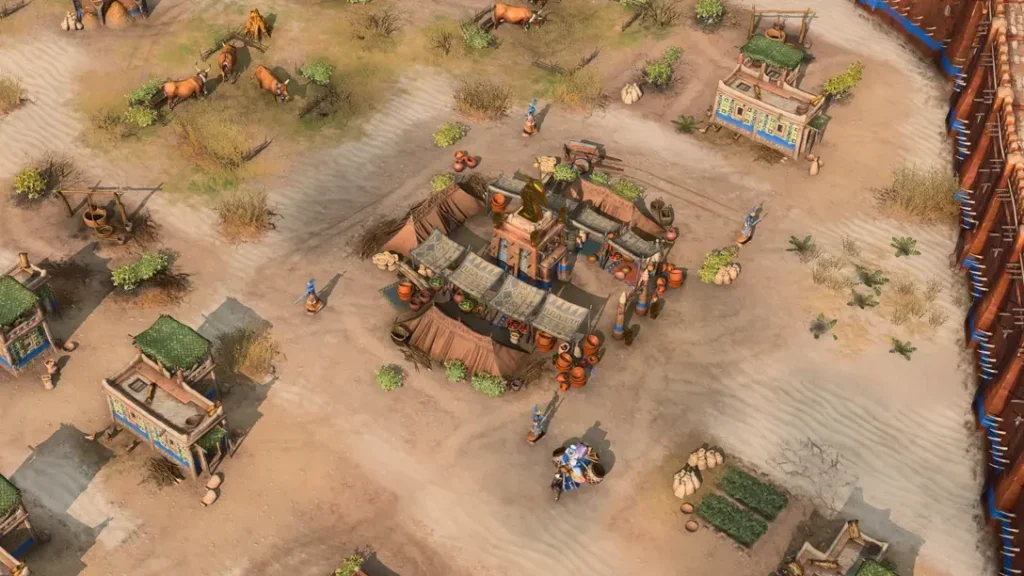
An Age of Empires 4 Malian cow economy starts with Cattle produced at a Mill. You can harvest those animals with Villagers for food or garrison them in Cattle Ranches for continuing food income. A Ranch costs 125 wood, holds three Cattle, and lists a baseline of 25 food per minute per garrisoned animal before relevant food upgrades.
Choose the animal’s job before using it. A Cow intended for a Ranch is part of a continuing income investment; one assigned to Villager harvesting serves a different food plan. Keep the Cattle purchase budget separate from Ranch construction, and inspect the selected Mill’s current purchase card before queuing animals.

This guide covers the original Malian civilization in an AI land skirmish. It uses retrieved Mill, Ranch, landmark, and civilization descriptions, not a measured fast-Castle opening. The Age of Empires 4 beginner guide explains resource drop-offs and worker assignment first.
On this page
Age of Empires 4 Malian cow economy in 6 checks
Track Mill production, living Cattle, Ranch occupancy, and current food income as separate states. A completed empty Ranch is not a working Cow economy, and Cattle waiting beside a building are not evidence that its garrison income is active.
1. Keep ordinary food gathering working
Maintain Villager production and gather safe nearby food while preparing the Cattle system. Passive food arrives over time, so it cannot replace an immediate stockpile the moment you place a Ranch. Houses, wood gathering, resource access, and military production remain part of the opening.
Scout before extending workers or buildings beyond the safe base. A convenient animal-production building is not protection against a raid. If the next investment makes your workers vulnerable or prevents a funded defensive queue, delay optional expansion until you can protect the existing economy and keep its food flowing.
2. Construct a Mill and inspect Cattle production
A Malian Mill costs 50 wood in the checked entry. It accepts food drop-offs, contains food technologies, and produces Cattle. The civilization description makes that production available in Dark Age. Select the Mill after construction and find the animal purchase, its current resource cost, and the relevant queue.
Use the actual purchase card for the Cattle price. The retrieved unit files used for this guide do not include the animal’s standalone cost entry, so no fixed Cow price is supplied here. That does not change the verified Mill function or Ranch budget; it identifies the extra payment you must inspect before purchasing the group.
3. Decide between harvesting and garrisoning
The Mill description offers two uses: Villagers harvest Cattle for food, or the animals are garrisoned in Ranches for food over time. Decide which need you are meeting. If you need gatherable food now, include workers and a short drop-off route. If you want continuing Ranch income, preserve the animals for that role.
Do not assign a harvested animal to a future Ranch budget as though the same Cow will serve both plans at once. Keep your intended Ranch group separate from food being gathered. Select the animals before issuing orders so a worker command does not accidentally commit the wrong group to harvesting.
4. Build a Ranch after reaching Feudal
The checked Cattle Ranch entry is a Feudal building, costs 125 wood, and has a capacity of three Cattle. Place it inside a protected part of the economy with a clear route from the Mill. A closer transfer route is easier to manage than moving newly purchased animals through enemy-accessible space.
An empty Ranch has its construction cost behind it but no occupied-animal baseline income. Check the available Cattle and purchase budget before building several Ranches at once. Staging one useful occupied building at a time can keep more wood available for ordinary production and needed resource access.
5. Garrison Cattle and confirm occupancy
Select the intended animals, order them into the Ranch, and inspect its garrison panel. The three-animal capacity is a real limit. An animal standing beside a full building is not a fourth occupant, and the nearby visual scene alone does not confirm which Ranch is generating income.
The checked Ranch description gives 25 food per minute per garrisoned Cow before relevant upgrades. Three occupied slots therefore correspond to a 75-food-per-minute baseline. This is arithmetic from the source description, not an observed exact tick schedule or an income guarantee during destruction, evacuation, or other interrupted conditions.
6. Expand only when the next investment fits
Before adding another Ranch, check its wood cost, the animals needed to occupy it, and the army protecting the area. Keep the Cattle purchase reserve separate from landmark gold and other spending. A food system financed through new purchases still needs a functioning economy to expand.
Inspect food research as well. The Ranch description says its income value is increased by food upgrades, so the baseline is not a permanent final rate for every researched state. Read the current upgrade and building display before comparing income across games. Do not add an unverified percentage to a budget merely because another guide calls the setup upgraded.
A clear Ranch construction budget
One Mill and one Ranch require 175 wood before Cattle purchases: 50 for the Mill plus 125 for the Ranch. Three Ranches cost 375 wood, or 425 wood when adding a new Mill. Neither total includes the animals, workers, housing, military buildings, units, or age advancement.
This separation avoids a common planning mistake. A guide can call the finished setup inexpensive while silently omitting the animals needed to make it productive. Write down the selected Mill’s Cow price, multiply it by the group you intend to buy, and add that resource commitment as its own budget line.
For three fully occupied Ranches, the capacity is nine Cattle. At the retrieved unmodified 25-food-per-minute rate, their combined baseline is 225 food per minute. That is the described steady rate for occupied buildings, not 225 food instantly gained on completing the third foundation or purchasing the last animal.
Do not turn this example into a competitive break-even promise. A real payback calculation needs the actual Cattle price, upgrade state, construction and transfer time, and lost opportunities from the resources spent. The source-derived construction sums help you plan purchases, but they do not establish an optimal minute for the investment.

Pit Mine gold supports a separate food system
The Malians can build Pit Mines on Gold Veins for continuing gold generation. The checked Pit Mine costs 150 wood and describes income without depleting the deposit. Houses and Mining Camps within its influence can improve its output according to the civilization overview. Villagers can also mine the resource separately.
This gold system can support the Cattle economy, but a Pit Mine is not a food-producing Ranch. Track its gold and your Cattle spending separately. You may still need gold for age advancement, units, or technologies, so the existence of passive gold does not justify spending the entire stockpile on animals.
Place influenced Houses where they remain useful for population and base movement. The gold benefit does not remove the need for a workable layout. Protect the Mine and the route around it, and keep a reserve for military needs when an opponent begins targeting the economy rather than expanding quietly.
Grand Fulani Corral is a later decision
Grand Fulani Corral is a Castle-transition landmark costing 1,200 food and 600 gold in the checked entry. Its description says nearby Cattle provide 16 food per minute. That is a landmark-specific nearby-animal effect, distinct from the Ranch’s garrisoned-animal baseline and three-slot capacity.
Choose its position around the actual protected Cattle system you intend to maintain. Do not place it far away simply because the landmark foundation fits there. Inspect the current influence or effect display and the animals’ location after completion to understand which part of the economy it is supporting.
This guide does not certify a universal combined Ranch-and-Corral income formula. The two descriptions specify different effects, and a complete stacking calculation would need the current game state and modifiers. Keep the baseline Ranch example separate and read the current Corral display before adding its contribution to a larger projection.
A focused Cow economy practice exercise
In a quiet AI game, maintain ordinary gathering, build a Mill, and record the current Cattle purchase price. After Feudal, construct one Ranch and buy the animals you intend to garrison. Transfer them and confirm occupancy in the panel. This is a proposed exercise, not a claim that a timed experiment has already been completed.
Compare the empty and occupied Ranch states while leaving other new investments unchanged. Note the building’s described rate, total food stockpile, and your other food sources. The stockpile can also fall because Villager and military queues spend food, so a payment stream does not always make the visible balance rise continuously.
Add a second Ranch only after you can explain the first building’s construction cost, animal payment, occupancy, and protection. That gives you a repeatable economic decision. It also makes a failed expansion easier to diagnose than filling the base with several empty Ranches and wondering why the intended food has not arrived.


Troubleshooting and quick answers
Why is my Ranch producing less than expected? Confirm its occupants, relevant food upgrades, and whether the building is intact. Three slots are not automatically filled by constructing it. Use the 25-food-per-minute source rate as an unmodified baseline, not a promise for every game state.
Can I put unlimited Cattle in one Ranch? No. The checked garrison capacity is three. More Ranch capacity requires more buildings and wood, plus animals to occupy them. A larger visible group nearby does not change that capacity.
Do I need Villagers harvesting the Ranch animals? Garrisoning generates food over time; direct harvesting is the separate Mill-described use. Choose the intended role and confirm the order rather than mixing the two jobs in the same budget.
Start with one protected, occupied Ranch and a working ordinary economy. Mechanics were checked on November 8, 2026 against the official Malian overview and AoE4 World building data. Current Mill purchase cards control the animal price and later updates.
Sources and further reading
Keep exploring
Games Like Age of Empires 4: economy, settlement or tactics?
Northgard fits resource and victory planning; Manor Lords fits settlement design; COH3 fits tactical combat with a campaign layer.

Age of Empires 2 Definitive Edition vs Age of Empires 4: where to start
Choose campaign breadth in AoE II DE or documented onboarding and newer presentation in AoE IV.
Age of Empires 4 Naval Combat: 6 Dock and Fleet Checks
A Dock-menu guide separating English combat, fishing, transport and trade ships, current per-item prices and unmeasured performance.