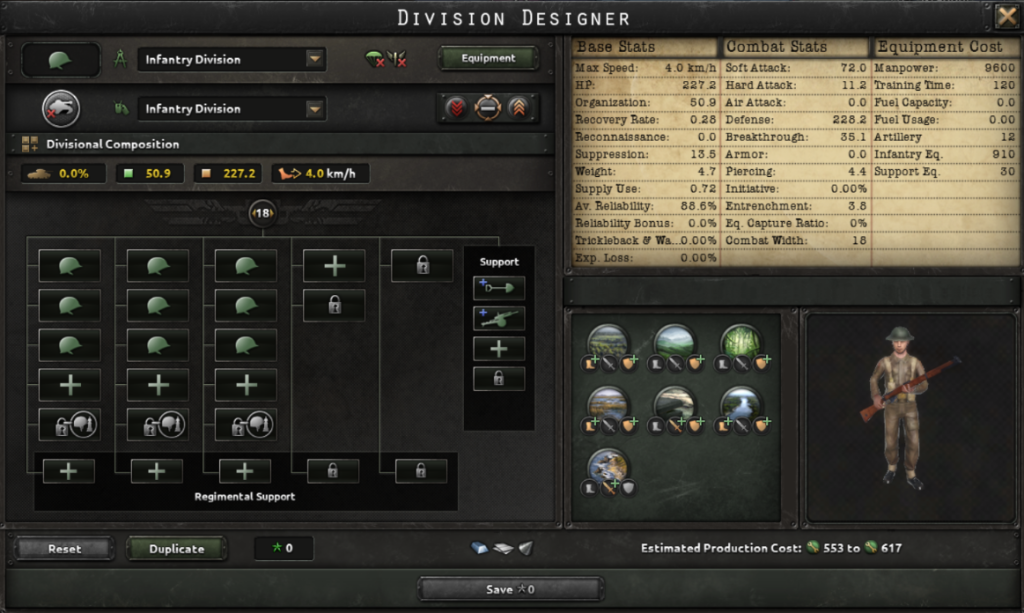
TL;DR: Start Hearts of Iron 4 infantry division templates with a clear holding or attacking job. A nine-infantry-battalion layout is a practical comparison baseline, then add only support your equipment and supply can sustain. The 2026 free update added regimental support, so inspect current eligibility and designer values rather than copying an older support-row screenshot.
For a holding force, begin with supplied infantry and evaluate engineers and support artillery against the front’s actual needs. For a limited offensive variant, compare adding one line-artillery battalion to the same baseline, then inspect organization, equipment demand and supply before deploying it. These are starting layouts for evaluation, not claims of a universal best width or a tested current meta.

This guide uses Paradox’s official division-design explanations and the June 2026 release and patch notes. It also accounts for the November-updated 1.19.4 notes where relevant. Exact stats depend on your installed version, technologies, doctrine and modifications; this article does not turn historical preview bonuses into current guarantees.
On this page
Choose the job before building Hearts of Iron 4 infantry division templates
Decide whether the division will hold a line, reinforce a threatened sector or attempt limited attacks. Those jobs place different demands on the template and the equipment pool.
A holding template needs to remain useful across the frontage you assign. Adding costly support to every division can make that harder if your industry cannot equip the force. A smaller group intended for selected attacks can justify different equipment without converting the entire army.
For a hypothetical modest-industry country, start by equipping the divisions already responsible for the defensive line. If infantry equipment is short, an elaborate paper template can widen the shortage. Improve the supplied force before assuming extra battalions create additional useful strength.
For a larger country, keep holding infantry distinct from specialized offensive formations. Ordinary infantry does not need every available support option simply because the production base can research them. Choose the additions that solve the specific job.
Write the role in the template name if it helps you distinguish conversions. A separate holding and limited-attack template makes it easier to inspect equipment requirements before applying changes to the wrong group.
Start with a plain nine-infantry baseline
Use nine line-infantry battalions as a concrete baseline to inspect in the current designer. One simple arrangement is three infantry regiments containing three battalions each. This is an example layout, not a fixed combat-width recommendation.
Keep the first comparison free of unnecessary support. Read the resulting organization, defense, supply use, manpower and equipment requirements. The designer tells you what that layout requires with your present technology and doctrine.
Then compare it with the template your existing units use. A starting national template may be more economical to maintain than an immediate whole-army conversion. If it already performs the intended holding job, identify a concrete deficiency before replacing it.
Do not assume nine battalions produces the same width in every version and doctrine situation. Paradox’s 2021 combat-width diary explained the effort to move away from one overall best division through terrain and targeting changes. More recent doctrine and display changes further justify inspecting the current values.
The baseline gives you a stable comparison. If you add a support company, compare the same nine battalions before and after that addition. Changing line composition, support and doctrine at once makes it difficult to see which part changed the requirements.
Add divisional support for a specific problem
Evaluate each support company against its current effects, equipment cost and the battalions it benefits. Do not fill every support slot by default.
For a holding force, engineers are a reasonable option to inspect where their current defensive and terrain effects serve the job. Compare the displayed benefit with the support equipment you can provide. The recommendation is to evaluate the option, not to claim an old flat entrenchment number applies today.
Support artillery is another comparison when the force needs additional relevant firepower and you can equip it. Inspect the current attack, organization and equipment changes. A support choice that consumes equipment you lack can remain a paper improvement.
If air pressure or another threat is the reason for changing the template, inspect a corresponding support option rather than adding unrelated companies. Check the actual battlefield problem and the current tooltip. A template change should answer the observed gap.
Paradox’s 2023 support-company explanation describes modifiers applying to specific battalion categories. Its numerical examples were explicitly subject to change. The useful lesson is to read which parts of your division receive a benefit, not to copy every preview percentage.
Check doctrine interactions too. A company that benefits one category under your current setup may have a different value in another army or doctrine path. The November-updated 1.19.4 notes contain further doctrine adjustments; they are evidence that this comparison remains version-sensitive.

Compare a limited offensive variant without changing the entire army
Duplicate the baseline for a limited-attack comparison and add one line-artillery battalion in a slot the current designer permits. The resulting example is nine infantry plus one line artillery, with support chosen for the actual job.
Read the changes before saving or converting units. Compare relevant attack, organization, width, supply and artillery demand. Do not assume the addition improves every part of the division or makes ordinary infantry suitable for every offensive task.
For a hypothetical narrow, selected operation, you might equip a small group with this variant while the baseline continues holding the rest of the front. The comparison makes the equipment commitment visible without imposing it on every division.
Choose where the extra artillery will come from. Existing divisions, training units and other templates can be competing for the same pool. If the conversion leaves the selected group under-equipped, the intended offensive improvement has not been delivered.
Use the current designer’s compatibility rules when placing the line battalion. Do not assume the support available to an infantry regiment automatically applies to a mixed or different-category regiment. The 2026 regimental system adds another reason to inspect the exact placement.
This variant is not a return to a universal old seven-infantry/two-artillery formula. The example deliberately begins from the holding baseline so you can compare one clear change. If the front still needs a specialized offensive force, an infantry template comparison alone does not settle that wider decision.
Inspect the 2026 designer and regimental support row
Regimental support is released content in the 2026 free update, rather than merely a future feature in a development diary. Paradox’s June release announcement explicitly places it in the free patch, and the 1.19.0 notes list the new designer row and regimental companies.
The May designer explanation describes the larger interface, a combat-width indicator in the grid and highlighted resource and production costs. Divisional support moved to the right, with the added regimental row below. An older screenshot can therefore put the options in a different place from your installed interface.
Regimental support has eligibility conditions. The developer explanation says a regiment must contain enough eligible line battalions before a company can attach, and that company types are not compatible with every line category. Read the current requirement rather than assuming any three-battalion arrangement unlocks every option.
For the nine-infantry baseline, inspect each infantry regiment’s available regimental support. A locked option can mean the current composition, research or eligibility condition is not satisfied. It is not proof that the feature requires the paid theater content.
Compare each eligible addition with the same layout without it. The system adds support without simply overloading combat width, but its equipment and production demands still matter. The May explanation specifically connects the revised research and support equipment with industrial capacity.
Keep divisional and regimental support distinct in your notes. A company added to the right-side divisional section is a different placement from one attached to an eligible regiment below. Do not report a template merely as “with support” when the placement affects compatibility and comparison.
Compare terrain width, equipment and supply together
Use the current width display alongside the terrain and battle conditions where the division will operate. A single remembered width does not explain every front.
Paradox’s 2021 combat-width discussion describes terrain-dependent widths and targeting changes intended to break the overall-best-division pattern. It does not establish one timeless replacement number for every situation.
The November-updated 1.19.4 notes include a fix for combat width being displayed based on equipment or manpower fulfillment. If an older installed version gives confusing values, check the version and relevant display behavior before interpreting the number as a reliable template rule.
Inspect the deployed division as well as the designer. The template describes requirements; the unit’s actual equipment and manpower show whether those requirements are met. A well-arranged design can still be incomplete in the field.
Supply is another separate constraint. If the location cannot support the current force, adding more equipment-heavy units may increase the pressure. Inspect local supply and the division’s displayed consumption before attributing every poor result to the battalion pattern.
Use current logistics-company information where that option is relevant. Its cost and doctrine interactions should be checked in your version rather than assumed from a historical example. Support cannot be treated as an automatic repair for every supply limitation.
Upgrade a small group before changing the army
Apply the chosen variant to a manageable group whose job you can observe. Confirm that the required equipment arrives and compare the unit’s actual condition before expanding the conversion.
For the hypothetical limited-attack group, check that the new line artillery and selected support are supplied. If the wider equipment pool turns negative, decide whether to delay more conversions, adjust production or simplify the addition.
Observe the assigned role rather than inventing a performance score. Did the holding group remain equipped and useful? Did the limited-attack group receive the equipment the template demanded? Were terrain, supply or another battlefield condition responsible for the problem you saw?
Change the next condition based on that answer. If equipment remains short, adding another support option is unlikely to resolve the shortage. If the template is supplied but the job is unsuitable, reconsider the role before repeating the conversion across the army.
Use the Hearts of Iron IV hub for related supply and combat guides. Keep the baseline and comparison template separate, and save a short note explaining which problem each selected support company is meant to solve.
FAQ
What infantry template should a beginner start by comparing?
Nine line-infantry battalions provide a concrete baseline to inspect. Compare equipment, supply and current width, then add support for the holding job rather than assuming this layout is universally best.
Is regimental support still a preview feature?
No. The June 2026 release and 1.19.0 free-patch notes confirm it shipped. Older versions or modified games can show different interfaces and options.
Does every regiment accept every support company?
No. Inspect the current minimum-battalion and category requirements, along with research eligibility. Placement and composition matter.
Should every infantry division use line artillery?
Compare it for a specific job and equipment budget. A small limited-attack group can use a different layout from the divisions maintaining the rest of the front.
Sources and further reading
- https://steamstore-a.akamaihd.net/news/externalpost/steam_community_announcements/1833334318568855
- https://steamstore-a.akamaihd.net/news/externalpost/steam_community_announcements/5151601211222412251
- https://steamstore-a.akamaihd.net/news/externalpost/steam_community_announcements/3938951840876523620
- https://steamstore-a.akamaihd.net/news/externalpost/steam_community_announcements/1835236783561023
- https://steamstore-a.akamaihd.net/news/externalpost/steam_community_announcements/1835236783557496
- https://steamstore-a.akamaihd.net/news/externalpost/steam_community_announcements/1847286114049046
Keep exploring

Hearts of Iron 4 occupation laws: control resistance without draining reserves
Match occupation policy to resistance, compliance and a garrison you can actually supply; use stronger control only when the situation justifies its cost.
Games Like Hearts of Iron 4: choose what you want to command
Choose Stellaris for another empire project, CK3 for personal politics and heirs, or Ultimate General Civil War for tactical army progression.
Stellaris vs Hearts of Iron 4: discovery or industrial war planning?
Choose Stellaris for discovering a galaxy and shaping a space society; choose Hearts of Iron IV for coordinating industry, army design and politics around a WWII nation.