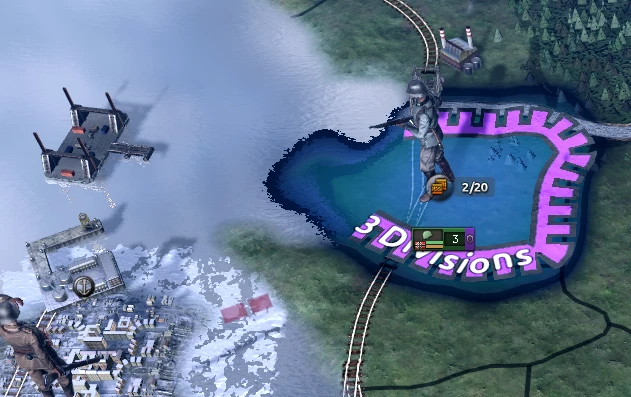
TL;DR: Hearts of Iron 4 naval invasion planning needs a useful landing objective, assigned troops, available transports and a workable sea route. Read the current limits on simultaneous plans and divisions per plan. Then protect the crossing and secure lasting port supply before expanding the beachhead.
Preparing an invasion and sustaining the landed army are different tasks. A plan that passes the departure checks can still lose transports at sea or leave its divisions without a useful supply connection ashore.

The released No Compromise, No Surrender changes replaced the old global division cap and preparation time that scaled with division count. This guide combines those changes with the original naval-invasion explanation, excluding obsolete timing rules and fixed sea-control percentages.
On this page
Hearts of Iron 4 naval invasion planning: choose a port objective
Build the operation around a port and a position your landing force can defend. Consider the destination’s terrain, known defenders, nearby approaches and inland supply connections before selecting the coast.
A lightly defended coastal province is not necessarily a good long-term beachhead. If the force lands away from a usable port, it still needs a credible way to obtain one before expanding.
For an illustrative landing, choose a port as the main objective and an adjacent coastal position only if your forces can support the follow-up attack. Decide which divisions must capture the port and which must hold the approaches.
Account for uncertainty in enemy strength. A plan based on an assumed empty coast needs a response if defenders appear. Reduce the commitment or select another objective when the available force cannot handle the likely resistance.
Read the current plan limits and preparation
Check how many invasion plans you can prepare simultaneously and how many divisions each plan permits. The released rework uses those separate limits instead of one global pool of divisions assigned to invasions.
Read the preparation information on the actual order. The release notes explicitly state that preparation time no longer depends on the number of divisions attached to the order. Do not apply an old guide’s per-division timetable.
Splitting every division into a separate order is therefore not a reliable way to bypass the old preparation cost. Additional orders also have to fit the current simultaneous-plan limit.
Inspect technologies, doctrines and national modifiers in your installed setup. The amended 1.19.4 notes change a Japanese invasion-planning bonus, illustrating why a country’s actual tooltip is more useful than a universal remembered timer.
Choose a number of plans you can manage and support. Draw the main landing clearly, then add another objective only when its operational purpose justifies dividing the force and transport commitment.
Assign troops and inspect convoy requirements
Position the intended divisions at the departure naval base, create the landing order and verify that those divisions are assigned to it. An arrow drawn on the map does not establish that the right force will embark.
Read the order’s required convoys and current availability. The original developer explanation describes transport availability as part of preparing the invasion. Use the current requirement rather than estimating from a fixed convoy-per-division figure.
Check equipment, organization and readiness before committing the force. An invasion that is technically executable can still contain divisions poorly prepared for the landing battle.
The original explanation identifies marines as useful landing troops. Inspect the available template’s actual landing modifiers and equipment needs before choosing it. A unit’s name alone does not tell you its present condition.
Keep the intended reinforcement force separate in your notes. Divisions scheduled to follow a successful landing still need a route and supply; they should not be counted as already holding the port.

Inspect every sea region on the route
Follow the invasion’s actual route and inspect each required sea region. The developer’s original design makes sufficient sea control along the route a departure condition, not merely a check at the destination coastline.
Read the current order’s blocked conditions and the relevant naval information. Address the region identified by the tooltip rather than assuming that a strong fleet anywhere nearby is sufficient.
The released fleet rework restores a Home Base from which the fleet draws range and supply, with an automatic selection option. Inspect the fleet’s actual base and reach when its task forces cannot support the intended route.
Select missions for the job being performed and check their active regions. Preparation, control of the route and protecting transports are related responsibilities, but they should not be inferred from one completed progress indicator.
This guide gives no fixed control percentage or preview dominance formula. The sea-region display and invasion order in your current campaign determine the condition you must meet.
Protect the crossing and support the landing
Arrange transport protection before launching. The original developer explanation warns that an invasion can pass the sea-control requirement and still have convoys intercepted after departure.
Inspect escort coverage along the crossing and consider what happens if the enemy fleet moves into the route. A momentarily executable order does not guarantee an uninterrupted voyage.
Where available and appropriate, use naval support at the landing coast. The developer describes naval bombardment as assistance for the beach battle. Check the task force’s actual orders and contribution instead of assuming every nearby ship supplies that support.
Coordinate aircraft with the operation’s region and timing. Inspect their mission and coverage, then assess the landing battle itself. Aircraft in another region do not automatically support this coast.
| Stage | Required observation | Decision |
|---|---|---|
| Departure | Assigned divisions, preparation, transports and route conditions | Launch only when the order is ready |
| Crossing | Transport protection and current enemy pressure | Maintain protection and reconsider follow-up traffic |
| Landing | Combat progress and force condition | Support the actual battle |
| Beachhead | Usable port, supply route and defensible approaches | Reinforce within sustainable capacity |
Turn the beachhead into a supplied front
Secure a usable port and inspect the supply route after landing. The official first-look supply explanation places naval bases within the network and identifies their role in transporting supply over water.
Look at port damage, maritime access and the inland connection serving the force. Capturing the map location is an important objective, but the resulting supply state still needs inspection.
Temporary landing support, where present in your setup, is a bridge rather than a permanent substitute for a port. The developer’s floating-harbor description explicitly keeps important harbors among the early invasion objectives.
Reinforce at a pace the beachhead can sustain. Sending every reserve division immediately can create demand the new position cannot serve. Hold the port and expand toward useful inland connections with the force actually supported.
If the landing stalls, revisit the objective, route protection and supply together. A failed beachhead is not always evidence that the invasion needed more assigned divisions.
FAQ and the departure decision
Does preparation take longer with more divisions?
The released rework states that planning time no longer depends on division count. Read the current plan and per-plan limits.
Why will a fully prepared order not launch?
Inspect assigned troops, transports and every required sea region. Preparation is only one departure condition.
Does a successful landing guarantee supply?
No. Check the usable port, maritime route and inland delivery before adding more forces.
The Hearts of Iron 4 beginner guide covers wider preparation. Before sailing, identify the first port objective, verify the order’s actual requirements and decide how the army will remain supplied once ashore.
Sources and further reading
- https://steamstore-a.akamaihd.net/news/externalpost/steam_community_announcements/295355928887196900
- https://steamstore-a.akamaihd.net/news/externalpost/steam_community_announcements/1816849002009911
- https://steamstore-a.akamaihd.net/news/externalpost/steam_community_announcements/1847286114049046
- https://steamstore-a.akamaihd.net/news/externalpost/steam_community_announcements/4032392655085553654
- https://steamstore-a.akamaihd.net/news/externalpost/steam_community_announcements/4117954072998655724
Keep exploring

Hearts of Iron 4 occupation laws: control resistance without draining reserves
Match occupation policy to resistance, compliance and a garrison you can actually supply; use stronger control only when the situation justifies its cost.
Games Like Hearts of Iron 4: choose what you want to command
Choose Stellaris for another empire project, CK3 for personal politics and heirs, or Ultimate General Civil War for tactical army progression.
Stellaris vs Hearts of Iron 4: discovery or industrial war planning?
Choose Stellaris for discovering a galaxy and shaping a space society; choose Hearts of Iron IV for coordinating industry, army design and politics around a WWII nation.