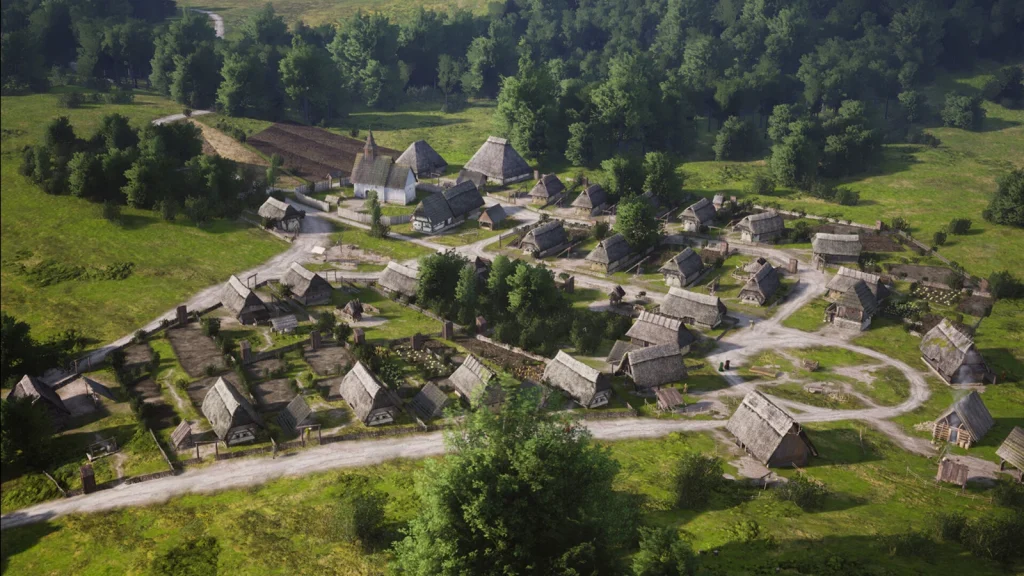
A Manor Lords beginner guide should get your first village working before it asks you to expand. Begin with timber, food collection, storage, housing and fuel. Keep workers available for construction and ox handling, then add trade and higher-level homes when the existing families are supplied.
The current game differs substantially from launch guides. March 2026 added a fourth burgage level and family-based settlement progression; August added professional builders and active artisan recipes; October revised the farming calendar. This walkthrough follows those released systems rather than a fixed opening that assumes the old requirements.

On this page
Manor Lords Beginner Guide: Before building: read the region, not an ideal layout
Pause and inspect the starting region. Find its natural food sources, forests, mineral deposits and crop fertility. The December 2025 core rework documented alternative food nodes, such as fish or small game and berries or mushrooms, so do not expect every start to supply the same early buildings.
Choose a village center with access to roads and room for homes, storage and a marketplace. Place resource buildings where the resource is useful, rather than forcing every workplace into that center. A distant food node can still be valuable, but transporting its output becomes part of the staffing decision.
Preserve a sensible area for future housing and extensions. A huge vegetable backyard has a planting cost that scales with its area; it is not a free way to guarantee a large food reserve. Start with what you can fund and work.
First project: make construction possible
Build and staff a Logging Camp, retain access to the starting ox, and leave some workers available to carry out construction. Timber stock alone does not complete a building: the log must reach the site, and the site needs workers.
The March 2026 released notes specify that construction oxen can be guided by unassigned workers or Logging Camp workers. For other deliveries, the eligible guide is an unassigned worker or a worker from the receiving building. Assigning every family elsewhere can therefore create a transport blockage even when an ox is present.
Build storage and the essential homes before filling the map with optional construction. If several sites wait on timber, pause the least useful ones and finish the building that unlocks food, shelter or the next required material. You want completed functions, not a large collection of foundations.
Later, the Construction Yard changes this workflow. The August 2026 main update introduced professional builders for Advanced Structures. Unassigned families still help with transport and basic tasks, but they cannot replace those professional workers when a project requires them.

Second project: get food and fuel into homes
Staff the food building that matches an actual local node. Add a Granary for collection and storage, and establish market supply rather than assuming all goods in the regional total are already available to families. Staff a Woodcutter’s Lodge for firewood; construction timber and household fuel solve different problems.
Watch the selected workplace’s reserve, production limit, work area and storage. A hunting or fishing building can stop because the reserve protects the remaining population. A full output store can stop a productive workplace. Neither is automatically a reason to assign more families.
Market supply also has a chain. The December core update states that storage workers supply their stalls from their own Granary or Storehouse. If food remains at the producer while the supplying Granary is empty, repair collection first. If the Granary holds the right food but homes remain short, inspect the marketplace’s allowed goods and actual stall supply.
Food variety now means categories. Two different meats do not automatically provide two different food categories for an upgrade. Foraged goods, meats, fishes, vegetables, grains and animal produce belong to the documented category system. Read the chosen home’s current requirement before building a second chain that repeats what it already has.
Third project: house people you can actually support
Complete burgage living space and inspect approval before expecting migration. The early homelessness grace period is a chance to finish shelter, not a reason to delay it while building an export industry. The current approval system uses tiers with different growth effects, so read the displayed tier instead of using a launch-era percentage rule.
As families arrive, place them into the first missing function. An extra workplace family is useful when it improves collection or production; an unassigned family is useful when construction or ox guidance is the bottleneck. Increase one commitment at a time so you can see the effect.
Upgrade selected homes only after their recurring supply is stable. Settlement progression now checks families of the required level living in the region, rather than simply counting empty upgraded buildings. An attractive higher-level street without residents can fail to advance the settlement.
Keep some plots intended for ordinary workers, some for gardens or animals, and suitable plots for future artisans. When you add an artisan workshop in the August system, select its Active Recipes. Newly created artisans start without an active recipe, so building the workshop alone does not start its output.
Use the first winter to test the village
Before winter, inspect stored food, available fuel and the homes’ actual supply. Compare production and consumption in Records where available. A comfortable harvest does not prove the reserve will last if the town has grown or a new processing chain consumes the same inputs.
Do not make the first winter depend on an uncompleted field. The October 2026 default-branch update separates spring and winter crops and gives fields a twelve-month activity timeline. Wheat and rye are winter crops with optional spring sowing; flax, barley and oats can only be sown in spring. Read that timeline before committing workers and expecting food on a particular date.
Pasture animals add another winter commitment. Cows, calves, sheep and lambs need animal feed during winter under the August system. Do not buy a large herd simply because there is pasture space: fund the oats-to-feed chain and preserve the feed stock first.
| What you see | What to inspect first |
|---|---|
| Construction waiting despite timber | Ox, eligible guide and professional-builder requirement |
| Food exists but a home is short | Collection into the supplying Granary, stalls and allowed category |
| New workshop produces nothing | Active Recipes, inputs, maintenance and output storage |
| Settlement level does not rise | Resident families at the required completed burgage level |
End the opening with fewer unfinished promises: supplied homes, working collection, a construction workforce and enough reserve to cover the coming season. Use the Manor Lords guides hub for the particular supply chain that is holding back your next project.
Sources and further reading
- https://store.steampowered.com/app/1363080/Manor_Lords/
- https://steamstore-a.akamaihd.net/news/externalpost/steam_community_announcements/1819386365095372
- https://steamstore-a.akamaihd.net/news/externalpost/steam_community_announcements/1827626365750540
- https://steamstore-a.akamaihd.net/news/externalpost/steam_community_announcements/1842212951300554
- https://steamstore-a.akamaihd.net/news/externalpost/steam_community_announcements/1847920302241640
Keep exploring
Manor Lords vs Crusader Kings 3: build a town or guide a dynasty?
Pick Manor Lords for a medieval settlement and its household economy; pick Crusader Kings III for rulers, relationships and a realm passed between generations.
Northgard vs Manor Lords: clan objectives or settlement planning?
Choose Northgard for clan-specific strategy and explicit victory routes; choose Manor Lords for the placement, households and production of a medieval settlement.

Manor Lords Retinue Management: Roster, Armor and Treasury
Manor Lords retinue management: budget recruitment and armor, assign a clear battlefield role, and protect the settlement economy behind it.