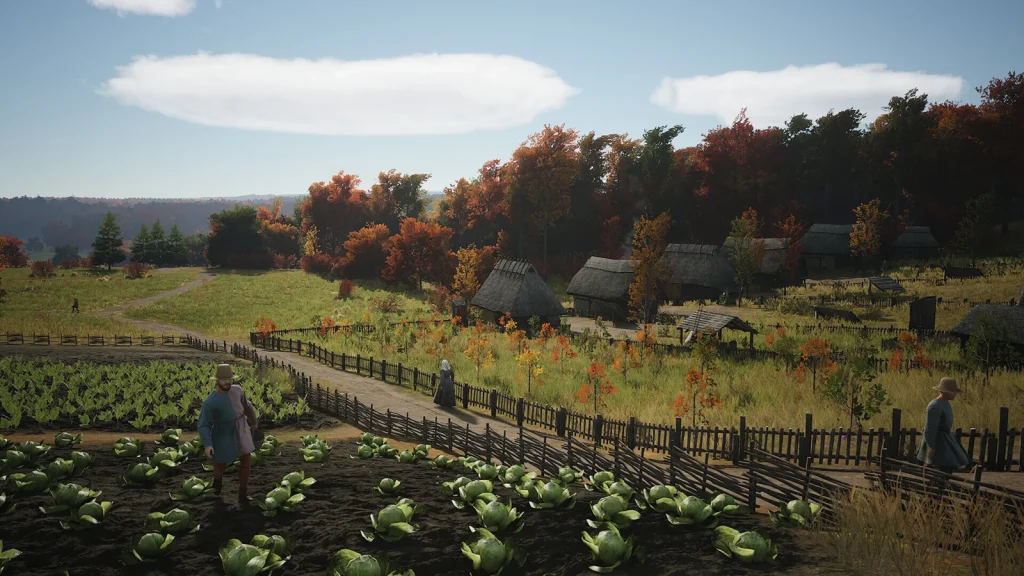
Manor Lords farming crop rotation now follows separate spring and winter crop windows, and rotation is always enabled. Read the field’s twelve-month timeline before assigning a crop. Keep fallow cycles in the plan, staff the seasonal workload and finish transport and processing before counting the harvest as usable supply.
These rules come from version 0.8.117, promoted to the default branch on October 31, 2026. A guide that assumes all crops can be sown on the same autumn schedule describes a different farming system.

On this page
Manor Lords Farming Crop Rotation: Read the next year before placing more fields
| Crop or stage | Released rule | What to do |
|---|---|---|
| Wheat and rye | Winter crops; optional spring sowing gives a quicker return with less yield | Choose the intended window from the field timeline |
| Flax, barley and oats | Spring crops, sown only in spring | Keep their spring labor available |
| Fallow | Rebuilds fertility; plowing has the lowest task priority | Include it in the rotation, not just a crop swap |
| Unharvested October crops | Begin dying and losing yield instead of instant forced rotation | Finish the remaining harvest while it is salvageable |
Inspect crop-specific fertility and the actual field area. A large field on poor soil is not an efficient solution merely because it promises more land under cultivation. Place fields the available workforce can finish within the appropriate tasks and months.
Then decide where the output goes. Wheat or rye needs the relevant grain processing; barley serves a different chain; flax is not emergency food; oats can become food or animal feed. A crop choice should answer a real demand rather than complete an arbitrary list.
Rotate for fertility and manageable work
The October release lowers fallow regeneration and says fallow cycles are generally needed for sustainable fertility. Changing crops alone is not a promise that fertility will recover fast enough.
A three-field example is useful as a planning pattern, not a prescribed optimal layout. Put one field on a winter-grain task, another on a spring-crop task and a third on fallow. At the next appropriate rotation, change which field rests according to its crop-specific fertility and the next year’s needs.
The advantage is that you can inspect each field and distribute the workload. The cost is that only part of the total area produces a harvest in a given cycle. Compare that useful harvest with the labor and fertility you preserve, rather than measuring success by total planted area.
Rotation timing is explicit in the current release. A field with nothing to harvest rotates on September 1, a harvested field rotates after harvest finishes, and an unharvested field whose crop dies rotates on November 1. Read the next selection before the trigger so you do not discover an unintended crop at the start of its work window.

Give the Farmhouse a finishable seasonal task
Assign families before the relevant sowing, harvest and transport work is due. The August 2026 update added Seasonal Assignment, which can cycle assigned families by season. Configure it against the current timeline instead of assuming last year’s schedule still fits.
Inspect the Farmhouse’s work area, field priority, storage and active tasks. An idle worker can mean the crop is outside its permitted window; an unfinished harvest can mean the workforce or transport cannot clear the field in time.
Oxen also need the relevant farmhouse assignment and workers. The October release states that assigned livestock require workers from their building to perform tasks. Owning a free ox elsewhere is not proof that the intended field has functioning plowing support.
Do not overexpand the farming area after one good year. Recheck labor after new homes, artisan conversions or a militia call-up. The same field plan can become unfinishable when those families have different commitments.
Use fallow and fertilizer as different tools
The October release adds the Dunghill: assigned dung collectors produce fertilizer, which is stored there. Farmhouse workers apply it during summer to increase a fallow field’s maximum fertility, and its effect lasts a little over two years.
This is a separate supply and work chain, not an instruction to plant continuously. You need dung, staffed fertilizer production, the correct field state and summer application. Inspect those conditions before planning the fertility benefit into your next harvest.
If a field still has a crop selected but nothing planted, the current rules allow it to recover fertility as if fallow. That explains why a selected crop does not necessarily mean active fertility drain; inspect its actual planted state.
Count the usable output, not the field estimate
After harvest, trace sheaves into the Farmhouse, threshing and the next required building. Oats may be consumed after threshing, but turning some into animal feed competes with the food reserve. Grain destined for bread still needs its processing chain.
Check losses as well as planted area. The current rules make October’s remaining crop a declining reserve; storage and transport delays can also separate a successful harvest from available food. Inspect the weakest stage before adding another field.
For the next season, keep one written crop-and-output plan per field: crop, work window, intended destination and rest cycle. Use the Manor Lords guides hub for food and livestock when the harvest serves those downstream commitments.
Sources and further reading
Keep exploring
Manor Lords vs Crusader Kings 3: build a town or guide a dynasty?
Pick Manor Lords for a medieval settlement and its household economy; pick Crusader Kings III for rulers, relationships and a realm passed between generations.
Northgard vs Manor Lords: clan objectives or settlement planning?
Choose Northgard for clan-specific strategy and explicit victory routes; choose Manor Lords for the placement, households and production of a medieval settlement.

Manor Lords Retinue Management: Roster, Armor and Treasury
Manor Lords retinue management: budget recruitment and armor, assign a clear battlefield role, and protect the settlement economy behind it.