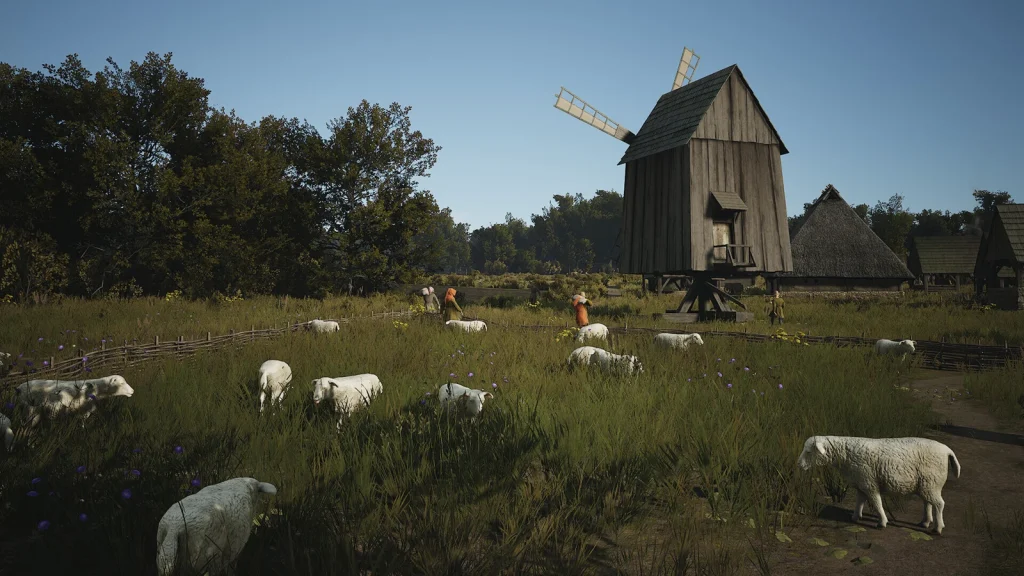
Manor Lords livestock planning starts by separating transport animals from pasture production and backyard extensions. Buy each animal for a named job, complete its space and support chain, and include the coming winter in the budget. Available pasture area does not mean a herd can survive without feed.
On this page
Manor Lords Livestock Planning: Three animal plans that solve different problems
| Plan | Examples | First constraint |
|---|---|---|
| Transport | Ox for timber, horse assigned to a Trading Post | Completed housing, workplace assignment and guide |
| Pasture production | Cows and sheep | Pasture space, Livestock Farm work and winter feed |
| Backyard production | Animal pen or chicken-coop options | Suitable burgage extension and actual animal order |
Do not use a pasture calculation to decide whether a transport animal has a home. Inspect the relevant building’s actual capacity and assignment. Likewise, a vacant backyard does not purchase the animal or complete the extension.

The December 2025 core rework changed animal values and backyard production, so read the current order and output tooltip. This guide gives a planning sequence instead of claiming one timeless best animal or fixed return on investment.

Plan winter feed before expanding a herd
The August 2026 main update added cows and calves, animal feed, and hunger for cows, calves, sheep and lambs during winter. Those pasture animals consume feed each winter month and can die without it.
Build the whole chain: oats supply, a staffed Livestock Farm that crafts feed, storage and an appropriate reserve. Oats can be eaten by families too, so protect the quantity assigned to the herd rather than assuming all harvested oats remain available.
Read the animal help page for current feed consumption and multiply by the herd you expect to have. Include calves and lambs where relevant. Use that actual rate and current stock to judge the winter budget; no unobserved feed-per-animal formula is supplied here.
If the budget fails, stop additional purchases, reduce the expansion plan or acquire the missing feed supply before winter. Buying more animals while the support chain is still under construction increases the obligation without producing a completed solution.
Seasonal output changes the purchase calculation
Cows are milked monthly outside winter under the August rules. Sheep are sheared once per year in summer. Neither should be budgeted as an identical monthly production stream throughout the year.
Breeding is seasonal as well. August ties cow breeding to summer and sheep breeding to autumn, with offspring arriving in spring. The October default-branch release revises breeding logic to a single seasonal chance and changes its balance.
Leave room and feed capacity for possible offspring, but do not promise yourself a guaranteed number next spring. Plan essential consumption from the herd and output you actually have; treat uncertain growth as a later adjustment.
Butchering is another tradeoff. The August update describes beef and hides from cows, and lower yield from calves and lambs than adults. Compare immediate output with the future production you give up before sending productive animals into that chain.
Make the pasture and workplace fit each other
Pasture area and construction cost changed in August, while the Livestock Trader and Livestock Farm lost pasture space. Use the present plot preview and completed pasture capacity. Do not count an old building-capacity screenshot as current animal space.
The Livestock Farm’s work area matters. August says workers gather from pastures inside that area, although they can retrieve oats outside it for feed crafting. A full pasture outside the chosen area can therefore be the wrong source for the workers you assigned.
October adds per-animal acceptance filters in a pasture’s Advanced tab. Use them when you want to control which herd uses the space, then inspect actual occupancy after animals move. The same update says animals enter buildings only after construction is complete.
For a transport animal, inspect guide eligibility and workplace staff instead. March changed ox guidance, and October confirms assigned livestock need their own building’s workers. The livestock plan should end with an animal doing a useful task, not merely an animal listed in the region.
Before the next order, check five things: purpose, completed space, available workers, seasonal output and winter reserve. Use the Manor Lords guides hub for farming or timber transport when that supporting chain still needs work.
Sources and further reading
- https://steamstore-a.akamaihd.net/news/externalpost/steam_community_announcements/1842212951300554
- https://steamstore-a.akamaihd.net/news/externalpost/steam_community_announcements/1847920302241640
- https://steamstore-a.akamaihd.net/news/externalpost/steam_community_announcements/1819386365095372
- https://steamstore-a.akamaihd.net/news/externalpost/steam_community_announcements/1827626365750540
Keep exploring
Manor Lords vs Crusader Kings 3: build a town or guide a dynasty?
Pick Manor Lords for a medieval settlement and its household economy; pick Crusader Kings III for rulers, relationships and a realm passed between generations.
Northgard vs Manor Lords: clan objectives or settlement planning?
Choose Northgard for clan-specific strategy and explicit victory routes; choose Manor Lords for the placement, households and production of a medieval settlement.

Manor Lords Retinue Management: Roster, Armor and Treasury
Manor Lords retinue management: budget recruitment and armor, assign a clear battlefield role, and protect the settlement economy behind it.