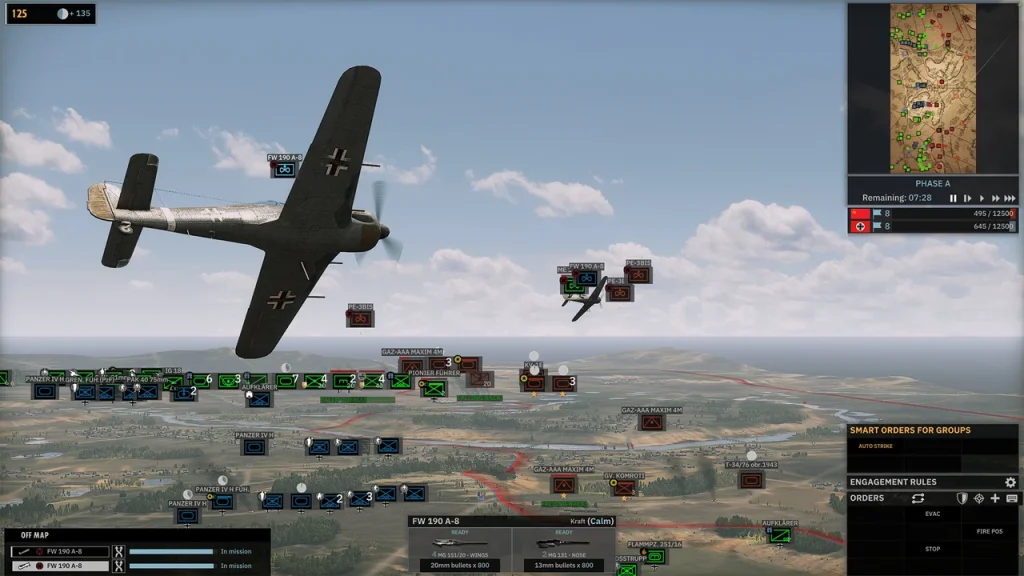
TL;DR: Steel Division 2 air superiority should mean a workable response to the air threat around your useful ground. Choose aircraft by the actual mission, keep ground anti-air relevant to the front, and inspect availability before relying on another flight. Purchasing a fighter does not guarantee permanent control of every air approach.
For a tactical skirmish, identify whether you need to answer an opposing aircraft, support a ground action or gain information. Those are different jobs, even when a card’s aircraft carries several weapons. Keep the aircraft decision connected to the position your ground force is trying to hold or contest.

This guide uses Eugen’s deck and tactical explanations alongside its released War Reserves unit announcement. It does not provide tested aircraft rankings, current speed tables or guaranteed engagement results. Read the installed card’s weapons, role, phase and status for the specific division you use.
On this page
Name the mission before planning Steel Division 2 air superiority
Choose one job for the aircraft you are about to use. A fighter response, a ground-support mission and an observation task should not be assumed to produce the same result.
Eugen’s War Reserves release announcement explicitly distinguishes aircraft roles. Its examples include the A-36A APACHE fighter-bomber for Task Force 45, MUSTANG Mk. I recon fighter for the 15th Scottish Infantry Division and FOKKER C.X recon bomber for Ryhmä Raappana.
Those examples are useful because the role and variant matter. A recognizable aircraft family name is not enough to decide the job. Inspect the actual card rather than treating every Mustang-related option as an identical air-control purchase.
For a hypothetical village defense, the immediate problem might be an opposing aircraft threatening the holding force. That is different from wanting a ground-support flight against a position beyond the village. Choose the response to the current threat before spending on another attractive target.
Keep the goal limited. Protecting one useful action or responding to one observed air threat is a clearer task than promising total air control for the rest of the match.
Keep an aircraft response matched to the actual threat
Inspect the available fighter or other relevant aircraft’s current weapons and characteristics. The label identifies its role, but does not guarantee a favorable result against every opposing plane.
Check phase and remaining card availability before planning the response. Eugen’s deck-builder explanation makes card phase, quantity and experience deliberate choices. A later aircraft card cannot supply an opening answer before it unlocks.
Separate availability from tactical points. If a suitable card remains but you cannot afford the unit, the limitation concerns purchasing power. If the only relevant card is later or exhausted, choosing another income curve does not solve that availability in the current battle.
Read the target’s observed route and the current aircraft controls before committing. Avoid relying on a remembered interception sequence from a different variant or control setup. Confirm what the chosen order asks the aircraft to do.
After an engagement, inspect the surviving aircraft and current status rather than declaring the entire air threat solved. Another approach or mission can become relevant while your ground force remains in the same exposed position.
Assess ground anti-air before relying on a flight
Keep ground anti-air tied to the positions that need its protection. An available aircraft response and useful ground coverage are different parts of the plan.
The War Reserves announcement includes dedicated anti-air additions such as the FLAKPANZER SFL IVc for 26. Panzerdivision. That supports the distinction between air and ground roles, but it is not a claim that this named unit is available to every division or wins every engagement.
For the village example, inspect whether the current anti-air position covers the useful holding area and remains supported on the ground. A unit positioned beside an abandoned approach can be poorly placed even when its weapon is suited to aircraft.
Check the route and exposure before moving it. Ground anti-air still occupies the tactical battlefield and can need protection from ground pressure. Adding an anti-air unit does not remove the infantry and observation jobs around the position.
Do not copy historical range, damage or price numbers into the current plan. Eugen’s tactical diary describes aircraft critical damage, while later patches change aircraft and anti-air characteristics. The installed card is the reference for the exact option you purchase.

Plan a ground-support flight without abandoning the holding job
Use a supporting flight for a target that matters to the next ground action. The ground force still needs a suitable route and a destination it can hold after the mission.
For a hypothetical attempt to contest the village’s far edge, identify the observed position you want the flight to address. Keep infantry, observation and the relevant ground support prepared for their own jobs. A flight selected against one position does not establish that every nearby approach is clear.
Inspect the aircraft’s actual loadout. A fighter-bomber, dedicated bomber and reconnaissance variant can offer different tools despite sharing an aircraft family or similar appearance. Choose the card for the target and task, not solely the silhouette.
Confirm the observed result before advancing the ground force. A target disappearing from view is not enough evidence to report a guaranteed destruction. Reassess the approach with the information available in the battle.
Avoid selecting another flight only because the first mission did not produce the expected opening. Check whether the target, route or ground plan was unsuitable. Repeating an unsupported action can consume more availability without improving the position.
Keep the front functional while aircraft availability changes
Inspect the current aircraft panel and unit status when planning the next response. Do not assume an aircraft already committed to another job is immediately available for this one.
The ground force should have useful positions during the gap between its own actions and the next air response. In the village example, maintain the holding infantry and relevant anti-air rather than allowing the whole plan to depend on a flight arriving at an assumed time.
Check whether a lost or unavailable aircraft changes the next purchase. You may need a different available response or a more limited ground action. A scarce card’s remaining quantity matters when you choose to commit it again.
Keep tactical aircraft distinct from Army General air missions. Campaign reconnaissance, disruption and area tasks use strategic systems. This article concerns a tactical skirmish and should not be read as a universal explanation of campaign aircraft eligibility.
Reassess after losses or a changed threat
Review the first mission that failed to serve its intended job. Was the role wrong, the card unavailable, the order unsuitable or the ground action dependent on an unconfirmed result?
If the opponent’s air pressure repeatedly reaches a useful holding position, inspect both your aircraft response and ground anti-air arrangement. If your own supporting flights arrive without a ground plan, revise that coordination before adding more aircraft cards.
Use the Steel Division 2 hub to review deck phases and team coordination. Give the next aircraft a specific mission, then judge its usefulness by what it changed for the ground force.
FAQ
Does buying a fighter guarantee air superiority?
No. Inspect the mission, target, availability and the ground positions you need to protect. A single purchase does not promise permanent air control.
Are fighter and reconnaissance variants interchangeable?
Read the actual role and loadout. Official released-unit descriptions distinguish variants and their assigned functions.
Can ground anti-air replace checking aircraft availability?
They are separate parts of the response. Position ground coverage meaningfully and inspect what aircraft can actually perform the next mission.
Should ground units advance as soon as a supporting flight completes?
Confirm the useful result and reassess the approach first. The ground force still needs observation, support and a position it can hold.
Sources and further reading
- https://steamstore-a.akamaihd.net/news/externalpost/steam_community_announcements/2417769111283800691
- https://steamstore-a.akamaihd.net/news/externalpost/steam_community_announcements/3702426087238377874
- https://steamstore-a.akamaihd.net/news/externalpost/steam_community_announcements/2426802221715528052
- https://steamstore-a.akamaihd.net/news/externalpost/steam_community_announcements/4074045878072394391
- https://steamstore-a.akamaihd.net/news/externalpost/steam_community_announcements/1794102528065812
Keep exploring
Steel Division 2 artillery correction: connect the observer area to the target
Identify the radio-equipped observer and eligible artillery, place the intended target inside the correction area, then check the shot and move the observer when the task changes.
Steel Division 2 anti tank positioning: match the lane, target and ammunition
Choose an observed lane that matches the gun’s actual ammunition range, set its engagement behavior, and reassess after the target or observation changes.
Gates of Hell Ostfront vs Steel Division 2: Conquest or Army General?
Pick Ostfront for researching and developing a Conquest army with switchable unit control; pick Steel Division 2 for battalion-map planning and battlegroup decks.