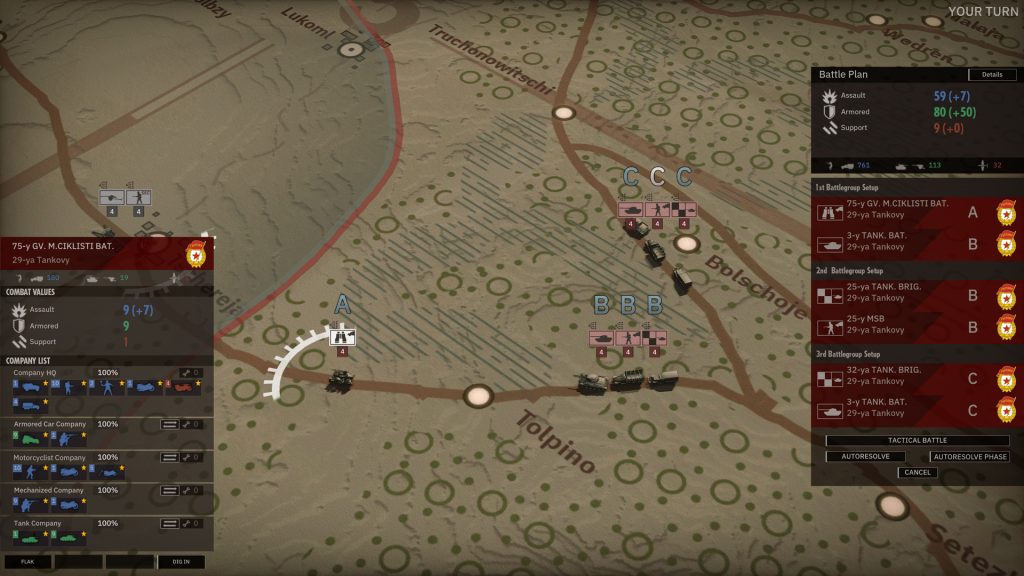
TL;DR: Choose Steel Division 2 Army General air missions by the campaign problem: reconnaissance for information, bombardment for an action-point disruption, or area denial for a movement constraint. Inspect the current target, effect and availability before spending the mission. Strategic air tasks are separate from using aircraft inside a tactical battle.
Start with the ground formation’s next job. An air mission is useful when its information or disruption changes that move or engagement. Assigning an available aircraft without a specific campaign question can consume an opportunity while leaving the ground plan unchanged.

This guide follows Eugen’s Army General movement and combat explanations and its later campaign-improvements article. These sources document historical systems and changes. Current mission tooltips, effects and campaign eligibility should determine exact costs and duration; no preview numerical effect is treated as a universal present rule.
On this page
Choose information or disruption for Steel Division 2 Army General air missions
Decide what you need before selecting the mission. Revealing a campaign position, limiting a formation’s available actions and making a route less convenient are different jobs.
Eugen’s Army General combat explanation identifies aerial reconnaissance for revealing positions, alongside bombardment and denial roles. It also distinguishes campaign aircraft tasks from bringing planes into a real-time tactical battle.
For a hypothetical approach to a campaign crossroads, reconnaissance may be useful if the ground move depends on information you do not yet have. A disruption mission serves a different purpose when the relevant opposing formation is already identified.
Name the ground decision the result should change. Will you select another engagement, choose a different route or retain a formation for support? If you would make the same move regardless of the mission result, reconsider whether this is the best use of the available task.
Inspect the campaign’s actual aircraft availability and controls. The presence of an air asset does not establish that every mission type is available to it in every scenario.
Use reconnaissance for a question the ground force can answer
Choose an area where information matters to the intended move or engagement. The goal is a better decision, not simply revealing a distant part of the map.
For the crossroads example, inspect the approach and possible supporting positions relevant to your next engagement. A newly revealed formation can change which battalions you select or where you keep a reserve.
Do not treat revealed information as a permanent picture of the campaign. A formation can move, and the situation can change between the mission and the ground action. Recheck the map and current status before confirming the next step.
Keep strategic reconnaissance distinct from tactical spotting. A campaign mission revealing a battalion does not automatically mean a unit inside the subsequent real-time battle has every target in view. The tactical map and observation tasks still need their own planning.
If the information does not change your intended engagement, record why. That helps distinguish a useful reconnaissance question from a mission selected merely because the button was available.
Use bombardment for an action-point problem
Choose disruption when limiting a particular formation’s available campaign actions serves the ground plan. Check the current displayed effect before assuming how long that limitation lasts.
Eugen’s movement diary describes campaign bombardment as affecting action points. The later Army General improvements preview discusses extending its duration. Those different dated explanations are a reason to inspect the current status rather than copy an old turn count.
For the hypothetical crossroads plan, disruption could be relevant if an identified opposing formation’s available actions interfere with your intended movement. Select the target according to that campaign relationship and confirm what the mission actually changes.
Do not assume disruption removes the need to inspect zones of control or battle eligibility. The mission may change the situation, but your ground battalion still needs a legal route and useful remaining actions.
Read the resulting status on the campaign map. Do not infer a formation’s exact future behavior merely because the mission animation completed. Plan the next move from the feedback the installed game provides.

Use area denial for a movement problem
Choose an area task when the relevant problem is movement through a route or sector. That differs from targeting one formation’s current action availability.
The movement diary describes a campaign air task that affects opposing formations passing through the designated area. It explains this as a way to slow movement. Current coverage, mission eligibility and the displayed effect need inspection in your version.
For a road approach, inspect where the affected sector sits relative to the route the opponent can use. A marked area beyond the meaningful junction may do little for the position you are trying to maintain.
Also consider alternate routes. A constrained road does not establish that every possible approach is covered. Your ground force still needs observation and support around the campaign position it intends to hold.
Avoid assuming a fixed delay from a historical article. Terrain, unit actions and current mission rules can change what the affected formation can do. Confirm the displayed conditions before depending on the area effect for a time-sensitive move.
Assess tactical air participation separately
Inspect the selected engagement’s battle planner when you want aircraft inside the tactical fight. A strategic mission assignment is not the same as tactical participation.
The Army General combat diary describes bringing planes into battle through the campaign’s support arrangements. Its original HQ and battle-slot examples are development-era details, so use the present planner for current eligibility.
Choose tactical support according to the selected battle’s need. A campaign information task, a movement-denial mission and an aircraft role inside the real-time battle answer different questions. Do not count the same asset as satisfying every job without checking its current availability and rules.
Inspect the opening and later participation of the ground force too. Aircraft support does not make an unsuitable opening battalion automatically capable of holding until other formations join. The entire selected engagement still needs a workable plan.
Review the actual mission effect before moving ground units
After the mission, check the campaign status and revisit the next ground action. Information, action availability or area coverage may differ from what you expected.
For the crossroads example, confirm the selected engagement still has the desired supporting battalions. If a newly revealed formation changes the approach, revise the move rather than following the original plan simply because the air task has already been spent.
If the disruption did not create the intended opportunity, inspect its target and current effect. Repeating a mission without identifying the mismatch can consume further availability without solving the campaign problem.
Keep a simple note of the purpose and observed result when learning the system. “Reveal the supporting position before selecting the engagement” is more informative than a generic claim that air missions are always valuable.
Use the Steel Division 2 hub for campaign movement and participation guides. Give the next air mission one campaign question, then make the ground decision from the actual result.
FAQ
Are strategic air missions the same as tactical aircraft orders?
No. Campaign tasks affect information or strategic conditions, while tactical participation is checked for the selected battle.
Does bombardment always last a fixed number of turns?
Use the current mission and status information. The official articles describe dated versions and a later duration change, not one universal present value.
Can an area mission replace checking ground routes?
No. Inspect the route, control zones and remaining actions after the mission. The area effect is one condition in the movement plan.
What makes reconnaissance worth using?
A question whose answer changes your next move, engagement or support position. Revealing information that does not affect the plan has a less clear campaign purpose.
Sources and further reading
- https://steamstore-a.akamaihd.net/news/externalpost/steam_community_announcements/2426778849016224556
- https://steamstore-a.akamaihd.net/news/externalpost/steam_community_announcements/2425653583382603208
- https://steamstore-a.akamaihd.net/news/externalpost/steam_community_announcements/3112492477886055534
Keep exploring
Steel Division 2 anti tank positioning: match the lane, target and ammunition
Choose an observed lane that matches the gun’s actual ammunition range, set its engagement behavior, and reassess after the target or observation changes.
Steel Division 2 artillery correction: connect the observer area to the target
Identify the radio-equipped observer and eligible artillery, place the intended target inside the correction area, then check the shot and move the observer when the task changes.
Gates of Hell Ostfront vs Steel Division 2: Conquest or Army General?
Pick Ostfront for researching and developing a Conquest army with switchable unit control; pick Steel Division 2 for battalion-map planning and battlegroup decks.