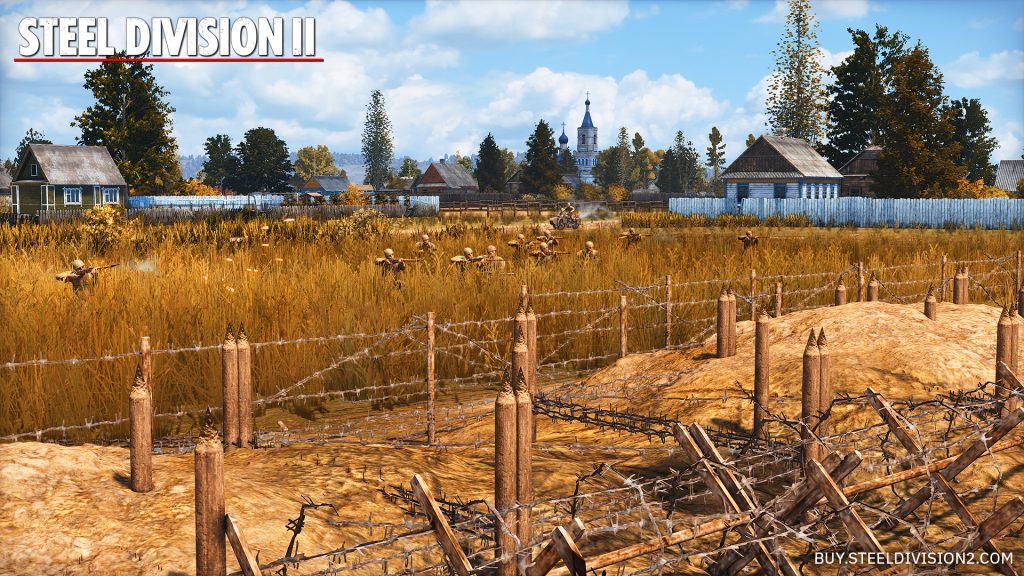
TL;DR: Steel Division 2 breakthrough mode gives the defender a deployment problem and the attacker a route problem. Read the selected side and setup, then build a defended layout or prepare a supported advance. Treat obstacles, infantry cover and fixed weapons as different tools rather than assuming every defensive structure performs the same job.
The defender should connect structures with useful terrain and a mobile force. The attacker should identify a limited approach, confirm the observed defenses and prepare the units needed for that route. A static line needs support, while an advance needs more than a destination inside the defending side’s ground.

This guide uses Eugen’s official defensive-structures and Army General combat explanations. Their development-era map percentages, structure quantities and protection comparisons are not universal current values. Use the installed mode, deck and placement rules for the exact battle you select.
On this page
Read the side and setup in Steel Division 2 breakthrough mode
Confirm whether you are the attacker or defender before selecting the force and deployment plan. The roles are asymmetric, so a layout appropriate for holding ground is not automatically a workable advancing force.
Eugen’s defensive-structures diary explains that the defending player can deploy structures during the deployment phase. The attacker has to advance into the defended map rather than build the same static arrangement.
Read the actual scenario and objective display. The source gives a preview-era map share for the defender, but that old number is not the rule for every present map or campaign-generated fight. Confirm the setup rather than applying a remembered percentage.
For a hypothetical approach through a village and adjoining field, the defender needs to decide which route the layout should contest. The attacker needs to decide which part of that arrangement is worth approaching first. Both decisions should reflect terrain and available units.
Prepare the defender’s layout during deployment
Place defenses around a useful holding plan rather than drawing a continuous line simply because the deck offers material. Each structure should have a job that nearby units can support.
The official diary identifies barbed wire, trenches, gun pits and bunkers. It also explains that placement and rotation matter and that terrain limits where structures can be built. Read the current placement feedback for the specific ground you choose.
For the village-field example, consider covered infantry positions watching the relevant route, obstacles affecting the approach and fixed weapons oriented toward useful ground. Keep the force’s movement route behind the layout clear enough for the task you plan.
Do not assume every structure should face the widest open area. A broad view can also expose a position to opposition that can engage it. The diary specifically warns against placing defenses in the open solely to maximize their field of fire.
Check card quantities and category slots in the present deck. The source describes defenses as deck choices with individual structures or deployable lengths. Its old quantities and division-slot examples should not be copied as current limits.
Separate obstacle, cover and fixed-weapon jobs
Choose the structure according to what it changes in the approach. Slowing movement, sheltering infantry and providing a fixed firing position are different functions.
The developer describes barbed wire as an obstacle affecting movement. Use it to shape a meaningful route, rather than treating it as a weapon that completes the holding task by itself. The units covering that route still need suitable positions.
Trenches are described as infantry shelter. Place them for the infantry’s view, protection and movement job rather than copying the historical diary’s house-protection comparison as an exact current value.
Gun pits are described as protective positions for equipment and are initially empty. A placed pit does not automatically contain a working unit. Confirm what the current scenario allows you to position there and whether that unit has a useful task.
Bunkers are fixed armed structures with a limited field of fire in the source’s explanation. Rotation and approach therefore matter. A bunker that cannot cover the meaningful route can be poorly placed despite its protection.
Keep these distinctions visible when planning the force. An obstacle without coverage, cover without a holding unit and a fixed weapon facing the wrong approach are three different gaps.

Give the attacker a limited supported route
Choose an approach you can observe and a force that can address its actual defenders. Do not send the whole army toward the most obvious road without checking the layout around it.
For the hypothetical village-field setup, first inspect the observed obstacle and fixed positions affecting the road. Consider whether a different approach gives the force a more useful entry, subject to the actual terrain and scenario rules.
Do not assume changing the route removes every defense. The new approach can meet another view or covered position. Keep the observation and supporting force connected to the chosen route before advancing.
Assign the first force a specific job: reach a protected staging point, contest a limited defended area or establish a position for follow-up. A broad instruction to break through everywhere at once can split the available support.
Confirm the result before sending later units forward. A defended position that is no longer visible is not proof that the route is clear. The next advance needs current information and a useful destination.
Keep mobile reserves and relocation options
The defender should have a response to a threatened approach that the fixed layout does not address. The attacker should keep a follow-up force that can support a gained position rather than spending every purchase on the first advance.
For the defender, inspect what happens when pressure shifts beside a fixed weapon’s arc. A mobile unit or different supported position can answer a route the structure does not cover. Static protection alone does not make the layout adaptable.
For the attacker, establish a holding job after gaining ground. Units moving beyond their supporting view or infantry protection can create a new vulnerability. The first successful movement is only part of the route plan.
Use current movement and unit controls for relocation. Different equipment and structures do not share identical mobility. A fixed bunker cannot be treated as a reserve that will simply move to another approach.
Eugen’s Smart Orders explanation offers delegated Seize and Hold Position tasks for suitable groups. Observe the chosen route and result; the order does not guarantee success against a layout the group cannot address.
Distinguish campaign defenses from a custom skirmish setup
Army General can create defensive battle conditions through campaign positioning and digging in. That strategic preparation is separate from selecting a defending side and placing deck structures in a custom Breakthrough match.
Eugen’s Army General combat explanation connects strategic location and formation state with the subsequent tactical scenario. Its original examples are development-era descriptions, so inspect the current battle preview.
Read which formations can participate and what the selected fight allows. A campaign battalion’s state does not imply that every custom deck or structure option is available in that battle.
Use the Steel Division 2 hub for related movement and deployment checks. Before the match, give each defensive structure or advancing group a specific route and supporting relationship you can explain.
FAQ
Can both sides place the same defenses?
The official Breakthrough explanation gives deployment structures to the defender. Inspect the selected scenario rather than assuming symmetric placement.
Does a gun pit arrive with a weapon already inside?
The developer describes gun pits as empty protective positions. Confirm the unit you place and its current scenario eligibility.
Can a bunker cover every direction?
The source describes a limited field of fire. Inspect its orientation and actual coverage before relying on it for an approach.
Are Army General defenses the same setup as a custom skirmish?
Campaign state and battle eligibility create separate conditions. Read the current preview and available structures for the selected fight.
Sources and further reading
- https://steamstore-a.akamaihd.net/news/externalpost/steam_community_announcements/2461683368385085357
- https://steamstore-a.akamaihd.net/news/externalpost/steam_community_announcements/2425653583382603208
- https://steamstore-a.akamaihd.net/news/externalpost/steam_community_announcements/2426802221715528052
Keep exploring
Steel Division 2 artillery correction: connect the observer area to the target
Identify the radio-equipped observer and eligible artillery, place the intended target inside the correction area, then check the shot and move the observer when the task changes.
Steel Division 2 anti tank positioning: match the lane, target and ammunition
Choose an observed lane that matches the gun’s actual ammunition range, set its engagement behavior, and reassess after the target or observation changes.
Gates of Hell Ostfront vs Steel Division 2: Conquest or Army General?
Pick Ostfront for researching and developing a Conquest army with switchable unit control; pick Steel Division 2 for battalion-map planning and battlegroup decks.