TL;DR: Choose Steel Division 2 income types by the timing of the purchases your plan needs. Compare the current economy curve with your A opening, B reinforcement job and C reserves. Keep tactical income separate from card phase availability and Conquest objective control.
A useful economy lets you fund the force’s important jobs without leaving another phase unplayable. A late-focused curve needs an opening that can hold until its purchasing advantage matters. A middle-phase plan needs suitable B cards and a position from which those reinforcements can work.

Eugen’s deck-builder diary explains selectable tactical economies, while later patch notes show their balance changing. This guide uses those sources for the design rather than presenting an old income table as current. Inspect the installed economy options and match setup for exact values.
On this page
Read Steel Division 2 income types separately from card availability
The economy determines purchasing income over the match. A card’s phase determines when that card can supply units, and its quantity determines how many remain available. These checks solve different problems.
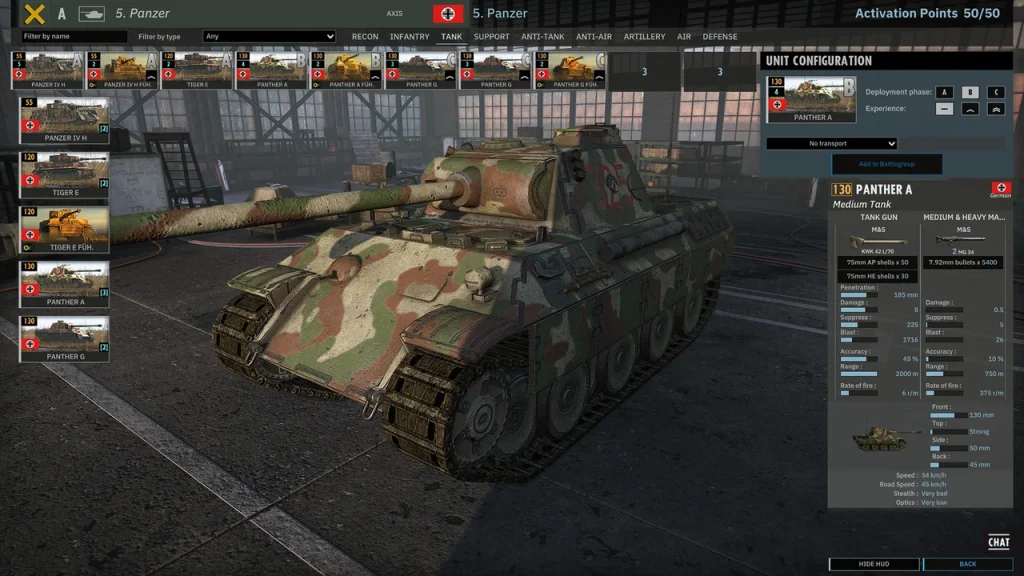
Eugen’s deck-builder explanation gives the player control over tactical economy, card phase and veterancy. That freedom means you need to coordinate the choices rather than assume selecting one automatically aligns the others.
If you have tactical points but the needed unit is assigned to C, extra income does not make it available in A. If an appropriate A unit remains available but you cannot afford it, moving the card earlier addresses no useful problem.
Keep deck activation points separate too. Those unlock card slots during deck construction. They are not the tactical points you spend purchasing individual units during a battle.
Write the intended purchase jobs before comparing curves. The opening might need infantry, observation and a suitable supporting weapon. B might reinforce a threatened approach, and C might maintain the surviving position. Now you can compare when the economy needs to fund those tasks.
Choose an opening plan that can survive its economy
Make the A force functional with the actual starting conditions and early income. Do not assume a later purchasing advantage can restore every position you surrender while waiting.
For a hypothetical village defense, your opening needs enough units to reach covered ground, observe the road and answer a plausible threat. An expensive opening that leaves no useful follow-up can be fragile even when every selected card is available in A.
An early-oriented economy can fit a plan requiring prompt pressure, but the purchases still need supported jobs. Spending the early points on disconnected units does not create a useful advance merely because the curve supplies them quickly.
Keep later phases in the comparison. If your plan relies on sustaining several positions after its initial purchases, inspect the economy’s later values and the card reserves available then. An early advantage is only part of the schedule.
Before changing the curve, check execution. A force lost on an exposed route or placed without observation may fail under several economies. More points can purchase replacements without fixing the original arrangement.
Use a middle-phase economy for a defined reinforcement job
Choose stronger middle-phase purchasing when B has a specific task your opening prepares. A reinforced attack, a new capability or replacement depth provides a reason to favor that timing.
The 2019 diary describes Maverick as an economy with stronger B income. Treat that as its historical design profile and inspect the current selection for its actual values. The name alone is not a current numerical build recommendation.
In the village example, A might establish a holding position while B brings the suitable force to contest the next approach. Plan the staging ground and support before the extra purchases arrive. A higher B income cannot make a lost arrival route protected.
Check that the B cards supply the intended jobs. If the useful reinforcement is assigned to C, choosing a B-focused curve can leave you with points and the wrong availability. Coordinate the deck schedule with the economy schedule.
Also distinguish replacing losses from expanding the force. The same B income cannot be assumed to fund both a full recovery and the original attack at their planned timing. Revise the job when the opening changes.

Make a late-focused economy earn its wait
Consider a late-oriented curve when your opening can hold useful ground and the later deck contains units you can deploy meaningfully. The plan needs continuity, not simply a large collection of C cards.
The deck-builder diary describes Juggernaut as focused on late income. That description explains the intended timing but does not establish the current rates. Read the installed curve and compare it against the match conditions you actually use.
Plan what the early force will preserve. A defensible village edge with observation and relevant support is a clearer waiting plan than abandoning several approaches and expecting late purchases to solve every problem at once.
Check the supporting roles in C. A large late pool in one category can remain awkward if the infantry, observation or other support it needs has been exhausted. More purchasing power cannot restore an exhausted card’s availability.
Decide what changes your plan. If the opponent pressures the holding position earlier than expected, spend on the response the force actually needs. Waiting for a favored phase is not a reason to ignore an immediate problem that would remove the useful staging ground.
Separate objective control from purchasing power
In the documented Conquest system, flags affect the victory contest rather than tactical income. Do not build a purchase schedule around the expectation that capturing the next flag increases your point generation.
Eugen’s Conquest explanation states this distinction explicitly. It also describes capturing objectives through frontline coverage, rather than parking a unit on the flag icon.
A successful capture can still require a purchase to hold it. Account for that follow-up when planning the attack. The objective’s value in the victory contest does not remove the reinforcement’s cost.
Check other modes and match settings independently. Army General strategic actions, battalion eligibility and tactical participation are separate campaign systems. This skirmish economy guide should not be used as a universal explanation of every campaign or custom-mode resource.
Diagnose an income problem before rebuilding the deck
Review the first moment when you could not fund an important job. Note the phase, available card, current points and what the force needed at that moment.
If the unit was affordable but phase-locked, revise availability rather than income. If the card was exhausted, compare quantities and earlier losses. If useful units remained but points were the limiting condition, the economy choice deserves a closer comparison.
Use Eugen’s historical patch notes as evidence that economy balance has changed, not as a current spreadsheet. The next comparison should use values displayed in your installed game.
Keep the purchase plan stable while comparing a curve where practical. Changing the division, card schedule and economy at once makes the result harder to explain. Use the Steel Division 2 hub to connect economy choice with deployment planning, then change the condition responsible for the shortage.
FAQ
Is there one best income type for every division?
Choose from the current curves according to the purchase timing your plan needs. Division roster, card phases and match conditions affect the fit.
Can extra income unlock a later card early?
No. Income and phase availability are separate checks. You need a card available in the current phase to purchase its units.
Does a Conquest flag generate more income?
The official Conquest explanation separates flags from tactical income. Objectives influence the victory contest; the chosen economy supplies purchasing income.
Should a late-focused economy avoid early reinforcements?
Buy the response needed to preserve a useful position. The later plan depends on retaining ground and support from which those purchases can work.
Sources and further reading
- https://steamstore-a.akamaihd.net/news/externalpost/steam_community_announcements/3702426087238377874
- https://steamstore-a.akamaihd.net/news/externalpost/steam_community_announcements/2417771014048533539
- https://steamstore-a.akamaihd.net/news/externalpost/steam_community_announcements/4074045878072394391
Keep exploring
Steel Division 2 anti tank positioning: match the lane, target and ammunition
Choose an observed lane that matches the gun’s actual ammunition range, set its engagement behavior, and reassess after the target or observation changes.

Steel Division 2 artillery correction: connect the observer area to the target
Identify the radio-equipped observer and eligible artillery, place the intended target inside the correction area, then check the shot and move the observer when the task changes.
Gates of Hell Ostfront vs Steel Division 2: Conquest or Army General?
Pick Ostfront for researching and developing a Conquest army with switchable unit control; pick Steel Division 2 for battalion-map planning and battlegroup decks.