TL;DR: Total War Shogun 2 agent skill trees work best when each agent has a defined campaign job. Specialize a ninja for scouting, sabotage or assassination; a monk for town support, army support, conversion or Chi research; a metsuke for the oversight or policing role you need; and a geisha for supported assassination. Choose points for the next useful action while budgeting prerequisites, survival and action costs. The trees belong to different agents and campaign versions, so one build does not fit them all.

The official manual describes experience, rank and spendable skill points gained through character activity. The dedicated ninja, monk and geisha references supply named skill effects. This guide uses base Sengoku agents and distinguishes their jobs before choosing the branch.
On this page
Total War Shogun 2 agent skill trees: choose the next job
- Identify the town, army or hostile character the agent should help address.
- Select a branch whose named effects apply to that task.
- Allow for the prerequisite route and available skill ranks.
- Consider action cost, exposure and survival alongside success.
- Use the agent where the chosen benefit actually applies.
- Reassess when the campaign’s need changes.
A high-level character can still be poorly used if the build and assignment disagree. An army-support monk sitting away from the army and an assassination ninja spending every turn on building sabotage do not exploit the same investments.
1. Build a ninja around scouting or a specific action
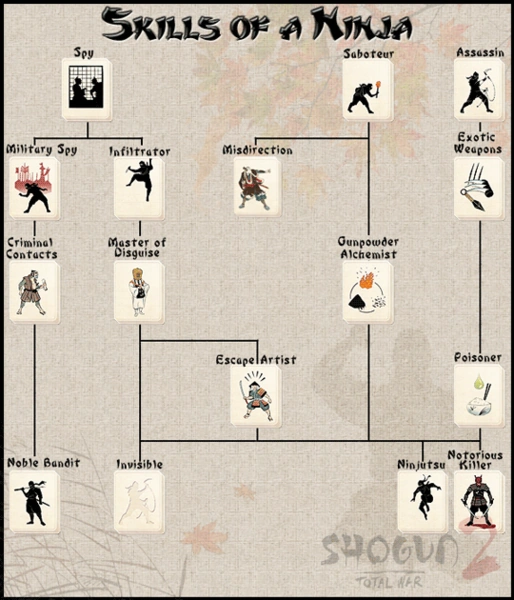
The ninja skill table identifies Spy for spying and campaign visibility, Military Spy for field scouting, and Misdirection for sabotaging armies. Those are related information and military-control jobs, but their effects apply to different tasks.
For a threatened frontier, decide whether the immediate need is better information or interference with an enemy army. Choose the relevant skill rather than assuming every point on the tree improves every action equally. Keep the agent positioned where it can perform the chosen job.
Saboteur and Gunpowder Alchemist support building sabotage in the reference. Assassin and Poisoner improve assassination. A town-development target and an enemy commander are different investments; select the action the campaign can presently use.
The dedicated page describes army sabotage restricting movement and reinforcement. That makes it a potentially useful military action, but success still needs to occur. Do not plan the entire army’s safety around a single guaranteed agent result.

2. Compare ninja success, cost and escape
Ninjutsu supplies broader action-success benefits in the table. Its appeal differs from an action-specific specialization, but the route still needs prerequisite spending. Count the points needed to reach the desired node instead of considering only its final effect.
Infiltrator, Master of Disguise and Invisible include avoiding detection after failure; some also support an embedded army’s movement. Escape Artist improves escape, while Notorious Killer targets critical success. These outcomes are distinct from ordinary success.
A costly assassination attempt can justify considering survival or critical effects alongside the chance of completing the action. A scouting ninja exposed near hostile agents may value escape differently from one working safely in the interior.
The reference also discusses action-cost reductions, including Noble Bandit. Reduced cost can support repeated operations, but it does not make every target suitable or guarantee a successful attempt. Choose the route for actual affordable actions rather than adopting a purported universal maximum build.
3. Separate a monk’s town and army roles
The monk table identifies Inspiring for town support and Militant for inspiring armies. An unrest problem in a castle town and morale support for a field force therefore justify different point choices.
The action description specifies a sufficiently Buddhist town for the happiness benefit. Consider the religion of the province alongside the skill. A stronger Inspiring investment should not be presented as a substitute for the religious condition of the action.
Embedding the monk in an army improves morale and resistance to bribery in the reference, while blocking that agent’s passive population conversion. A military assignment can be useful, but it stops the monk doing a separate province-conversion job at the same time.
Pilgrim supports an embedded army’s movement, with a Chi research contribution at its listed higher level. Choose it for that combined use when the army actually benefits. A stationary town specialist may have a more immediate reason to strengthen its local role.

4. Choose conversion, disruption or Chi research deliberately
Religious Advisor supports character conversion. Scripture supports converting provinces, while Persuader covers both categories in the table. Removing a hostile agent and changing a population’s religion are different tasks, even though both use a religious character.
Pacifist improves demoralizing armies, and Agitator supports inciting unrest. The dedicated monk page describes revolt as situational, including lower suitability in a mainly Buddhist region. An invested skill does not turn every province into a sensible revolt target.
Spiritual and Meditation contribute to Chi arts research. A research-focused monk can fit a development plan when that contribution matters more than the immediate army or town role. Compare the research objective with what another point could do on the current front.
Monks are vulnerable to ninja and geisha in the source, although they counter metsuke. Keep survival and hostile agent exposure in the placement decision. A specialist whose supporting job is valuable should not be left unprotected simply because its skills improved.
5. Give the metsuke a clear oversight or policing role
The Metsuke reference identifies overseeing towns for tax income, overseeing armies against bribery, apprehending agents and bribing eligible enemy forces. Those jobs compete for the same character’s location and attention.
Its published skill-tree diagram shows a connected route through Counter Espionage, Investigator and Yakuza Contacts, and another through Magistrate, Secret Policeman and Censor. It also names later choices such as Eyes & Ears and Legendary Thieftaker.
The diagram supplies names and connections, rather than a full effect table. Do not infer an exact tax percentage or action bonus from a node’s name alone. Use the actual node effect in the campaign when spending toward the chosen oversight or policing role.
For an income specialist, keep the agent in a useful town and compare its real contribution. For an apprehension task, position it near the hostile agent instead. The overview also notes diminishing returns from several metsuke in one town, so stacking all of them in one province is not automatically the best allocation.

6. Treat the geisha as a separate assassination specialist
The geisha page describes assassination without ninja-style building sabotage or spy networks. Its narrower role means copying a general-purpose ninja plan does not make sense, and its base Sengoku skills differ from the identically named Fall of the Samurai agent.
Entertainer, Seduction and Poisoner support assassination in the table. Courtesan and Cultured Lady include general success or survival effects at their listed levels. Flattery and Fox Lady add escape or critical-success considerations.
Choose for the target and exposure. The source says geisha are not hidden from other factions by default and work best with agent protection. Improved assassination performance does not remove the need to avoid apprehension, conversion or a hostile assassin.
Recruitment requires the final Sake Den-chain building in the dedicated reference. Do not plan every early campaign around a geisha that the clan cannot yet train. The skill investment belongs inside a funded recruitment and protection plan.
7. Match the investment to one campaign example
Suppose an approaching army threatens a useful province. A ninja assigned to information or army sabotage and a monk assigned to friendly army support can serve that front differently. Choose the respective skills for those tasks, then retain a military response if the hostile action fails.
Suppose instead that the army is secure but a productive town needs support. A metsuke’s oversight or an appropriately placed monk’s town role can be more useful than another assassination investment. Check whether the agent’s current placement matches that purpose after spending the point.
These are conditional examples, not tested success-rate guarantees. Prerequisites, available ranks, faction religion, target conditions and hostile agents still affect the result. Develop the skill that the campaign can use next and preserve a sensible alternative when the action is uncertain.
8. Connect recruitment to the development plan
The dedicated references connect ninja recruitment to Sake Den facilities, metsuke to markets and Buddhist monks to temples. Their provincial specialties or improved building chains can affect the initial experience of a recruited agent. Choose a recruiting location that supports the intended character, but retain money for the actions that character must perform afterward.
A higher starting rank can help reach a useful specialization sooner. It still does not decide the point allocation for you: a newly recruited ninja intended to scout an army needs a different immediate investment from an assassin sent after a protected general. Define the task before spending the available points rather than treating recruitment quality as a completed build.
Compare repeat duties with occasional interventions. A monk supporting the same town has a continuing local role, while a hostile-agent removal may be an urgent one-time task. Choose skills whose benefit will be used at the expected frequency, and keep the agent protected enough to continue that work.
Frequently asked questions
Is general success the same as critical success?
No. The cited tables list ordinary success, critical outcomes and escape as different effects.
Does an army monk keep converting the population?
The dedicated action description says army inspiration blocks its passive population conversion.
Can one tree guide cover the expansion agents unchanged?
No. Religion-specific and expansion counterparts have different roles or trees.
Sources and further reading
- https://www.feralinteractive.com/en/manuals/shogun2tw/latest/linux/
- https://totalwar.fandom.com/wiki/Ninja_(Total_War:_Shogun_2)
- https://totalwar.fandom.com/wiki/Monk_(Total_War:_Shogun_2)
- https://totalwar.fandom.com/wiki/Metsuke
- https://totalwar.fandom.com/wiki/File:471px-S2TW_metsuke_skill.png
- https://totalwar.fandom.com/wiki/Geisha_(Total_War:_Shogun_2)
Keep exploring
Total War Shogun 2 Naval Bombardment: check the campaign first
The queried coastal bombardment and land-battle naval support belong to Fall of the Samurai, rather than base SHOGUN 2 naval combat.
Total War Attila vs Total War Shogun 2: survive or reunite?
ATTILA offers late-antique survival and destructive warfare; SHOGUN 2 centers a clan campaign on reunifying Japan.

Total War Rome 2 vs Total War Shogun 2: empire or clan?
ROME II suits classical empire building; SHOGUN 2 suits a focused Japanese clan campaign with growing generals and agents.