TL;DR: Total War Shogun 2 honor and loyalty are related but different systems. The daimyo’s honor affects the clan’s public happiness, diplomatic standing and generals’ loyalty; each general’s loyalty affects vulnerability to bribery and defection. Preserve honor through supported decisions, develop suitable character skills and protect exposed armies with a practical counter to hostile agents. A high honor rating helps the realm, but it does not make every general or diplomatic partner permanently dependable.

The official manual distinguishes daimyo honor from general loyalty. The Honour reference supplies specific base-game influences, using the series’ British spelling. This guide keeps the American keyword spelling while explaining the same base Sengoku mechanic.
On this page
Total War Shogun 2 honor and loyalty: read both ratings
| Rating | Who holds it | What the decision affects |
|---|---|---|
| Honor | The daimyo | Wider happiness, diplomatic relations and loyalty conditions |
| Loyalty | An individual general | That character’s risk of bribery or defection |
A clan-wide honor problem can affect several commanders, while a particular general can need attention even when the daimyo remains respectable. Identify whether the concern is the faction’s reputation, one exposed character or both before choosing a response.
1. Count the honor cost of campaign decisions
The base Honour page identifies looting provinces, betraying allies or vassals, crushing defeats suffered by the daimyo, bankruptcy and unfulfilled diplomatic threats as negative influences. These actions have consequences beyond their immediate money or military result.
Before looting, compare the immediate payment with the position you intend to retain afterward. A funded province, stable generals and workable relationships can be worth more than a short cash injection. Do not assume the treasury gain is the only relevant result.
A declaration against a former partner also deserves a wider calculation. If the relationship is supporting another front, the new war can change both diplomacy and the clan’s reputation. Choose the target for a supported strategic purpose rather than creating a political problem for a marginal acquisition.
Keep recurring costs compatible with income. The source lists bankruptcy as an honor pressure, so preserving a usable reserve helps more than construction alone. A large army that the realm cannot sustain can create military and political difficulties together.
2. Keep the daimyo useful and alive
The manual describes a general’s morale influence and rallying ability, with a harmful morale effect when the commander dies. The daimyo performs that battlefield role while also carrying the clan’s leadership and honor responsibilities.
The General reference describes leadership and direct-combat development as different investments. A character built to support the army should not automatically be used as a frontline cavalry unit simply because its bodyguard is mounted.
Use an aggressive opportunity when the battlefield supports it, then retain the commander’s safety. An isolated attack through enemy spears can jeopardize both the army’s morale and the faction’s leadership. The value of a routed archer group should be weighed against that wider risk.
Seek genuine favorable victories instead of engineering a timer exploit for heroic results. The Honour source discusses heroic wins but also recommends artificial clock manipulation. A supported military victory is the useful objective here, not treating a community exploit as a necessary honor system.
3. Choose a useful positive honor route
The Honour page identifies the Honourable skill, Tea Ceremony in Chi arts, obtaining vassals and heroic victories among positive influences. Some traits, retainers and events also contribute, but they are not guaranteed to appear when the campaign needs them.
Tea Ceremony offers a development route connected to diplomacy and honor. The official manual allows only one art to be studied at a time, so compare that research with the military or economic unlock currently needed. A useful political benefit still has an opportunity cost.
A vassal can contribute to the daimyo’s honor in the reference, but the arrangement also brings strategic responsibilities. The Realm Divide source says vassals and their holdings count toward fame. Do not treat creating one as free expansion outside the campaign’s political escalation.
For an event requiring financial help, compare the payment with the army and repair budget before accepting it for honor. The benefit is useful when the clan can fund both the event and its immediate commitments. An unaffordable reputation purchase can worsen the treasury problem it was meant to prevent.

4. Understand the same skill’s different role
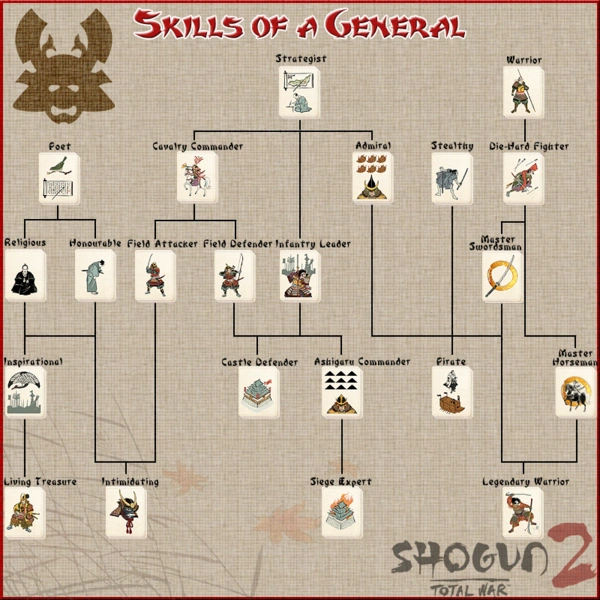
The General skill table gives Honourable a loyalty benefit for an ordinary general and an honor benefit for the daimyo. The identity of the character therefore determines which rating the investment supports.
The same entry also reduces income from looting. That is a concrete tradeoff: the skill supports political stability while giving less immediate money from that particular conquest choice. Do not present it as an upgrade with no effect on the wider plan.
For a general carrying an important army, stronger personal loyalty can address a character-level concern. For the daimyo, the honor contribution can affect the wider conditions across the clan. Select the investment for the actual problem instead of assuming the two benefits are interchangeable.
Compare the route with another useful leadership skill. A character who never faces a relevant loyalty problem may have an immediate battlefield need elsewhere. Choose available points for the next supported task without asserting one universal tree for every commander.
5. Respond to an exposed general’s loyalty
The manual says loyalty indicates susceptibility to bribery and that very low loyalty can lead to defection. Inspect important commanders when relationships, leadership or campaign conditions change. A valuable army should not be assessed only by its unit quality.
The Metsuke reference connects enemy army bribery with the acting agent’s proficiency and the target general’s loyalty. A vulnerable commander near a capable enemy agent presents a different risk from one on a secure interior route.
The same source describes a friendly metsuke overseeing an army as protection against bribery. That can be a useful response for an important force, though the agent then has a different job from overseeing a town for tax income. Compare the military protection with the economic contribution being reassigned.
Keep the risk response attached to the actual front. Moving a useful protector somewhere it cannot meet the hostile threat does little for the exposed army. Plan the agent’s location and the army’s route together while improving the underlying political conditions.
If several generals become vulnerable together, review the daimyo’s honor and recent clan decisions before treating each commander as a separate problem. If only one important general is exposed, compare that character’s applicable skills and the nearby hostile-agent threat. The two reviews can lead to different priorities: a wider political recovery in the first case, or a targeted protective placement in the second.
6. Account for faith and clan differences
The base Honour source lists Christian conversion and Christian daimyo conditions among honor penalties, while identifying a Shimazu honor advantage. Different clans and faith decisions therefore should not be judged from a single assumed starting rating.
Conversion can still support a chosen economic or military strategy. The point is to include its political cost alongside the new opportunity. Develop the religious transition and budget without pretending the honor system is unrelated to that decision.
Likewise, a clan advantage does not remove the consequences of later actions. A more favorable starting position gives room for a supported plan, but repeated looting, betrayal or financial difficulty can still matter. Preserve the benefit through decisions that fit the campaign.
7. Review the system after succession
The Daimyo reference distinguishes leadership from ordinary generals and describes succession when the daimyo dies. The manual also warns about losing the ruler and eligible family commanders, including an underage-heir regency.
Keep a workable succession plan and avoid risking all eligible family members in the same unnecessary battle. The political value of surviving leadership is broader than the immediate effectiveness of another bodyguard unit.
After leadership changes, review the new daimyo’s honor and the loyalty of important generals. Character traits and applicable effects need not produce an identical situation to the previous ruler’s. Reassess diplomacy and army protection before continuing the same expansion unchanged.
Do not rely on contradictory community descriptions of emergency replacement to justify sacrificing the family. This guide uses the verified broad need for continuity, rather than promising a specific fallback character or rating in every version.
8. Use a short political review before expansion
- Identify the daimyo’s present honor and important generals’ loyalty.
- Consider whether the next action creates a known honor pressure.
- Check the budget and the risk to the commander carrying the front.
- Choose a useful skill, research or agent response for that concern.
- Reassess after the action, succession or a major diplomatic change.
For a conditional example, suppose the army is strong but its commander is vulnerable near hostile metsuke. Political and agent protection can be more useful than buying another expensive infantry unit. If the larger problem is low clan honor after costly decisions, address that cause rather than treating every general as an unrelated emergency.
Neither plan guarantees permanent loyalty. Use the two ratings to understand the present risk and preserve the ability to respond if the campaign changes.
Frequently asked questions
Are honor and loyalty the same rating?
No. Daimyo honor has wider effects; loyalty belongs to individual generals.
Does Honourable always improve honor?
The cited skill gives honor to a daimyo and loyalty to an ordinary general.
Does high honor make every ally safe?
No. Diplomacy and campaign escalation still require a practical defense plan.
Sources and further reading
Keep exploring
Total War Shogun 2 Naval Bombardment: check the campaign first
The queried coastal bombardment and land-battle naval support belong to Fall of the Samurai, rather than base SHOGUN 2 naval combat.
Total War Attila vs Total War Shogun 2: survive or reunite?
ATTILA offers late-antique survival and destructive warfare; SHOGUN 2 centers a clan campaign on reunifying Japan.
Total War Rome 2 vs Total War Shogun 2: empire or clan?
ROME II suits classical empire building; SHOGUN 2 suits a focused Japanese clan campaign with growing generals and agents.